


US senator and former vice presidential candidate Joseph -Lieberman has called on the administration of US President Barack Obama to negotiate a free-trade agreement (FTA) with Taiwan.
“If any nation has done what we hope countries will do — it is Taiwan,” he said.
A Democrat turned independent, Lieberman was delivering the annual B.C. Lee Lecture on “US Policy in the Asia-Pacific” on Wednesday at the conservative Heritage Foundation in Washington.
He said the US needed — in addition to military measures — an ambitious and strategically minded forward-looking trade policy for the Asia-Pacific region.
“While countries in the region are eager to enjoy the opportunities created by China’s growth, they also worry about growing over-dependent on China’s trade and business,” he said.
The strategic balance these countries seek, he said, was not only military, but also economic.
“And that’s the balance that they seek from us,” said Lieberman, chairman of the Senate Homeland Security and Governmental Affairs Committee. “In this respect, it is to the credit of President Obama that he changed his initial opposition to the [South] Korea-US Free Trade Agreement and really worked hard to secure its passage.”
“But the fact remains that the US has not yet signed a single free-trade agreement during this administration,” he said.
According to one recent analysis cited by Lieberman, more than 300 trade agreements have either been concluded or are now being negotiated in the Asia-Pacific region and none of them involve the US.
“That is wrong. It is unacceptable,” he said, adding: “More is required.”
“In particular, I think it is time for Washington to negotiate a free-trade agreement with Taiwan. There’s an odd irony here. Taiwan’s trade relations with mainland China are now arguably more free than their trade relations with the United States,” he said.
The senator, who plans to retire next year, said that Washington should also conclude a bilateral investment treaty with India and actively explore a free-trade agreement with Japan. Rupert -Hammond-Chambers, president of the US-Taiwan Business Council, said later that Lieberman’s statement was significant in that it raised the issue of a Taiwan free-trade agreement as “important.”
However, “it is not relevant in regards to the next 14 months. I do not see Obama embracing FTAs at this juncture of his term in office,” Hammond-Chambers said. “He may launch an FTA process in his second term, but I’d bet on his sticking with the underwhelming Trans-Pacific Partnership, which Taiwan isn’t a member of either.”
“If a Republican is elected president, I expect a robust FTA policy and for Taiwan to be in the mix of countries considered,” Hammond-Chambers said.
Gerrit van der Wees, senior political adviser with the Formosan Association for Public Affairs (FAPA), was more optimistic.
“I think Lieberman’s statement is highly significant. He is a senior voice in the US Senate,” he said.
Lieberman, who retains close ties to the Democratic Party, said: “In our foreign policy in the Asia-Pacific region, the United States must never shy from standing by our values.”
He said that the US’ leadership in the world was at its best when Washington was not just pursuing commercial or security interests, but when it was rooted in national values and principles such as democracy, rule of law and human rights.
The major problem or hurdle in pursuing a free-trade agreement with Taiwan, he said, was the perception in Washington that it would adversely affect relations with China.
“We don’t want to upset their sensitivity,” Liberman said. “But — and I am going to speak simplistically now — one of the things that I have found in my time in Washington is that in more ways than one might imagine, you can fashion your foreign policy in the same way you would want to fashion your personal relations with people.”
“I find that when I have a disagreement with someone, including a colleague in the Senate, the best thing to do is not to tiptoe around the colleague and not talk about the disagreement because we both know it’s there,” he said. “It is best to talk about it and say: ‘Sorry pal, I owe John or whatever his name is, because John has been with me politically for a long time and we agree on a lot of stuff and so I have to go with him.’”
“We are committed by law and we believe in the rule of law. The Taiwan Relations Act establishes a clear framework for our relations with Taiwan, not in our opinion in a way that should damage our relations with China,” Lieberman said. “I think we should be honest.”
Lieberman said that Taiwan had developed a democratic political system and a market-based economy.
“I just come back to the irony that struck me as I was preparing my remarks for today. It’s quite a remarkable statement that Taiwan has actually freer trade relations with China than it does with us,” he said. “Heavens, that’s a ridiculous result. The result of our own hypersensitivity.”

NATIONAL SECURITY: Authorities are working to confirm the identities of the military personnel involved and investigating possible illegal conduct and regulatory violations Authorities are probing possible national security implications after Kinmen police and immigration officers on Sunday found a Chinese woman allegedly posing as a tourist while engaging in prostitution involving more than 10 military personnel. The woman, surnamed Chen (陳), has since been deported, authorities said, adding that investigators are still working to confirm the identities of those implicated, as the records only listed code names and aliases. The case stemmed from a report received by the Kinmen District Prosecutors’ Office on Friday last week from the Jinhu Precinct of the Kinmen County Police Bureau. On Sunday, police, along with the National Immigration

GLOBALGIVING: ‘ Caving to external pressure is not acceptable for an organization that has cultivated justice reform and human rights for 30 years,’ one NGO said A slew of non-government organizations (NGOs) have withdrawn from the GlobalGiving fundraising platform after it announced it would use “Chinese Taipei” instead of “Taiwan” from next month. The Taiwan Good Rice Association wrote on Facebook on Friday that it was informed on April 28 via a teleconference call of the change, which was made because the platform wanted to operate in China. Taiwan Good Rice is to terminate all cooperative relationships with GlobalGiving in response to the platform’s “unilateral and non-negotiable” decision to remove references to Taiwan, the NGO said. “Taiwan is in the official name of Taiwan Good Rice Association and the

HEAVY WEATHER: Typhoon Jangmi is due to crash straight into the Ryukyus as airlines look to shift flights to larger aircraft or cancel flights to Okinawa entirely Taiwan’s international air carriers announced flight adjustments over the weekend as Typhoon Jangmi is forecast to hit the Ryukyu Islands today and tomorrow. The Central Weather Administration (CWA) upgraded Jangmi from a tropical storm to a typhoon at 8am yesterday, with the eye located 580km south of Naha city. It was moving north at 19kph. Today, China Airlines’ CI-120, CI-121, CI-122 and CI-123 flights between Taoyuan and Naha, Okinawa, have been canceled as well as CI-132 and CI-133 between Kaohsiung and Naha. EVA Air’s BR-112, BR-113, BR-186 and BR-185 flights between Taoyuan and Naha are also canceled. Low-cost carrier Tigerair Taiwan canceled IT-230,
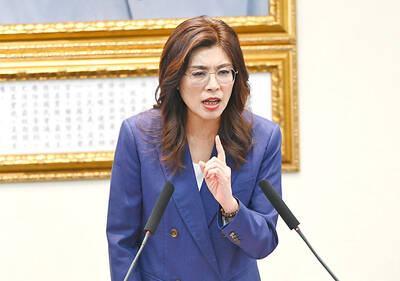
Chinese Nationalist Party (KMT) Chairwoman Cheng Li-wun (鄭麗文) yesterday briefed her party’s Central Standing Committee regarding her scheduled visit to the US between Monday next week and June 16, saying that her purpose would be to persuade the US that the Republic of China (ROC) Constitution was a “one China” constitution that would foster stable and peaceful cross-strait relations. The ROC Constitution is the most important defense for all Taiwanese citizens, as it upholds our democracy and has contributed to our robust economy, which aligns with international and US interests, she said. “We would not be troublemakers and drag the US under,”


 RSS
RSS