


President Ma Ying-jeou (馬英九) yesterday defended the nation’s economic outlook amid the European and US debt crises and said he expected companies that turn net profits to refrain from implementing unpaid leave policies.
The Directorate-General of Budget, Accounting and Statistics has lowered its forecast of the nation’s economic growth for this year from 4.81 percent to 4.56 percent because of the European and US debt crises, Ma said, adding that Taiwan’s GDP would still reach a milestone of US$20,000 this year, however.
“The economic growth this year will slow down because of the European and US debt crises, but we should not be too pessimistic about the situation,” he said during a meeting with representatives from the Lions Clubs International at the Presidential Office. “And I hope private companies that turn net profits will not ask employees to take unpaid leave.”
Ma’s comments on the issue of unpaid leave in the private sector came amid reports that a growing number of companies that are sending their workers on unpaid furloughs.
The latest statistics from the Council of Labor Affairs showed the number of companies that have implemented unpaid leave measures had increased from six on Monday to 12 yesterday.
According to the council, employers who unilaterally impose a reduction in salaries on their employees could be fined between NT$20,000 and NT$300,000 or have the names of their company publicized if the case is severe.
Meanwhile, Premier Wu Den-yih (吳敦義) said he did not fully agree with Quanta chairman Barry Lam (林百里), who opposes government intervention in companies’ unpaid leave measures.
On Monday, Lam advised the government against interfering in the practice, saying the intervention was based on electoral considerations.
Lam is of the opinion that the government shouldn’t fault enterprises for unpaid leave as long as they practice it with employees’ consent.
“Half of what Lam said was right, but not the other half. The government should not meddle too much, but it’s not right if it just does a little to address the problem. It [the balance] has to be just right,” Wu said when approached for comment yesterday.
“The government would like to see employers and employees respect and cherish each other so that harmony can be maintained and the values of equality and social justice in the labor market can be held,” Wu said. “I don’t think it’s right if the government keeps its hands off in this regard.”
However, Wu said the government would not get involved in arbitration between employers and employees, or in companies’ arrangements for unpaid leave and their redundancy plans.
At a separate setting, Democratic Progressive Party (DPP) Chairperson Tsai Ing-wen (蔡英文) urged the government to pay close attention to the growing trend of companies encouraging employees to take unpaid leave.
The number of companies that offer unpaid leave is not the most important issue, the DPP presidential candidate said, adding that a more important matter was the meaning behind the phenomenon.
“The trend could suggest that the economy is sliding and more jobs could be lost, which is why the government should not underestimate the issue,” she said.
Tsai said there should be immediate solutions to the nation’s slowing economy before Taiwan’s industrial structure is upgraded to meet future challenges.
Additional reporting by Chris Wang

FUKUOKA SITUATION: Japanese media reported that the pathogen is expected to be identified by the summer, while the CDC downplayed the idea that it was hMPV A “mysterious cold-like illness” reported in Japan’s Fukuoka Prefecture does not seem to be a new disease, but Japanese authorities have been asked about the situation, the Centers for Disease Control (CDC) said yesterday. The Fukuoka Prefectural Medical Association on Wednesday told a news conference that a “mystery cold” that has become a hot topic on social media is “highly likely to be caused by some kind of viral infection,” Japan’s KBC News reported. “Many people are experiencing symptoms starting with a sore throat, followed by a runny nose, phlegm and a severe cough,” KBC News reported, citing association officials. Health authorities are

Nvidia Corp CEO Jensen Huang (黃仁勳) arrived in Taiwan yesterday ahead of upcoming AI and technology events, saying he plans to meet with clients and Taiwan Semiconductor Manufacturing Co Chairman C.C. Wei (魏哲家) during his visit. After landing at Taipei Songshan Airport, Huang posed for photos with fans and handed out Yakult drinks to reporters and supporters waiting at the scene, saying he has “a lot to do” during the trip. Asked about reports that Nvidia’s planned headquarters site in Taipei’s Beitou Shilin Technology Park could break ground on May 27, Huang said that if the company holds an event, he would

The Ministry of Finance this afternoon announced the winning numbers for the March-April uniform invoice lottery. The winning number for the NT$10 million (US$318,060) special prize is 19531471, and the winning number for the NT$2 million grand prize is 85941329. Three numbers were drawn for the NT$200,000 first prize: 07225810, 20231230 and 83518781. Those with receipts matching the last seven digits of any of the first-prize numbers will win the NT$40,000 second prize, while those matching the last six digits will win the NT$10,000 third prize. Those whose receipts match the last five digits of the first-prize numbers can claim the NT$4,000 fourth prize,
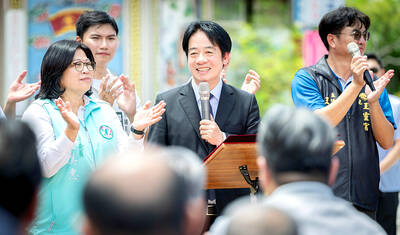
SIX SUBSIDIES: The monthly allowance for older farmers is to increase to NT$10,000, and NT$5,000 is to be given to homemakers under the national pension system, Lai said The government is to implement major welfare policies for disadvantaged groups, including raising the monthly allowance for older farmers to NT$10,000 and providing homemakers with NT$5,000 per month, President William Lai (賴清德) said yesterday. Lai made the remarks during a visit to Wangling Temple in Chiayi County, saying that the planned increases were being introduced amid economic growth and an increase in tax revenue. Touting a policy, in which the government plans to provide a monthly allowance of NT$5,000 for every child under the age of 18 in a bid to address Taiwan’s low birthrate, Lai said that if received for the


 RSS
RSS