


The number of signatures collected for People First Party (PFP) Chairman James Soong (宋楚瑜) passed the threshold required to register for participating in the January presidential election, PFP officials said yesterday.
As stipulated in Article 46 of the Constitution and Article 23 of the Presidential and Vice Presidential Election and Recall Act (總統副總統選舉罷免法), presidential and vice presidential candidates must gather signatures amounting to 1.5 percent of voters in the most recent elections to demonstrate that the candidate enjoys popular support.
That means Soong needs 257,695 signatures to enter the presidential election.
PFP spokesperson Wu Kun-yu (吳崑玉) said the number of signatures in the first batch that the party is scheduled to deliver to the Central Election Commission’s (CEC) Taipei branch today likely exceed 300,000.
“We hope the CEC will not try to nitpick problems with the petitions,” he said.
As some of the petitions have not yet been processed, the PFP is also expected to turn in a second batch of signatures before Saturday’s deadline, which by law is the 45th day after Soong and running mate Lin Ruey-shiung (林瑞雄) applied to the commission to run in the presidential and vice presidential election.
To avoid any interference as the petitions are processed before they are sent to the commission, the PFP has kept the processing location a secret.
Once the petitions are submitted to the commission, the PFP will continue to make plans for the January presidential and legislative elections, including the announcement of another wave of legislative nominees and the announcement of its legislators-at-large list.

SECURITY: Starlink owner Elon Musk has taken pro-Beijing positions, and allowing pro-China companies to control Taiwan’s critical infrastructure is risky, a legislator said Starlink was reluctant to offer services in Taiwan because of the nation’s extremely high penetration rates in 4G and 5G services, the Ministry of Digital Affairs said yesterday. The ministry made the comments at a meeting of the legislature’s Transportation Committee, which reviewed amendments to Article 36 of the Telecommunications Management Act (電信管理法). Article 36 bans foreigners from holding more than 49 percent of shares in public telecommunications networks, while shares foreigners directly and indirectly hold are also capped at 60 percent of the total, unless specified otherwise by law. The amendments, sponsored by Chinese Nationalist Party (KMT) Legislator Ko

The eastern extension of the Taipei MRT Red Line could begin operations as early as late June, the Taipei Department of Rapid Transit Systems said yesterday. Taipei Rapid Transit Corp said it is considering offering one month of free rides on the new section to mark its opening. Construction progress on the 1.4km extension, which is to run from the current terminal Xiangshan Station to a new eastern terminal, Guangci/Fengtian Temple Station, was 90.6 percent complete by the end of last month, the department said in a report to the Taipei City Council's Transportation Committee. While construction began in October 2016 with an

NON-RED SUPPLY: Boosting the nation’s drone industry is becoming increasingly urgent as China’s UAV dominance could become an issue in a crisis, an analyst said Taiwan’s drone exports to Europe grew 41.7-fold from 2024 to last year, with demand from Ukraine’s fight against Russian aggression the most likely driver of growth, a study showed. The Institute for Democracy, Society and Emerging Technology (DSET) in a statement on Wednesday said it found that many of Taiwan’s uncrewed aerial vehicle (UAV) sales were from Poland and the Czech Republic. These countries likely transferred the drones to Ukraine to aid it in its fight against the Russian invasion that started in 2022, it said. Despite the gains, Taiwan is not the dominant drone exporter to these markets, ranking second and fourth
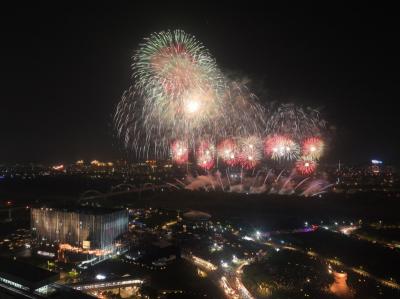
The New Taipei City Art Museum this weekend plans to celebrate its first anniversary with a two-day extravaganza featuring live concerts and a large-scale synchronized fireworks and drone display, the New Taipei City Cultural Affairs Department said. The two-day celebrations are to take place in the museum’s outdoor park, with markets and live performances by singers including Ann Bai (白安), Bii (畢書盡) and the Cosmos People (宇宙人), the department said. The highlight on both evenings would be the "Echoes of Light" show, an aerial spectacle combining fireworks and drone performances designed around the concept of "dual stages in the sky," it


 RSS
RSS