


A Washington conference has been told that a minority view supporting the US’ “abandonment” of Taiwan is getting a lot of attention because there is a growing belief that China’s importance outweighs any affinity or obligation to its Asian ally.
However, historian Nancy Bernkopf Tucker of Georgetown University said that those views were creating false impressions, “misleading China and frightening Taiwan.”
Tucker, a specialist on Taiwan, said it was not in the US’ national interests to “abandon” Taiwan or to try to resolve the cross-strait impasse with greater direct US involvement, such as a dialogue with Beijing about Taiwan.
Addressing the security conference organized by the Center for Strategic and International Studies (CSIS), Tucker said: “Abandoning Taiwan risks reinforcing an image of a weak, vacillating and unreliable United States that can be pushed around.”
Bonnie Glaser, a senior fellow and China expert at CSIS, said US arms sales to Taiwan were stabilizing rather than destabilizing.
She said they were an integral part of a US policy that sought to create an environment in which China and Taiwan could improve relations, conduct negotiations and resolve differences on an equal footing.
“US arms sales facilitate greater cross-strait interaction and problem solving, and in fact they create the potential for a solution,” Glaser said. “I would argue that China should welcome arms sales for this very reason.”
“If the US were to announce an end to arms sales today, it is likely that Taipei would put its negotiations with China on hold and reassess its policy toward the mainland [China],” she said. “In the absence of US support, Taipei would lose confidence to continue such negotiations with Beijing and an abandoned and isolated Taiwan might in desperation declare independence or even revive efforts to produce nuclear weapons.”
Glaser said Taiwan should have the right to keep its options open and remain an autonomous democratic entity that is separate from China as long as the majority of the people in Taiwan do not support unification.
Unification pressure or coercion should not be acceptable to the US, Glaser said.
“It would be contrary to our values and to our sense of justice, and it should be avoided at all costs,” she said.
Charles Glaser, professor of political science and director of the Elliott School’s Institute for Security and Conflict Studies, disagreed.
He said that his preference would be — in an ideal world — for Taiwan to choose its own destiny.
However, if “abandoning” Taiwan was in US interests, then it might be “the right thing to do” even if it meant sacrificing values “that the US holds highly.”
Taiwan, he said, was potentially very dangerous because it could sour US relations with China. Charles Glaser added that pulling back from Taiwan had the potential to improve US-China relations.
Bonnie Glaser and Charles Glaser are not related.
Michael Swaine, senior associate at the Asia Program of the Carnegie Endowment for International Peace, said that despite all the improvements in cross-strait relations, there were some trends that were very destabilizing.
These trends, he said, required some level of reassessment of policy toward Taiwan.
If the US was forced to sell “vastly more significant” arms to Taiwan, it would become “increasingly intolerable to the Chinese and would begin to overshadow other efforts to compensate,” Swaine said.
“We need to think hard about this and what the implications over time will be,” Swaine said. “It is not about stopping arms sales to Taiwan, it is about really assessing if it is possible to reach an understanding with Beijing that would involve sacrifice on China’s part in the way it manages Taiwan in return for certain changes in US policy.”
Bonnie Glaser said that increasingly, people in China were seeing the current improvement in cross-strait relations as Chinese President Hu Jintao’s (胡錦濤) legacy.
“What I hear is that it is possible — if the DPP [Democratic Progressive Party] comes back to power — that Hu Jintao’s legacy will be lost,” she said.
In that case, she said, the new leadership could be compelled to pursue a much tougher policy on Taiwan.
DPP Chairperson Tsai Ing-wen (蔡英文) should send signals to Beijing about what policies she would follow if she won the upcoming election, she said.
“There are ways to ease mainland China’s concerns about her and the DPP that might preserve the legacy of peaceful development across the Strait,” Bonnie Glaser said.
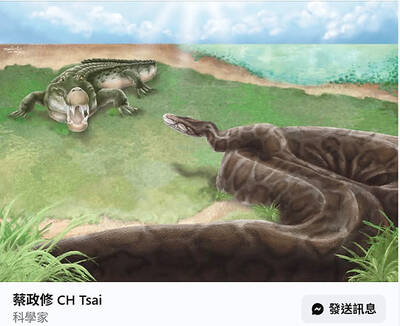
Taiwanese paleontologists have discovered fossil evidence that pythons up to 4m long inhabited Taiwan during the Pleistocene epoch, reporting their findings in the international scientific journal Historical Biology. National Taiwan University (NTU) Institute of Ecology and Evolutionary Biology associate professor Tsai Cheng-hsiu (蔡政修) led the team that discovered the largest snake fossil ever found in Taiwan. The single trunk vertebra was discovered in Tainan at the Chiting Formation, dated to between 400,000 and 800,000 years ago in the Middle Pleistocene, the paper said. The area also produced Taiwan’s first avian fossil, as well as crocodile, mammoth, saber-toothed cat and rhinoceros fossils, it said. Discoveries

Taiwanese paleontologists have discovered fossil evidence that pythons up to 4m long inhabited Taiwan during the Pleistocene epoch, reporting their findings in the international scientific journal Historical Biology. National Taiwan University (NTU) Institute of Ecology and Evolutionary Biology associate professor Tsai Cheng-hsiu (蔡政修) led the team that discovered the largest snake fossil ever found in Taiwan. A single trunk vertebra was discovered in Tainan at the Chiting Formation, dated to between 800,000 to 400,000 years ago in the Middle Pleistocene, the paper said. The area also produced Taiwan’s first avian fossil, as well as crocodile, mammoth, sabre-toothed cat and rhinoceros fossils, it said. Discoveries
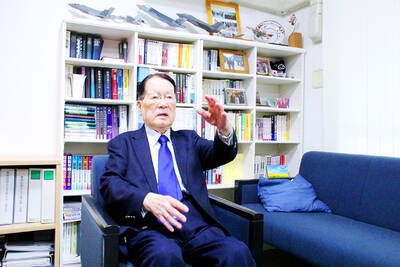
Whether Japan would help defend Taiwan in case of a cross-strait conflict would depend on the US and the extent to which Japan would be allowed to act under the US-Japan Security Treaty, former Japanese minister of defense Satoshi Morimoto said. As China has not given up on the idea of invading Taiwan by force, to what extent Japan could support US military action would hinge on Washington’s intention and its negotiation with Tokyo, Morimoto said in an interview with the Liberty Times (sister paper of the Taipei Times) yesterday. There has to be sufficient mutual recognition of how Japan could provide

UPDATED TEST: The new rules aim to assess drivers’ awareness of risky behaviors and how they respond under certain circumstances, the Highway Bureau said Driver’s license applicants who fail to yield to pedestrians at intersections or to check blind spots, or omit pointing-and-calling procedures would fail the driving test, the Highway Bureau said yesterday. The change is set to be implemented at the end of the month, and is part of the bureau’s reform of the driving portion of the test, which has been criticized for failing to assess whether drivers can operate vehicles safely. Sedan drivers would be tested regarding yielding to pedestrians and turning their heads to check blind spots, while drivers of large vehicles would be tested on their familiarity with pointing-and-calling


 RSS
RSS