


A recent opinion piece published by the Chinese Communist Party’s (CCP) mouthpiece calling for war in the South China Sea seemed strategically “unwise,” but was aimed at securing exploration of the area’s oil and gas resources, a visiting academic said in Taipei yesterday.
The CCP-run Chinese-language edition of the Global Times on Sept. 29 published a piece saying China should wage a war against Vietnam and the Philippines, two countries that have been assertive in defending their claims over the islets in the region.
Theresa Fallon, a senior associate at the European Institute of Asian Studies, a Brussels-based policy and research think tank supported by the EU, told the two-day international conference on the South China Sea issue that such saber-rattling seemed “unwise” and “counter-productive” from a strategic and military point of view.
It is likely to push Vietnam and the Philippines further toward the US, as well as toward India or Japan, to form a coalition against China, she said.
“But the op-ed may have the one more immediate goal to scare Western oil companies away from Vietnam and from the Philippines and to deter them from concluding deals with them,” she said.
Citing a cache of US diplomatic cables released by WikiLeaks on Sept. 1, Fallon said Chinese efforts to pressure oil companies such as Exxon Mobil, BP, Chevron and Petronas after they made deals with Hanoi went back to at least 2006.
In a paper delivered at the conference held by the Institute of European and American Studies at Academia Sinica, Fallon said the EU did not have any clear position or strong role to play in the region.
The EU as a whole has two main foreign policy priorities: the immediate neighborhood of the EU, including a response to the Arab Spring, and relations with strategic partners, Fallon said.
“China is the EU’s most important strategic partner and trade partner in Asia. China has also been supporting some weaker EU member states during the sovereign debt crisis,” she said.
Fallon said she was told during a meeting with an official of the European External Action Service on Sept. 19 that “Europe cannot say anything because of our financial situation. If [Chinese President] Hu Jintao [(胡錦濤)] says: ‘We have confidence in the euro,’ it goes up. If China goes to Greece and says we are unhappy with what they are doing in Brussels, what do you expect the Greek prime minister to do?”
Meanwhile, Daniel Schaeffer, a retired general and a researcher at the French think tank Asie 21, delivered a paper titled The South China Sea: a piece in the global naval encirclement strategy of Taiwan by Mainland China.
Schaeffer said Taiwan’s geographical position was why China wants to reunify with Taiwan at all costs.
“Taiwan is the bolt which closes the two China seas, two semi-closed seas structurally barred by chains of islands that constitute as many obstacles for navigation and compel ships to cross passes between the islands,” he said.
If China takes over Taiwan, the Chinese navy would consequently enjoy a free passage to the Pacific Ocean through what would become its territorial waters, he said.
Schaeffer said China “has started a large-scale strategy of naval encirclement of Taiwan, a strategy in which the making of a sanctuary of the South China Sea is only one piece” on the wide board of a “game of Go ” that is aimed at making Taiwan reunify with China.
The other pieces included the aggressive Chinese behavior concerning sovereignty over the Diaoyutai Islands (釣魚台), known as the Senkaku Islands in Japan; the multifarious passage of the Chinese navy through the Japanese straits; the Chinese naval exercises conducted in waters close to Japan; and the Chinese monitoring of Japan-US naval exercises, among others, Schaeffer said.
“When we put all these Chinese naval activities together, we cannot help but determine that the general aim is to isolate Taiwan, to exert a strong indirect pressure on the island so that it finally falls into the Mainland nets without too much resistance and without suffering too much damage, if possible,” he said.

NATIONAL SECURITY: Authorities are working to confirm the identities of the military personnel involved and investigating possible illegal conduct and regulatory violations Authorities are probing possible national security implications after Kinmen police and immigration officers on Sunday found a Chinese woman allegedly posing as a tourist while engaging in prostitution involving more than 10 military personnel. The woman, surnamed Chen (陳), has since been deported, authorities said, adding that investigators are still working to confirm the identities of those implicated, as the records only listed code names and aliases. The case stemmed from a report received by the Kinmen District Prosecutors’ Office on Friday last week from the Jinhu Precinct of the Kinmen County Police Bureau. On Sunday, police, along with the National Immigration
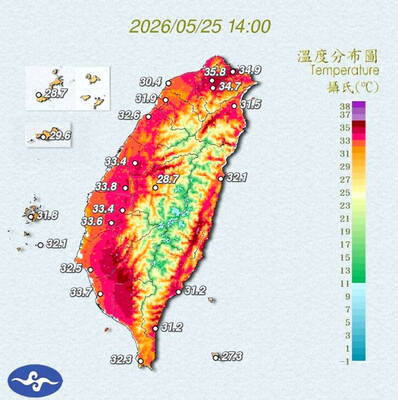
STAY COOL: The HPA recommended that people stay hydrated, use air-conditioning or fans while indoors, wear loose-fitting clothes and walk in the shade while outdoors Employers must implement measures such as installing cooling equipment, and providing drinking water and rest breaks for outdoor workers starting from Monday next week, the Taipei Department of Labor said on Sunday. Employers who fail to comply could face fines of NT$30,000 to NT$300,000 under the Occupational Safety and Health Act (職業安全衛生法), the department said. Businesses in Taipei employing fewer than 100 workers, as well as registered self-employed workers with labor insurance coverage, could receive on-site assessments and guidance from occupational safety consultants to help them apply for central government subsidies to implement or improve heat-protection measures, it said. Under the Ministry of

GLOBALGIVING: ‘ Caving to external pressure is not acceptable for an organization that has cultivated justice reform and human rights for 30 years,’ one NGO said A slew of non-government organizations (NGOs) have withdrawn from the GlobalGiving fundraising platform after it announced it would use “Chinese Taipei” instead of “Taiwan” from next month. The Taiwan Good Rice Association wrote on Facebook on Friday that it was informed on April 28 via a teleconference call of the change, which was made because the platform wanted to operate in China. Taiwan Good Rice is to terminate all cooperative relationships with GlobalGiving in response to the platform’s “unilateral and non-negotiable” decision to remove references to Taiwan, the NGO said. “Taiwan is in the official name of Taiwan Good Rice Association and the

Chinese Nationalist Party (KMT) Chairwoman Cheng Li-wun (鄭麗文) yesterday briefed her party’s Central Standing Committee regarding her scheduled visit to the US between Monday next week and June 16, saying that her purpose would be to persuade the US that the Republic of China (ROC) Constitution was a “one China” constitution that would foster stable and peaceful cross-strait relations. The ROC Constitution is the most important defense for all Taiwanese citizens, as it upholds our democracy and has contributed to our robust economy, which aligns with international and US interests, she said. “We would not be troublemakers and drag the US under,”


 RSS
RSS