


The Dalai Lama has expressed his gratitude to the Democratic Progressive Party (DPP) and DPP Chairperson Tsai Ing-wen (蔡英文) for supporting the recent changes to the Tibetan political system, the DPP said yesterday.
“Thank you for your recent letter of August 2011 highlighting my recent decision to strengthen the democratic system of the Tibetan community by transferring power to a democratically elected leader,” Dalai Lama wrote in a letter to Tsai.
The Tibetan leader offered his best wishes to Tsai for “continued success” in her work for the Taiwanese.
The Dalai Lama said he “voluntarily, proudly and happily took the decision of ending the 369-year-old tradition of the Dalai Lamas holding the dual responsibility of temporal and spiritual affairs.”
The DPP also took the opportunity to again call for China to respect human rights and freedom of speech and religion, saying that its hard-line position toward the incarnation of the Dalai Lama and its continued suppression of the Tibetans undermines the international image China has been trying to build.
The party expressed its disappointment over South Africa’s failure to grant the Dalai Lama a visa, which forced the cancelation of his meeting with fellow Nobel Peace laureate Archbishop Desmond Tutu, under Chinese pressure.
China’s interference is a violation of human rights, the DPP said, and the civil rights and democratic development of every country should be protected by the international community.
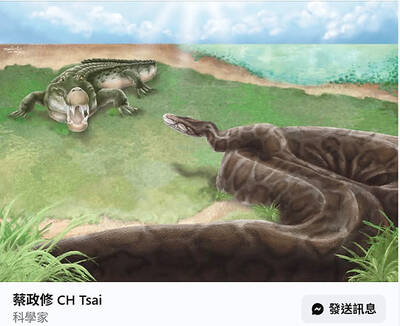
Taiwanese paleontologists have discovered fossil evidence that pythons up to 4m long inhabited Taiwan during the Pleistocene epoch, reporting their findings in the international scientific journal Historical Biology. National Taiwan University (NTU) Institute of Ecology and Evolutionary Biology associate professor Tsai Cheng-hsiu (蔡政修) led the team that discovered the largest snake fossil ever found in Taiwan. The single trunk vertebra was discovered in Tainan at the Chiting Formation, dated to between 400,000 and 800,000 years ago in the Middle Pleistocene, the paper said. The area also produced Taiwan’s first avian fossil, as well as crocodile, mammoth, saber-toothed cat and rhinoceros fossils, it said. Discoveries

Taiwanese paleontologists have discovered fossil evidence that pythons up to 4m long inhabited Taiwan during the Pleistocene epoch, reporting their findings in the international scientific journal Historical Biology. National Taiwan University (NTU) Institute of Ecology and Evolutionary Biology associate professor Tsai Cheng-hsiu (蔡政修) led the team that discovered the largest snake fossil ever found in Taiwan. A single trunk vertebra was discovered in Tainan at the Chiting Formation, dated to between 800,000 to 400,000 years ago in the Middle Pleistocene, the paper said. The area also produced Taiwan’s first avian fossil, as well as crocodile, mammoth, sabre-toothed cat and rhinoceros fossils, it said. Discoveries

Whether Japan would help defend Taiwan in case of a cross-strait conflict would depend on the US and the extent to which Japan would be allowed to act under the US-Japan Security Treaty, former Japanese minister of defense Satoshi Morimoto said. As China has not given up on the idea of invading Taiwan by force, to what extent Japan could support US military action would hinge on Washington’s intention and its negotiation with Tokyo, Morimoto said in an interview with the Liberty Times (sister paper of the Taipei Times) yesterday. There has to be sufficient mutual recognition of how Japan could provide
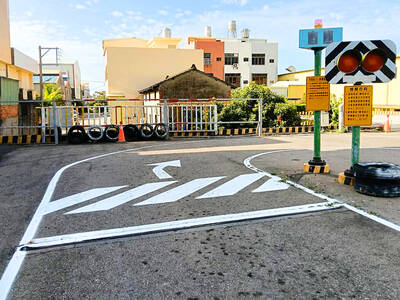
UPDATED TEST: The new rules aim to assess drivers’ awareness of risky behaviors and how they respond under certain circumstances, the Highway Bureau said Driver’s license applicants who fail to yield to pedestrians at intersections or to check blind spots, or omit pointing-and-calling procedures would fail the driving test, the Highway Bureau said yesterday. The change is set to be implemented at the end of the month, and is part of the bureau’s reform of the driving portion of the test, which has been criticized for failing to assess whether drivers can operate vehicles safely. Sedan drivers would be tested regarding yielding to pedestrians and turning their heads to check blind spots, while drivers of large vehicles would be tested on their familiarity with pointing-and-calling


 RSS
RSS