


President Ma Ying-jeou (馬英九) will open political talks with China if he is re-elected to a second term, a US diplomatic cable released by WikiLeaks cited Vice President Vincent Siew (蕭萬長) as saying.
Siew’s June 2009 statement to then American Institute in Taiwan director Stephen Young was the clearest indication so far by a senior official that Ma would expand on existing economic talks if he were re-elected in January.
Since Ma’s Chinese Nationalist Party (KMT) took office in May 2008, he has significantly improved ties with China by facilitating several successful trade agreements.
Public opinion polls give Ma a small lead over Democratic Progressive Party Chairperson Tsai Ing-wen (蔡英文) in the Jan. 14 elections. Tsai and her party say Ma is moving too far and too fast in his bid to improve relations with China, threatening Taiwan’s de facto independence in the process.
For his part, Ma says the DPP presidential nominee lacks a coherent policy for dealing with Beijing.
The WikiLeaks cable, dated June 30, 2009, quoted Siew as saying that political talks during a possible Ma second term would address key issues including “a peace treaty, a formal end to hostilities and development of bilateral military confidence mechanisms” with China.
In the past, Ma has put as a condition for opening political discussions with Beijing that China remove the estimated 1,500 missiles it has aimed at Taiwanese targets. However, there was no mention of this condition in the cable.
In public statements, Ma has usually been vague on the political talks with China issue, saying that until more progress is made on economic questions — the centerpiece of his three-and-a-half year administration — there was no need to consider the political side.
However, he has acknowledged in private conversations that China might be forcing his hand.
In a separate WikiLeaks cable dated Dec. 15, 2009, he told a senior US defense official that activities by the People’s Liberation Army could convince Taipei to enter into political talks with Beijing. enter into political talks with Beijing.

Taiwanese paleontologists have discovered fossil evidence that pythons up to 4m long inhabited Taiwan during the Pleistocene epoch, reporting their findings in the international scientific journal Historical Biology. National Taiwan University (NTU) Institute of Ecology and Evolutionary Biology associate professor Tsai Cheng-hsiu (蔡政修) led the team that discovered the largest snake fossil ever found in Taiwan. The single trunk vertebra was discovered in Tainan at the Chiting Formation, dated to between 400,000 and 800,000 years ago in the Middle Pleistocene, the paper said. The area also produced Taiwan’s first avian fossil, as well as crocodile, mammoth, saber-toothed cat and rhinoceros fossils, it said. Discoveries

Taiwanese paleontologists have discovered fossil evidence that pythons up to 4m long inhabited Taiwan during the Pleistocene epoch, reporting their findings in the international scientific journal Historical Biology. National Taiwan University (NTU) Institute of Ecology and Evolutionary Biology associate professor Tsai Cheng-hsiu (蔡政修) led the team that discovered the largest snake fossil ever found in Taiwan. A single trunk vertebra was discovered in Tainan at the Chiting Formation, dated to between 800,000 to 400,000 years ago in the Middle Pleistocene, the paper said. The area also produced Taiwan’s first avian fossil, as well as crocodile, mammoth, sabre-toothed cat and rhinoceros fossils, it said. Discoveries
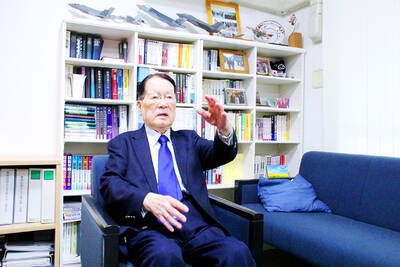
Whether Japan would help defend Taiwan in case of a cross-strait conflict would depend on the US and the extent to which Japan would be allowed to act under the US-Japan Security Treaty, former Japanese minister of defense Satoshi Morimoto said. As China has not given up on the idea of invading Taiwan by force, to what extent Japan could support US military action would hinge on Washington’s intention and its negotiation with Tokyo, Morimoto said in an interview with the Liberty Times (sister paper of the Taipei Times) yesterday. There has to be sufficient mutual recognition of how Japan could provide
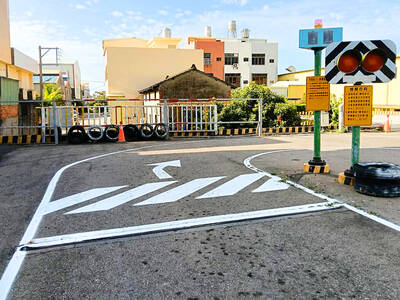
UPDATED TEST: The new rules aim to assess drivers’ awareness of risky behaviors and how they respond under certain circumstances, the Highway Bureau said Driver’s license applicants who fail to yield to pedestrians at intersections or to check blind spots, or omit pointing-and-calling procedures would fail the driving test, the Highway Bureau said yesterday. The change is set to be implemented at the end of the month, and is part of the bureau’s reform of the driving portion of the test, which has been criticized for failing to assess whether drivers can operate vehicles safely. Sedan drivers would be tested regarding yielding to pedestrians and turning their heads to check blind spots, while drivers of large vehicles would be tested on their familiarity with pointing-and-calling


 RSS
RSS