


The new arms package offered by the US to upgrade Taiwan’s F-16A/B aircraft is not enough to meet Taiwan’s security needs, the US-Taiwan Business Council said in a special commentary on Wednesday.
The commentary by US-Taiwan Business Council president Rupert Hammond-Chambers was written in response to a US announcement on Wednesday that it had decided to offer an upgrade of Taiwan’s F-16A/Bs as part of a US$5.85 billion arms deal for Taiwan.
The administration of US President Barack Obama said it had not made any decision on Taiwan’s request to acquire 66 new F-16C/Ds.
Of the total amount to be spent on the arms procurement package, US$5.3 billion is for the upgrade of the F-16A/Bs, US$500 million for the continuation of a pilot training program at Luke Air Force Base in the US and US$52 million for parts for other types of fighter jets.
“The Council welcomes the Obama administration’s partial commitment to supporting Taiwan’s efforts to upgrade and modernize its air power capabilities,” Hammond-Chambers wrote.
According to the council’s report, The Balance of Air Power in the Taiwan Strait, published earlier this year, Taiwan needs to overhaul its F-16A/Bs to modernize its air force, but renovating existing air fleets is not enough to defend Taiwan from the military threat posed by China and it would only contribute to destabilization of the cross-strait military balance and encourage Chinese adventurism.
Because it is likely to take 10 years to upgrade the existing F-16A/Bs under the new arms deal, a shortfall in maintaining its air fleet and finding replacements for costly Mirage 2000-5s and obsolete F-5s has been created, the council said.
“However, with effective fighter strength weakened by a combination of obsolescence of the F-5E/F fleet and low material availability of the Mirage 2000-5 aircraft, Taiwan’s ability to defend its air space against these likely threat scenarios can be expected to significantly deteriorate over the next few years,” the report said.
The council urged the US government to sell Taiwan new fighters to fill the gap, arguing that it would be much faster for Taiwan to acquire new fighter jets than to renovate old ones.
“The upgrade program is comprehensive, but spans almost 10 years with the first upgraded [F-16]A/B coming as late as the sixth year of the program,” the commentary said. “If the Obama administration were to accept a letter of request for 66 F-16C/Ds now, the entire tranche of new fighters could be delivered before Taiwan receives any of its upgraded F-16A/Bs.”
The number of operational F-16 aircraft would be reduced during the upgrade period, the council said.
The council said the US could have approved the sale of new F-16C/Ds along with F-16A/Bs, as they are not exclusive of each other and running both programs simultaneously would prevent degradation of the air force’s fighter capacity.
By approving the two programs, the US could equip Taiwan with enough ammunition to deter China from aggression or provocation, bringing balance to the cross-strait military power difference, the council said.
The sale of F-16C/Ds to Taiwan is within US interests and fulfills US obligations under the 1979 Taiwan Relations Act to provide Taiwan with defensive capabilities, the commentary said.
It would also provide new job opportunities in the US and help boost economic growth, it said.
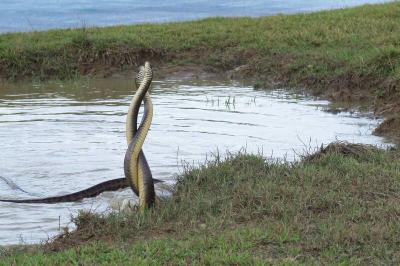
Kenting National Park service technician Yang Jien-fon (楊政峰) won a silver award in World Grand Prix Photography Awards Spring Season for his photograph of two male rat snakes intertwined in combat. Yang’s colleagues at Kenting National Park said he is a master of nature photography who has been held back by his job in civil service. The awards accept entries in all four seasons across six categories: architectural and urban photography, black-and-white and fine art photography, commercial and fashion photography, documentary and people photography, nature and experimental photography, and mobile photography. Awards are ranked according to scores and divided into platinum, gold and
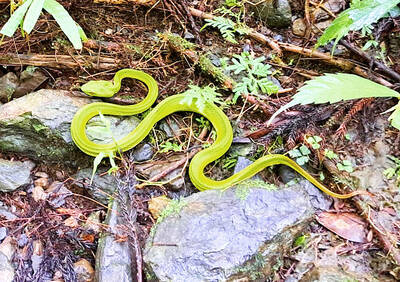
More than half of the bamboo vipers captured in Tainan in the past few years were found in the city’s Sinhua District (新化), while other districts had smaller catches or none at all. Every year, Tainan captures about 6,000 snakes which have made their way into people’s homes. Of the six major venomous snakes in Taiwan, the cobra, the many-banded krait, the brown-spotted pit viper and the bamboo viper are the most frequently captured. The high concentration of bamboo vipers captured in Sinhua District is puzzling. Tainan Agriculture Bureau Forestry and Nature Conservation Division head Chu Chien-ming (朱健明) earlier this week said that the
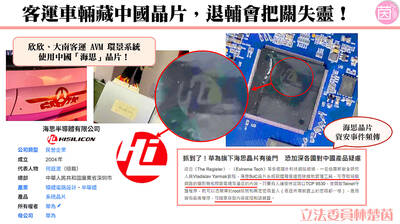
BREACH OF CONTRACT: The bus operators would seek compensation and have demanded that the manufacturer replace the chips with ones that meet regulations Two bus operators found to be using buses with China-made chips are to demand that the original manufacturers replace the systems and provide compensation for breach of contract, the Veterans Affairs Council said yesterday. Democratic Progressive Party Legislator Michelle Lin (林楚茵) yesterday said that Da Nan Bus Co and Shin-Shin Bus Co Ltd have fielded a total of 82 buses that are using Chinese chips. The bus models were made by Tron-E, while the systems provider was CYE Electronics, Lin said. Lin alleged that the buses were using chips manufactured by Huawei subsidiary HiSilicon Co, which presents a national security risk if the

The National Immigration Agency has banned two Chinese from returning to Taiwan, after they published social media content it described as disrespectful to national sovereignty. The agency imposed a two-month ban on a Chinese man surnamed Liang (梁) and a permanent ban on a woman surnamed Yang (楊), an influencer with 23 million followers, in October last year and last week respectively. Minister of the Interior Liu Shyh-fang (劉世芳) yesterday said on the sidelines of a legislative meeting that Chinese visitors to Taiwan are required to comply with the rules and regulations governing their entry permits. The government has handled the ban and


 RSS
RSS