


Democratic Progressive Party (DPP) Chairperson Tsai Ing-wen’s (蔡英文) US visit has apparently boosted her support rate as the latest opinion poll conducted by the party showed its presidential candidate is leading President Ma Ying-jeou (馬英九) by 1.5 percentage points, the DPP said yesterday.
The survey, conducted on Monday, showed that 44.3 percent of respondents support the pairing of Tsai with DPP Secretary--General Su Jia-chyuan (蘇嘉全), while 42.8 percent support President Ma Ying-jeou (馬英九), who is seeking re-election, and his running mate Premier Wu Den-yih (吳敦義).
If People First Party Chairman James Soong (宋楚瑜) enters the race, Tsai would still lead Ma by 1.2 percentage points, with Soong receiving 12.4 percent support, the survey found.
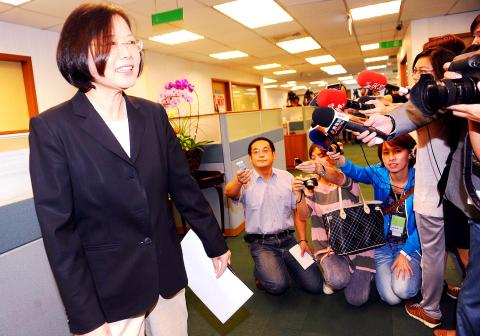
Photo: Chang Chia-ming, Taipei Times
The poll showed 45.3 percent of respondents agree that Tsai had a successful US visit, while 16.1 percent disagree.
The poll collected 858 samples and has a margin of error of 3.4 percent.
In another survey released yesterday by Global Views magazine, Ma held a small lead, receiving 39.2 percent compared with Tsai’s 38.3 percent, in a head-to-head battle.
However, Tsai edged Ma by 0.2 points — 36 percent to 35.8 percent — in a three way race, with Soong finishing last with 10 percent.
Meanwhile, DPP spokesman Lin Chun-hsien (林俊憲) said the party would decide by public opinion poll by Saturday on a legislative candidate for Greater Taichung’s seventh district to replace Chien Chao-tung (簡肇棟), who has withdrawn from the race after his involvement in a hit-and-run car accident that killed one person.
Lin said a survey will be conducted to determine the candidate between five hopefuls: Taichung City councilors Ho Hsin-chun (何欣純) and Lee Tien-shen (李天生), and former DPP legislators Lin Feng-hsi (林豐喜), Chiu Tai-san (邱太三) and Hsieh Hsin-ni (謝欣霓).
Chien’s replacement will be decided in time for the DPP’s three-in-one campaign activity to be held on Saturday in Greater Taichung.
The event will include the DPP’s party congress, the celebration of its Sept. 28 party anniversary and a rally for January’s presidential and legislative elections.
Taiwanese paleontologists have discovered fossil evidence that pythons up to 4m long inhabited Taiwan during the Pleistocene epoch, reporting their findings in the international scientific journal Historical Biology. National Taiwan University (NTU) Institute of Ecology and Evolutionary Biology associate professor Tsai Cheng-hsiu (蔡政修) led the team that discovered the largest snake fossil ever found in Taiwan. The single trunk vertebra was discovered in Tainan at the Chiting Formation, dated to between 400,000 and 800,000 years ago in the Middle Pleistocene, the paper said. The area also produced Taiwan’s first avian fossil, as well as crocodile, mammoth, saber-toothed cat and rhinoceros fossils, it said. Discoveries

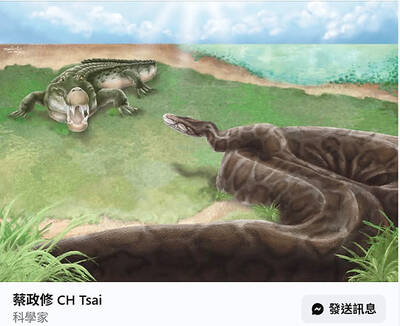
Taiwanese paleontologists have discovered fossil evidence that pythons up to 4m long inhabited Taiwan during the Pleistocene epoch, reporting their findings in the international scientific journal Historical Biology. National Taiwan University (NTU) Institute of Ecology and Evolutionary Biology associate professor Tsai Cheng-hsiu (蔡政修) led the team that discovered the largest snake fossil ever found in Taiwan. A single trunk vertebra was discovered in Tainan at the Chiting Formation, dated to between 800,000 to 400,000 years ago in the Middle Pleistocene, the paper said. The area also produced Taiwan’s first avian fossil, as well as crocodile, mammoth, sabre-toothed cat and rhinoceros fossils, it said. Discoveries
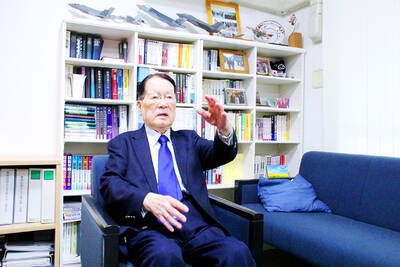
Whether Japan would help defend Taiwan in case of a cross-strait conflict would depend on the US and the extent to which Japan would be allowed to act under the US-Japan Security Treaty, former Japanese minister of defense Satoshi Morimoto said. As China has not given up on the idea of invading Taiwan by force, to what extent Japan could support US military action would hinge on Washington’s intention and its negotiation with Tokyo, Morimoto said in an interview with the Liberty Times (sister paper of the Taipei Times) yesterday. There has to be sufficient mutual recognition of how Japan could provide
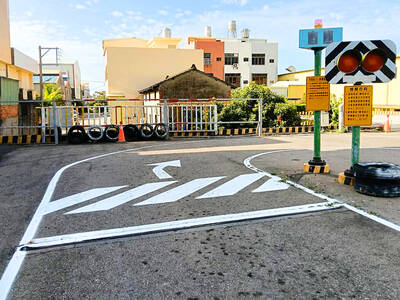
UPDATED TEST: The new rules aim to assess drivers’ awareness of risky behaviors and how they respond under certain circumstances, the Highway Bureau said Driver’s license applicants who fail to yield to pedestrians at intersections or to check blind spots, or omit pointing-and-calling procedures would fail the driving test, the Highway Bureau said yesterday. The change is set to be implemented at the end of the month, and is part of the bureau’s reform of the driving portion of the test, which has been criticized for failing to assess whether drivers can operate vehicles safely. Sedan drivers would be tested regarding yielding to pedestrians and turning their heads to check blind spots, while drivers of large vehicles would be tested on their familiarity with pointing-and-calling


 RSS
RSS