


Local governments are preparing for a variety of green activities to replace the traditional barbecue during the Mid-Autumn Festival as an effort to reduce the festival’s carbon footprint.
For many families, the Mid--Autumn Festival, which falls today this year, would not be complete without the barbecues that accompany the traditional family gatherings during the holiday.
However, to raise public awareness about carbon emissions created by firing up the grills, some local governments have decided they will provide alternative family activities that are green, but just as entertaining.
In Kinmen County, a 13-day Mid-Autumn Mooncake Gambling Game encourages tens of thousands of residents to gamble in a green and educational way, tourism official Lin Ching-i said last week.
Adapted from the ancient imperial exams, the simple dice game names different combinations of six dice based on the six ranks in the examination system.
Those who get the higher rank by throwing as many “fours” as possible will be the winners of the game and treated with mooncakes.
Part of Kinmen’s ongoing efforts to bill itself as a low-carbon island, Lin said, more people have been choosing gambling over barbecuing during the Mid-Autumn Festival over the years.
“What’s special this year is that we are offering a cow as a second prize to encourage people to be environmentally friendly,” she said. “Unlike a car, cattle will not create as much carbon emissions.”
In Greater Taichung, after three years of encouraging citizens to abandon grilling, the government is trying to refocus celebrations around its cherished tea industry.
A total of 1,000 free servings of bubble milk tea, along with live concerts, will be provided at the city hall plaza on the holiday, Taichung Mayor Jason Hu (胡志強) said.
“The world’s best tea is in Taichung,” Hu said. “We want more tea and less barbecue on the festival.”
The Environmental Protection Administration (EPA) said such green initiatives by local governments could cut several thousand tonnes of carbon dioxide if implemented every year.
“Compared with industrial carbon emissions, the carbon dioxide we will cut is relatively small,” EPA official Chen Hung-ta said. “However, it is one of the best opportunities for environmental awareness to take root in a fun and positive way.”


UPGRADE: The Kang Ding-class frigate is replacing its Chaparall missiles with Tien Chien II and Hua Yang VLS, which would provide it with long-range, 360° air defense Taiwan plans to produce 1,200 to 1,376 Hai Chien II missiles (海劍二, Sea Sword II) — also known as TC-2N — to serve as the standard air defense system of the navy’s surface combatant fleet, a source said yesterday. Last week, the Hai Chien II, the naval version of the Tien Kung II missile (天劍二, Sky Sword II), completed a live-fire test in waters off the National Chungshan Institute of Science and Technology’s Jiupeng facility (九鵬) in Pingtung County’s Manjhou Township (滿州). The MIM72 Chaparral and other dated air defense missiles that currently arm Taiwanese ships have inadequate range to combat Chinese

REASONS FOR TRAVEL: An assistant professor said that proposed amendments to penalize drivers if they used drugs overseas would not deter people from traveling People who operate a motor vehicle under the influence of marijuana would have their driver’s license revoked, even if they used the substance while overseas, the Ministry of Transportation and Communications said yesterday, citing proposed amendments to the Road Traffic Management and Penalty Act (道路交通管理處罰條例). The amendments would also authorize the government to revoke the licenses of people determined to have used Category 1 or Category 2 narcotics, even if they were not operating a vehicle while under the influence of drugs, as well as ban them from taking the license test for three years, the ministry said. People aged 18 or
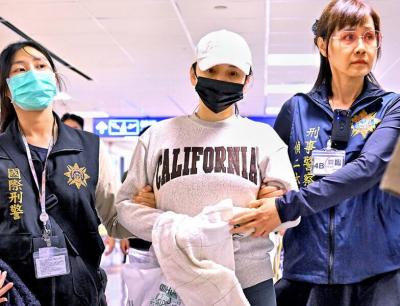
Johanne Liou (劉喬安), a Taiwanese woman who shot to unwanted fame during the Sunflower movement protests in 2014, returned to Taiwan last night after being deported from the US. She is to stand trial in Taiwan for charges involving embezzlement, fraud and drug crimes. The Criminal Investigation Bureau (CIB) said it took her into custody at Taiwan Taoyuan International Airport and would first question her before transferring her to the New Taipei District Prosecutors’ Office. She was arrested upon disembarking a flight from San Francisco that landed shortly before 7pm. Liou absconded to the US in 2019 after jumping bail
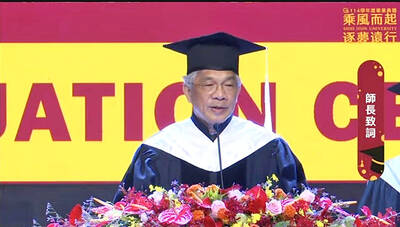
Shih Hsin University President Chen Ching-he (陳清河) yesterday issued a public apology for comments made in his commencement speech last week, stating that he has asked the school to suspend his duties and halt his wages for two months as a show of contrition. At the commencement ceremony on May 30, Chen said, “If you don’t manage your time well, or your own emotions, or your health, then I am telling every one of you — put a quick end to ‘you,’ because the world has no need for ‘you.’” The comments have sparked significant controversy online, and Chen through an open


 RSS
RSS