


The director of the much touted movie Seediq Bale (賽德克巴萊) said on Thursday in Venice that he made the movie not just to promote Taiwan in the international community, but also to bring peace and harmony to all the ethnic groups in the country.
Wei Te-sheng (魏德聖) had in mind the contradictions and conflicts among Taiwan’s different ethnic groups when he met the press to talk about his epic movie at the Venice Film Festival.
He said he hoped that the movie, based on Taiwanese Aborigines’ fight against Japanese colonizers, would increase the world’s understanding of the nation, whose history and culture had been created by the 14 native tribes, as well as Han Chinese immigrants and recent new immigrants from neighboring countries such as Vietnam and the Philippines.
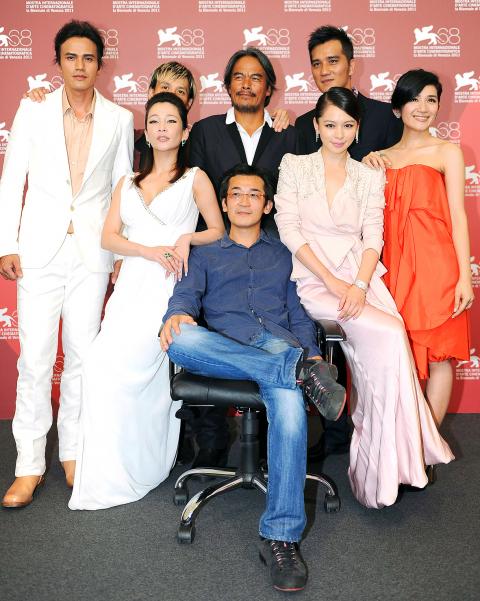
Photo: EPA
The interactions among these ethnic groups created a unique culture in Taiwan, he said, adding that he hoped the film would have a psychological healing effect on Taiwanese.
To dissipate hatred, “you’ve got to return to where it started,” Wei said.
He observed that people in Taiwan had not worked hard enough to learn about the culture of other ethnic groups, often resulting in one group’s “forceful intervention” in the lifestyle of another group or groups.
Every color in a rainbow exists on its own and next to other colors without one interfering with the others, but together they form a beautiful picture, he said.
The film is one of 22 that have been nominated for the Golden Lion award at this year’s Venice Film Festival — one of the world’s most prestigious cinematic competitions.
To accommodate the festival’s screening format, the four-and-a-half-hour film had to be cut to 135 minutes. Wei conceded that a large part of the emotional buildup in the film was sacrificed to allow room for other significant story lines.
After the film’s debut, Wei said he closely observed how the audiences reacted during screenings and kept asking himself whether their applause was because of true appreciation or simply politeness.
The Taiwanese production has been mired in controversy over how it has been labeled. The festival originally listed the film as originating from “China, Taiwan,” but after Taiwan’s representative to Italy protested, the listing was changed to “Chinese Taipei.”
When asked about the issue, Wei said he did not want the public to focus on political questions, but on the greatness of the power of art.
He said one of the most beautiful maps of the world is a satellite image of the Earth because it depicts the wholesome look of the planet. The ugliest map, he said, was one drawn by politicians with lines and blocks.
The power of art is like the satellite image of the Earth, which can remove all differences, Wei said.
“We as artists do not think within those lines. Whoever draws lines on the ground, I will ask them to remove them,” Wei added.
John Woo (吳宇森), the famed Hong Kong director and producer, who was present at the press conference, praised Wei for having produced an epic movie in which all Aboriginal actors had played their roles so sincerely that they made a touching movie.
Woo also commented that Wei’s work had demonstrated a humanitarian spirit, unlike Woo’s own heroes, who are a romantic reflection of his personality.
The film is scheduled to be released in Taiwan tomorrow under the title Warriors of the Rainbow: Seediq Bale (彩虹戰士:賽德克巴萊).

FUKUOKA SITUATION: Japanese media reported that the pathogen is expected to be identified by the summer, while the CDC downplayed the idea that it was hMPV A “mysterious cold-like illness” reported in Japan’s Fukuoka Prefecture does not seem to be a new disease, but Japanese authorities have been asked about the situation, the Centers for Disease Control (CDC) said yesterday. The Fukuoka Prefectural Medical Association on Wednesday told a news conference that a “mystery cold” that has become a hot topic on social media is “highly likely to be caused by some kind of viral infection,” Japan’s KBC News reported. “Many people are experiencing symptoms starting with a sore throat, followed by a runny nose, phlegm and a severe cough,” KBC News reported, citing association officials. Health authorities are

Nvidia Corp CEO Jensen Huang (黃仁勳) arrived in Taiwan yesterday ahead of upcoming AI and technology events, saying he plans to meet with clients and Taiwan Semiconductor Manufacturing Co Chairman C.C. Wei (魏哲家) during his visit. After landing at Taipei Songshan Airport, Huang posed for photos with fans and handed out Yakult drinks to reporters and supporters waiting at the scene, saying he has “a lot to do” during the trip. Asked about reports that Nvidia’s planned headquarters site in Taipei’s Beitou Shilin Technology Park could break ground on May 27, Huang said that if the company holds an event, he would

Carrefour Taiwan is to begin using a new name from the start of July, but it cannot divulge the name until then, the chairman of the supermarket chain's parent company said today. President Chain Store Co chairman Lo Chih-hsien (羅智先) was asked by reporters after a shareholders' meeting to confirm whether the company has settled on a new name for the supermarket brand. In March, the government-registered name of two Carrefour Taiwan branches was quietly changed to "Le Chia Kang" (樂家康) in Chinese, raising speculation that has been selected as the name. Lo said that because of local regulations and contractual obligations, the

The Philippines would likely be involved in any conflict over Taiwan due to its proximity to the democracy claimed by China, President Ferdinand Marcos Jr said, reiterating a stance that risks angering Beijing. “In the Philippines, we do not have a choice because Taiwan is so close to the Philippines and we have almost 200,000 Filipino nationals living and working in Taiwan,” Marcos said in an interview with Japanese media in Manila on Monday. The Philippine leader’s comments come ahead of a state visit to Japan next week, where he is to meet with Japanese Prime Minister Sanae Takaichi to discuss security


 RSS
RSS