


President Ma Ying-jeou (馬英九) and Democratic Progressive Party (DPP) Chairperson Tsai Ing-wen (蔡英文) almost tied in the latest Global Views magazine survey on public support for the two presidential candidates.
The poll, conducted from Wednesday to Friday last week, showed Ma with a 0.1 percentage point lead over Tsai, drawing a support rate of 37.3 percent against Tsai’s 37.2 percent.
Ma’s score was down 4.9 percentage points from the poll last month, when he scored 41.2 -percent against Tsai’s 36.3 percent.
About 74 percent of respondents said they would go to the polls in January, while the number of undecided voters rose to a three-month high of 25.5 percent, the poll showed.
Tai Li-an (戴立安), director of the magazine’s Survey Research Center, attributed the tie between Ma and Tsai to negative publicity afflicting both parties last week.
Growing concern about the Ma administration’s failure to address agricultural issues and an internal conflict arising from the DPP’s -legislator-at-large list were key factors behind the increase in the number of undecided voters, Tai said.
Overall, Tai said the polls did not show a significant change in the basic support base of the two candidates, while swing voters, who accounted for 4 to 5 percent of the electorate, were likely to play a major role in determining the election result.
On the two candidates’ cross-strait stance, 43.9 percent said they supported Ma’s Taiwan-China policy, while 35.1 percent disapproved of it.
A total of 73.8 percent said they had no knowledge of Tsai’s cross-strait policies, while 52.5 percent agreed that the DPP should adopt a more open policy toward cross-strait affairs.
The poll was conducted with a sample base of 1,229 voters, with a margin of error of 2.8 percent and a confidence level of 95 percent.
Ma’s campaign office spokesperson Lee Chia-fei (李佳霏) said the Ma camp would take all poll results into reference, adding that the administration would continue to focus on giving the public a solid performance.
DPP spokesperson Chen Chi-mai (陳其邁) said the recent indictment of former president Lee Teng-hui (李登輝) could have also contributed to the results of the poll, adding that there was growing public recognition of a political witch hunt against Lee Teng-hui.
Chen added that he believed Tsai’s election prospects would continue to rise, as support for the KMT in central and southern Taiwan weakens.
Speaking on the party’s internal surveys, DPP poll director Chen Chun-lin (陳俊麟) said: “We have also noticed a similar trend in Ma’s support ratings, which are especially pronounced in Taiwan’s central and southern farming districts.”
Thousands of agricultural workers converged in front of the Presidential Office last week to protest against land expropriation. Earlier this month, banana farmers also complained to Ma about slumping fruit prices.
ADDITIONAL REPORTING BY VINCENT Y. CHAO

Actor Darren Wang (王大陸) was sentenced to six months in prison, commutable to a fine, by the New Taipei District Court today for contravening the Personal Data Protection Act (個人資料保護法) in a case linked to an alleged draft-dodging scheme. Wang allegedly paid NT$3.6 million (US$114,380) to an illegal group to help him evade mandatory military service through falsified medical documents, prosecutors said. He transferred the funds to Chen Chih-ming (陳志明), the alleged mastermind of a draft-evasion ring, although he lost contact with him as he was already in detention on fraud charges, they said. Chen is accused of helping a

SECURITY: Starlink owner Elon Musk has taken pro-Beijing positions, and allowing pro-China companies to control Taiwan’s critical infrastructure is risky, a legislator said Starlink was reluctant to offer services in Taiwan because of the nation’s extremely high penetration rates in 4G and 5G services, the Ministry of Digital Affairs said yesterday. The ministry made the comments at a meeting of the legislature’s Transportation Committee, which reviewed amendments to Article 36 of the Telecommunications Management Act (電信管理法). Article 36 bans foreigners from holding more than 49 percent of shares in public telecommunications networks, while shares foreigners directly and indirectly hold are also capped at 60 percent of the total, unless specified otherwise by law. The amendments, sponsored by Chinese Nationalist Party (KMT) Legislator Ko

The eastern extension of the Taipei MRT Red Line could begin operations as early as late June, the Taipei Department of Rapid Transit Systems said yesterday. Taipei Rapid Transit Corp said it is considering offering one month of free rides on the new section to mark its opening. Construction progress on the 1.4km extension, which is to run from the current terminal Xiangshan Station to a new eastern terminal, Guangci/Fengtian Temple Station, was 90.6 percent complete by the end of last month, the department said in a report to the Taipei City Council's Transportation Committee. While construction began in October 2016 with an
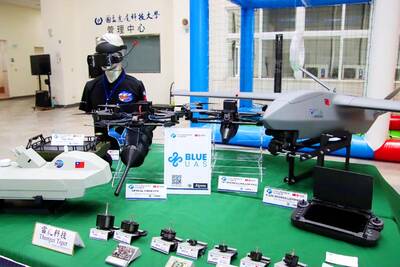
NON-RED SUPPLY: Boosting the nation’s drone industry is becoming increasingly urgent as China’s UAV dominance could become an issue in a crisis, an analyst said Taiwan’s drone exports to Europe grew 41.7-fold from 2024 to last year, with demand from Ukraine’s fight against Russian aggression the most likely driver of growth, a study showed. The Institute for Democracy, Society and Emerging Technology (DSET) in a statement on Wednesday said it found that many of Taiwan’s uncrewed aerial vehicle (UAV) sales were from Poland and the Czech Republic. These countries likely transferred the drones to Ukraine to aid it in its fight against the Russian invasion that started in 2022, it said. Despite the gains, Taiwan is not the dominant drone exporter to these markets, ranking second and fourth


 RSS
RSS