


Farmers’ rights activists expressed disappointment after a meeting with Premier Wu Den-yih (吳敦義) yesterday afternoon, during which the two sides failed to reach a consensus on a dispute over the expropriation of farmland.
“If you cannot solve the problem, there’s no need to try to appease angry farmers,” Taiwan Rural Front spokeswoman Tsai Pei-hui (蔡培慧) told reporters after walking out of the Executive Yuan. “The current Land Expropriation Act (土地徵收條例) has become a tool for land developers and speculators.”
In November last year, both the premier and Minister of the Interior Jiang Yi-huah (江宜樺) promised farmers and farmers’ rights advocates that the process to revise the act would at the very least begin during the legislative session which ended last month, she said.
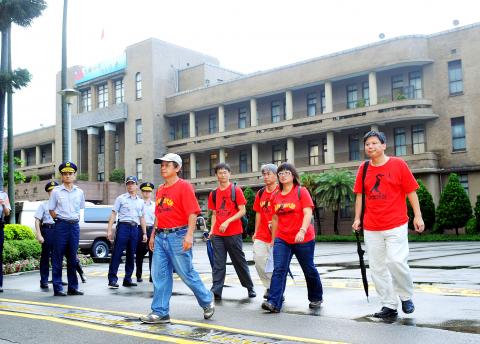
Photo: Wang Min-wei, Taipei Times
That promise has not been fulfilled, Tsai said.
“Thousands of farmers and their supporters will take their anger to the streets on Saturday and Wu so urgently wanted to meet us today [yesterday]. I really doubt his motives,” she said.
“What we’re hoping to change is the land expropriation system, which is unjust, while the premier only cares about isolated cases,” said Liao Pen-chuan (廖本全), an associate professor at National Taipei University’s Department of Real Estate and Built Environment.
Although every individual is important, “if the law is not amended, the same problem will happen over and over again,” Liao said.
Liu Ching-chang (劉慶昌), a senior farmer from the Erchongpu (二重埔) community in Jhudong Township (竹東), Hsinchu County, said he was “very disappointed with Wu.”
“Wu was very insincere; the meeting was just a show,” Liu said.
Although activists and farmers were not satisfied with the outcome, Wu saw things differently.
Liao said Wu told them he would give himself a grade of 95 percent for his handling of the land expropriation issue and asked the activists not to pay so much attention to the five points he did not get.
Wu also said he was “extremely unhappy” with what activists had told the media, Liao said, adding that Wu cursed five times during their meeting.
Despite yesterday’s meeting, the overnight rally on Taipei’s Ketagalan Boulevard in front of the Presidential Office on Saturday will proceed as planned, Tsai said, adding that more than 2,500 farmers from 12 communities facing land issues were expected to take part.

EXCUSES: Beijing is using government and research vessels as a pretext to harass the nation and enter its EEZ, and engage in ‘hegemonic expansion,’ the coast guard said The Coast Guard Administration yesterday said it drove away Chinese oceanographic research vessel Xiang Yang Hong 22 (向陽紅33) from restricted waters after warning it that it was in Taiwan’s exclusive economic zone (EEZ). The Chinese vessel entered restricted waters off the coast of Yilan County’s Suao (蘇澳) at 11:35pm on Thursday, the coast guard said, adding that it dispatched the Lanyu patrol vessel and the boat PP-10077 to shadow the Chinese ship and issue radio warnings ordering it to leave. China has no sovereignty over waters off Taiwan’s east coast, Lanyu’s crew told Xiang Yang Hong 22 over the radio, and demanded

BAIT AND SWITCH: Allowing KMT-run counties to sell to China while the threat of abrupt cancelations hangs overhead is another form of coercion, officials said Beijing is using agricultural purchase offers announced during the Straits Forum to deepen Taiwan’s dependence on the Chinese market, a Taiwanese official said yesterday as they criticized the Taitung County commissioner’s participation in the initiative. During the Straits Forum held in Xiamen on Saturday, Chinese officials announced a sales and purchase agreement for agricultural products from some counties led by the Chinese Nationalist Party (KMT). Taitung County Commissioner Yao Ching-ling (饒慶鈴), who was barred from attending the event in person by the Mainland Affairs Council, participated via video. Under the agreement, China would purchase atemoyas, pomeloes, tea and grouper harvested in Taitung,
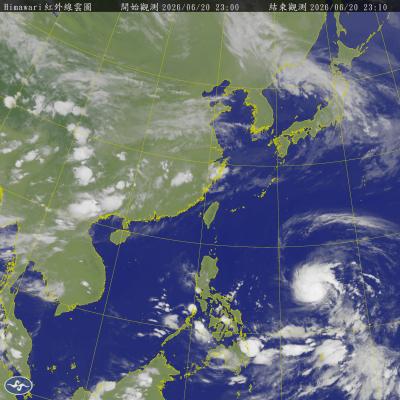
Tropical Storm Mekkhala is forecast to strengthen into a typhoon tomorrow and could come close enough to Taiwan later in the week to prompt a sea warning, the Central Weather Administration (CWA) said yesterday. As of 2 pm, the storm was located 1,870 kilometers southeast of Taiwan's southern tip and moving west- northwest at 23 km per hour. CWA forecaster Cheng Chieh-jen (鄭傑仁) said Mekkhala is expected to continue moving west-northwest through Tuesday under the influence of the Pacific high- pressure system before gradually turning north toward waters east of Taiwan or south of the Ryukyu Islands. The timing and angle of the
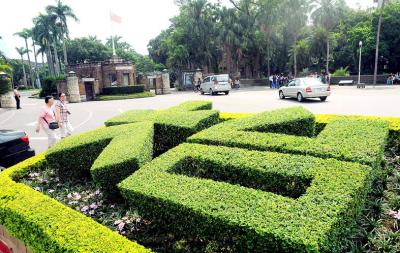
Four Taiwanese universities have been ranked among the world's top 200 institutions in the Quacquarelli Symonds (QS) World University Rankings for next year, the highest Taiwan has ever placed in the category, with National Taiwan University (NTU) achieving its best performance at 54th globally and 17th in Asia. The four Taiwanese institutions in the global top 200 are NTU (54th), National Tsing Hua University (142nd), National Yang Ming Chiao Tung University (177th) and National Cheng Kung University (191st), the rankings showed. All four universities achieved their highest-ever global rankings this year, QS data showed. National Cheng Kung University entered the top 200 for


 RSS
RSS