


The Homemakers’ Union and Foundation (HUCC) yesterday called on the Environmental Protection Administration (EPA) to impose stricter regulations on plasticizer chemicals.
The call came as the EPA is in the process of turning common plasticizers, including di(2--ethylhexyl) phthalate, or DEHP, from a category-four toxic chemical substance under the Toxic Chemical Substances Control Act (毒性化學物質管理法) to categories one and two to ensure tighter controls.
A public hearing on chemical substances controls was held last week, where many manufactures of plastic and perfume products expressed concerns that the revised regulations were too strict and would eventually put them out of business.
HUCC executive secretary Hsu Shin-shin (許心欣), who participated in the public hearing, said they urged the EPA to take a firmer stance in controlling the potentially toxic substances to protect the public and that it should not succumb to the opposition from manufacturers.
The foundation said a timetable for listing DEHP as a highly regulated substance should be shortened to reduce risks to public health, adding that regulations prohibiting the use of polyvinylchloride, or PVC, as food plastic wrap, currently scheduled to come into force in 2013, should be implemented earlier.
“If they know it’s bad for our health, why do they have to wait two more years?” Hsu asked.
People can choose to use polyethylene (PE) plastic wrap or glass containers that are safer to store food in, she said.
Moreover, the organization called for a total ban on dimethylformamide (DMF) as a material for sandals and kickboards for swimming, as peoples’ skin comes into direct contact with them.
A revision to regulations already bans DMF as a material in toys and floor mats.
In addition, the HUCC said endosulfan, a toxic pesticide, should be banned from agricultural use in accordance with a global ban on the manufacture and use of endosulfan negotiated under the Stockholm Convention in April, which will come into force in the middle of next year.
“There are already too many endocrine-disrupting chemicals threatening our health in our daily environment, but not everybody is aware of this,” Hsu said. “We hope the government will use this opportunity [the current scare over plasticizer chemicals] to modify the regulations — and not only in food products.”

LOUD AND PROUD Taiwan might have taken a drubbing against Australia and Japan, but you might not know it from the enthusiasm and numbers of the fans Taiwan might not be expected to win the World Baseball Classic (WBC) but their fans are making their presence felt in Tokyo, with tens of thousands decked out in the team’s blue, blowing horns and singing songs. Taiwanese fans have packed out the Tokyo Dome for all three of their games so far and even threatened to drown out home team supporters when their team played Japan on Friday. They blew trumpets, chanted for their favorite players and had their own cheerleading squad who dance on a stage during the game. The team struggled to match that exuberance on the field, with
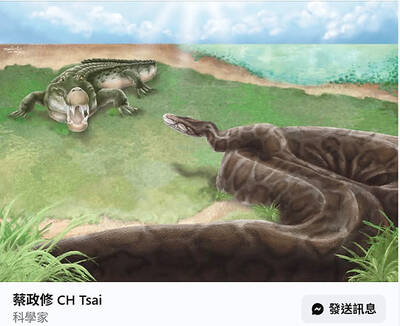
Taiwanese paleontologists have discovered fossil evidence that pythons up to 4m long inhabited Taiwan during the Pleistocene epoch, reporting their findings in the international scientific journal Historical Biology. National Taiwan University (NTU) Institute of Ecology and Evolutionary Biology associate professor Tsai Cheng-hsiu (蔡政修) led the team that discovered the largest snake fossil ever found in Taiwan. The single trunk vertebra was discovered in Tainan at the Chiting Formation, dated to between 400,000 and 800,000 years ago in the Middle Pleistocene, the paper said. The area also produced Taiwan’s first avian fossil, as well as crocodile, mammoth, saber-toothed cat and rhinoceros fossils, it said. Discoveries

Taiwanese paleontologists have discovered fossil evidence that pythons up to 4m long inhabited Taiwan during the Pleistocene epoch, reporting their findings in the international scientific journal Historical Biology. National Taiwan University (NTU) Institute of Ecology and Evolutionary Biology associate professor Tsai Cheng-hsiu (蔡政修) led the team that discovered the largest snake fossil ever found in Taiwan. A single trunk vertebra was discovered in Tainan at the Chiting Formation, dated to between 800,000 to 400,000 years ago in the Middle Pleistocene, the paper said. The area also produced Taiwan’s first avian fossil, as well as crocodile, mammoth, sabre-toothed cat and rhinoceros fossils, it said. Discoveries
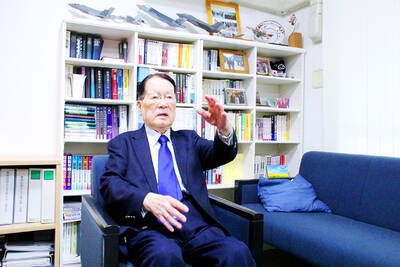
Whether Japan would help defend Taiwan in case of a cross-strait conflict would depend on the US and the extent to which Japan would be allowed to act under the US-Japan Security Treaty, former Japanese minister of defense Satoshi Morimoto said. As China has not given up on the idea of invading Taiwan by force, to what extent Japan could support US military action would hinge on Washington’s intention and its negotiation with Tokyo, Morimoto said in an interview with the Liberty Times (sister paper of the Taipei Times) yesterday. There has to be sufficient mutual recognition of how Japan could provide


 RSS
RSS