


Results of a Democratic Progressive Party (DPP) poll released yesterday showed DPP Chairperson and presidential nominee Tsai Ing-wen (蔡英文) holding a slight lead over her main rival, President Ma Ying-jeou (馬英九).
Support for Tsai registered at 41.3 percent compared with 40 percent for Ma, according to the poll.
Chen Chun-lin (陳俊麟), director of the party’s polling center, said the latest poll also showed that Tsai enjoyed 55.1 percent support from “neutral voters” and especially among younger voters (between the ages of 20 and 30) who have no distinctive affiliation to a political party.
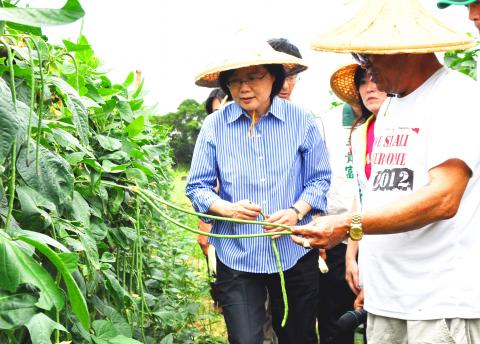
Photo: Peng Chien-li, Taipei Times
Support for Tsai from neutral voters was almost 20 percentage points greater than Ma’s 33.5 percent, Chen said.
Tsai’s image, which is largely seen as a departure from traditional DPP candidates, has turned many female voters, especially housewives with children, in the party’s favor, Chen said, adding that were it not for Tsai, this segment might not support the DPP candidate.
In central parts of the nation, Chen said support for Tsai stood at 41.7 percent against Ma’s 38.1 percent, adding that this showed that the traditional political demographics of a “blue north, green south” no longer seemed to apply.
Chen said the central part of the country has always been regarded as being pivotal during presidential elections.
However, since the five special municipality elections in November last year, dissatisfaction with Greater Taichung Mayor Jason Hu’s (胡志強) performance has whittled away the traditional advantage the pan-blue camp enjoyed in central Taiwan, Chen said.
Hu won the Nov. 27 election last year over the DPP’s Su Jia-chyuan (蘇嘉全) with 730,284 votes, or 51.12 percent, compared with Su’s 698,358, or 48.88 percent, in a race that was much closer than expected as Su won almost every township in then-Taichung County.
Recent polls have consistently given Tsai a lead over Ma in central Taiwan of between 1 and 3 percentage points, Chen added.
Chen said the poll also showed that the party had reduced its traditional weakness among white-collar workers, adding that this likely was the result of public dissatisfaction with a widening wealth gap nationwide, as well as an ongoing food scare that has gripped the nation, which have raised questions about the Ma administration’s ability to govern.
Tsai’s “reasonable” and “gentle” image is welcomed by the middle class, Chen added.
The poll surveyed 1,416 respondents older than 20 and was conducted from Tuesday through Thursday. The margin of error was 2.66 percentage points.
TRANSLATED BY JAKE CHUNG, STAFF WRITER, WITH ADDITIONAL REPORTING BY STAFF WRITER

NATIONAL SECURITY: Authorities are working to confirm the identities of the military personnel involved and investigating possible illegal conduct and regulatory violations Authorities are probing possible national security implications after Kinmen police and immigration officers on Sunday found a Chinese woman allegedly posing as a tourist while engaging in prostitution involving more than 10 military personnel. The woman, surnamed Chen (陳), has since been deported, authorities said, adding that investigators are still working to confirm the identities of those implicated, as the records only listed code names and aliases. The case stemmed from a report received by the Kinmen District Prosecutors’ Office on Friday last week from the Jinhu Precinct of the Kinmen County Police Bureau. On Sunday, police, along with the National Immigration

GLOBALGIVING: ‘ Caving to external pressure is not acceptable for an organization that has cultivated justice reform and human rights for 30 years,’ one NGO said A slew of non-government organizations (NGOs) have withdrawn from the GlobalGiving fundraising platform after it announced it would use “Chinese Taipei” instead of “Taiwan” from next month. The Taiwan Good Rice Association wrote on Facebook on Friday that it was informed on April 28 via a teleconference call of the change, which was made because the platform wanted to operate in China. Taiwan Good Rice is to terminate all cooperative relationships with GlobalGiving in response to the platform’s “unilateral and non-negotiable” decision to remove references to Taiwan, the NGO said. “Taiwan is in the official name of Taiwan Good Rice Association and the

HEAVY WEATHER: Typhoon Jangmi is due to crash straight into the Ryukyus as airlines look to shift flights to larger aircraft or cancel flights to Okinawa entirely Taiwan’s international air carriers announced flight adjustments over the weekend as Typhoon Jangmi is forecast to hit the Ryukyu Islands today and tomorrow. The Central Weather Administration (CWA) upgraded Jangmi from a tropical storm to a typhoon at 8am yesterday, with the eye located 580km south of Naha city. It was moving north at 19kph. Today, China Airlines’ CI-120, CI-121, CI-122 and CI-123 flights between Taoyuan and Naha, Okinawa, have been canceled as well as CI-132 and CI-133 between Kaohsiung and Naha. EVA Air’s BR-112, BR-113, BR-186 and BR-185 flights between Taoyuan and Naha are also canceled. Low-cost carrier Tigerair Taiwan canceled IT-230,
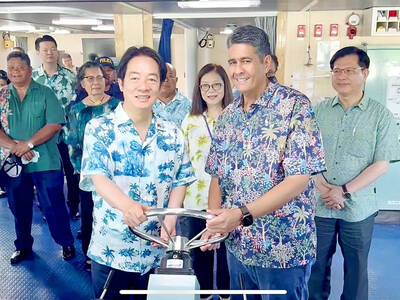
MULTIPRONGED APPROACH: China has sought to pressure Palau across a number of fronts, but the island nation has staunchly resisted overtures to ditch Taiwan Palau has been firm in backing Taiwan despite Chinese pressure that uses tourism economics, cyberattacks and criminal infiltration as tools to threaten the Pacific ally into renouncing its recognition of Taiwan as a sovereign state. The Presidential Office yesterday announced that Vice President Hsiao Bi-khim (蕭美琴) would visit Palau from Saturday to Wednesday next week at the invitation of Palauan President Surangel Whipps Jr. Whipps in April said in an interview that China had outspokenly asked Palau to “denounce Taiwan.” “And we have said: ‘We have no enemies, but nobody tells us who our friends are,’” he said. Whipps has told reporters multiple times


 RSS
RSS