


Huang Hsing-yao knows exactly how to spend every hour of the day, every day of the week: bent over the books, preparing for the most important test of his life.
With little time left before the university entrance exam that will decide his future, the 18-year-old high school student’s life is marked by relentless study, most of it in a cram school in downtown Taipei.
“At the moment, I hardly have any free time. It’s all spent studying,” he said, sporting a cool-kid haircut, but wearing a blue-and-white school uniform. “Sometimes I relax a bit at home, but I still have to do some preparation.”
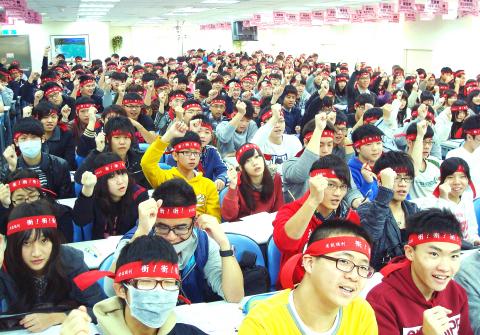
Photo: AFP
Taiwan is an education-obsessed society, due not least to a Confucian legacy that emphasizes personal improvement, and there are hundreds of thousands of young Taiwanese just like Huang.
Surveys show that eight in 10 high school students in Taiwan receive some kind of after-school tutoring to help them pass each hurdle in the education system to make it into the best universities and eventually get the best jobs.
The cram schools, whose bright logos grace the central area of every Taiwanese city, are a huge business in the country, with parents willing to pay thousands of dollars for what they consider an essential service.
“As parents, we all want our sons to become dragons and our daughters to become phoenixes,” Huang Hsien-chen, Hsing-yao’s 57-year-old father, quoting a traditional saying on how education unlocks the potential of the individual.
In traditional Chinese society, top degree holders typically entered into the government bureaucracy, while today most job opportunities await them in the private sector.
However, despite these changes, the faith in education as the only route to social progress is still widespread.
“A lot of parents have farming or worker backgrounds. So they want their children to be better than themselves,” said Chiang Shu-miao, chief executive of Yu Da Education Institution, a cram school with 23 branches nationwide.
“Traditionally, academia has occupied a high place in society and that’s why a lot of parents want their children’s studies to be reinforced at a cram school,” she said.
Cram school fees are about NT$100,000 a year for a high school student — a two-month salary for a number of Taiwanese.
“We also serve a social function,” Chiang said. “Parents and relatives are all busy working. They aren’t able to really nurture their children.”
“Cram schools have a stabilizing effect on families and society. I don’t care about how other people judge us. We have a mission to create a future for the youth,” Chiang said.
Some cram schools seek to attract students with the offer of star teachers known across the nation for their ability to get large numbers of students past exams.
They often also seek to create a special gung-ho atmosphere, such as in Huang’s cram school, where students wear red headbands screaming “Go!” in large characters and expressing a wish for a “Smooth Exam.”
Teachers, too, feel the strain — some have their mobile phones on 24 hours a day, ready to reply to questions from anxious parents.
“Teachers here come and go, come and go. The pressure is very high,” said Liu Chang-chi, a teacher at Yu Da with 25 years of cram school experience.
However, not all parents believe their children should do nothing but stare into textbooks like robots every waking hour of the day.
“I am traditional in that I respect education, but I’m also modern in my thinking,” Huang Hsien-chen said.
“I don’t always try to make him study, study, study. I also give my son pocket money. He does other activities like playing guitar and sports,” he said.

The Ministry of Finance this afternoon announced the winning numbers for the March-April uniform invoice lottery. The winning number for the NT$10 million (US$318,060) special prize is 19531471, and the winning number for the NT$2 million grand prize is 85941329. Three numbers were drawn for the NT$200,000 first prize: 07225810, 20231230 and 83518781. Those with receipts matching the last seven digits of any of the first-prize numbers will win the NT$40,000 second prize, while those matching the last six digits will win the NT$10,000 third prize. Those whose receipts match the last five digits of the first-prize numbers can claim the NT$4,000 fourth prize,

NATIONAL SECURITY: Authorities are working to confirm the identities of the military personnel involved and investigating possible illegal conduct and regulatory violations Authorities are probing possible national security implications after Kinmen police and immigration officers on Sunday found a Chinese woman allegedly posing as a tourist while engaging in prostitution involving more than 10 military personnel. The woman, surnamed Chen (陳), has since been deported, authorities said, adding that investigators are still working to confirm the identities of those implicated, as the records only listed code names and aliases. The case stemmed from a report received by the Kinmen District Prosecutors’ Office on Friday last week from the Jinhu Precinct of the Kinmen County Police Bureau. On Sunday, police, along with the National Immigration

SIX SUBSIDIES: The monthly allowance for older farmers is to increase to NT$10,000, and NT$5,000 is to be given to homemakers under the national pension system, Lai said The government is to implement major welfare policies for disadvantaged groups, including raising the monthly allowance for older farmers to NT$10,000 and providing homemakers with NT$5,000 per month, President William Lai (賴清德) said yesterday. Lai made the remarks during a visit to Wangling Temple in Chiayi County, saying that the planned increases were being introduced amid economic growth and an increase in tax revenue. Touting a policy, in which the government plans to provide a monthly allowance of NT$5,000 for every child under the age of 18 in a bid to address Taiwan’s low birthrate, Lai said that if received for the
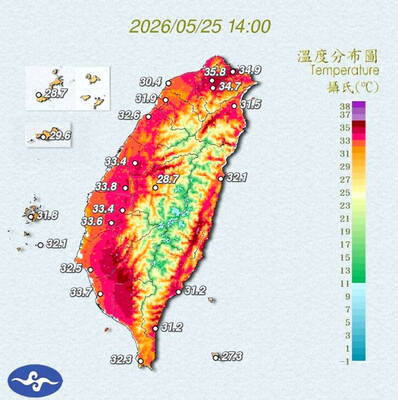
STAY COOL: The HPA recommended that people stay hydrated, use air-conditioning or fans while indoors, wear loose-fitting clothes and walk in the shade while outdoors Employers must implement measures such as installing cooling equipment, and providing drinking water and rest breaks for outdoor workers starting from Monday next week, the Taipei Department of Labor said on Sunday. Employers who fail to comply could face fines of NT$30,000 to NT$300,000 under the Occupational Safety and Health Act (職業安全衛生法), the department said. Businesses in Taipei employing fewer than 100 workers, as well as registered self-employed workers with labor insurance coverage, could receive on-site assessments and guidance from occupational safety consultants to help them apply for central government subsidies to implement or improve heat-protection measures, it said. Under the Ministry of


 RSS
RSS