


Eleven universities, including National Taiwan University, have been rated by the UK-based QS education network as among Asia’s top 100 universities.
National Taiwan University is ranked 21st, maintaining the same position as last year, while the Hong Kong University of Science and Technology tops the list.
Martin Ince, who is a member of the QS Advisory Board, said Taiwan had high quality universities and its overall performance was better than last year.
There is no doubt that National Taiwan University is a “world-class university by any standard. It’s an important university in Asia on a global scale,” he said.
He also said that Hong Kong universities are well regarded by people all over the world, adding that among the top 10, three were from Hong Kong.
China had another 14 among the top 100, he said. Given that the whole of China had 14, Taiwan’s performance was “very good” for a small country.
The 11 Taiwanese schools in the top 100 are National Taiwan University (21st), National Tsing Hua University (31st), National Cheng Kung University (32nd), National Yang Ming University (40th), National Chiao Tung University (52nd), National Central University (59th), National Taiwan University of Science and Technology (62nd), National Sun Yat-sen University (70th), Chang Gung University and Taipei Medical University (both 89th) and National Chung Hsing University (99th).
Although employers are generally positive about Taiwanese graduates, Taiwanese universities have fewer international faculty and students, Ince said. Also, the ratio of academic papers cited by academia abroad is low, he said.
The survey said the top 10 universities in Asia are Hong Kong University of Science and Technology, University of Hong Kong, National University of Singapore, University of Tokyo, Chinese University of Hong Kong, Seoul National University, Kyoto University, Osaka University, Tokyo Institute of Technology and Tohoku University.
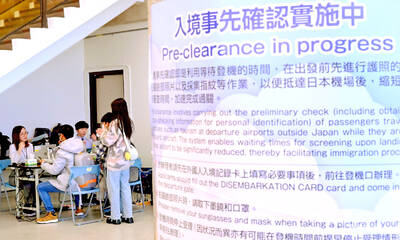
A preclearance service to facilitate entry for people traveling to select airports in Japan would be available from Thursday next week to Feb. 25 at Taiwan Taoyuan International Airport, Taoyuan International Airport Corp (TIAC) said on Tuesday. The service was first made available to Taiwanese travelers throughout the winter vacation of 2024 and during the Lunar New Year holiday. In addition to flights to the Japanese cities of Hakodate, Asahikawa, Akita, Sendai, Niigata, Okayama, Takamatsu, Kumamoto and Kagoshima, the service would be available to travelers to Kobe and Oita. The service can be accessed by passengers of 15 flight routes operated by
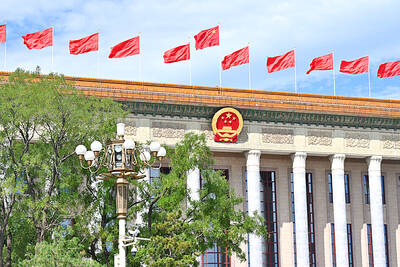
MORE FALL: An investigation into one of Xi’s key cronies, part of a broader ‘anti-corruption’ drive, indicates that he might have a deep distrust in the military, an expert said China’s latest military purge underscores systemic risks in its shift from collective leadership to sole rule under Chinese President Xi Jinping (習近平), and could disrupt its chain of command and military capabilities, a national security official said yesterday. If decisionmaking within the Chinese Communist Party has become “irrational” under one-man rule, the Taiwan Strait and the regional situation must be approached with extreme caution, given unforeseen risks, they added. The anonymous official made the remarks as China’s Central Military Commission Vice Chairman Zhang Youxia (張又俠) and Joint Staff Department Chief of Staff Liu Zhenli (劉振立) were reportedly being investigated for suspected “serious
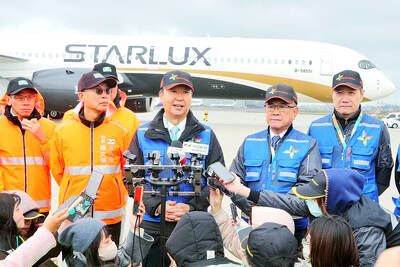
ENHANCING EFFICIENCY: The apron can accommodate 16 airplanes overnight at Taoyuan airport while work on the third runway continues, the transport minister said A new temporary overnight parking apron at Taiwan Taoyuan International Airport is to start operating on Friday next week to boost operational efficiency while the third runway is being constructed, the Ministry of Transportation and Communications said yesterday. The apron — one of the crucial projects in the construction of the third runway — can accommodate 16 aircraft overnight at the nation’s largest international airport, Minister of Transportation and Communications Chen Shih-kai (陳世凱) told reporters while inspecting the new facility yesterday morning. Aside from providing the airport operator with greater flexibility in aircraft parking during the third runway construction,
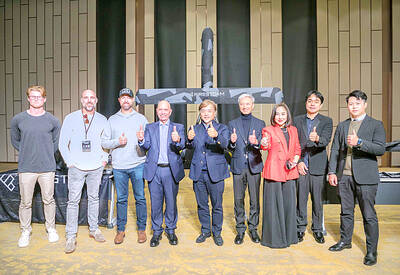
Taiwanese and US defense groups are collaborating to introduce deployable, semi-autonomous manufacturing systems for drones and components in a boost to the nation’s supply chain resilience. Taiwan’s G-Tech Optroelectronics Corp subsidiary GTOC and the US’ Aerkomm Inc on Friday announced an agreement with fellow US-based Firestorm Lab to adopt the latter’s xCell, a technology featuring 3D printers fitted in 6.1m container units. The systems enable aerial platforms and parts to be produced in high volumes from dispersed nodes capable of rapid redeployment, to minimize the risk of enemy strikes and to meet field requirements, they said. Firestorm chief technology officer Ian Muceus said


 RSS
RSS