


President Ma Ying-jeou (馬英九) yesterday promised to achieve more progress in terms of the country’s sovereignty, human rights and environmental protection.
In a 20-minute speech at the National University of Tainan to mark his third year in office, Ma said the government has the responsibility to work for the good of current and future generations.
“We should not narrow the opportunities for the next generation, but rather should lay a good foundation for its well-being,” he said. “This is transgenerational justice.”
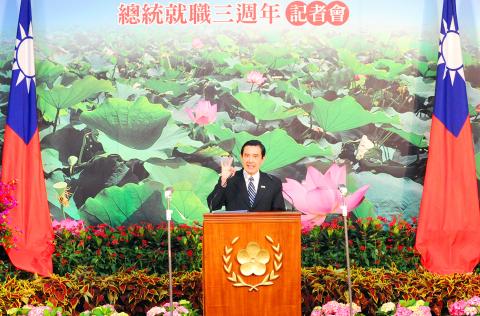
Photo: Huang Chih-yuan, Taipei Times
“Your future is Taiwan’s future. The government’s responsibility is to build an environment that allows you to use your talent,” he said, addressing the nation’s young people.
Today is the third anniversary of Ma’s inauguration.
Holding the speech and a press conference in Greater Tainan was seen as a re-election ploy because the area has long been a stronghold of the Democratic Progressive Party (DPP).
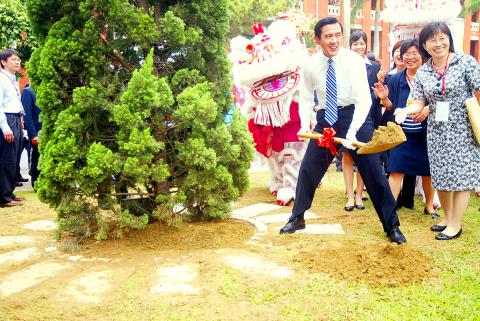
Photo: CNA
Ma, who will be seeking re-election in January, has long been accused by his critics of hurting Taiwan’s sovereignty and interests in his dealings with China, but he defended his policy of building better ties with China, saying that none of the 15 agreements signed between the two sides of the Taiwan Strait over the past three years had put Taiwan at a disadvantage.
“It is our responsibility to help future generations grow and develop in a peaceful cross-strait environment,” he said.
Despite improved cross-strait relations, Ma said, he has continued to urge the US to sell the “necessary defensive weapons” to Taiwan.

Photo: Hung Jui-chin, Taipei Times
“Only by increasing Taiwan’s power to defend itself will we be able to maintain a balance across the Taiwan Strait,” he said. “Only by doing so will Taiwan gain confidence in the course of its interactions with the mainland.”
Ma said that his administration has lodged strong protests with Beijing over any denigration of Taiwan’s sovereignty, including the recent case involving a memo issued by WHO Director-General Margaret Chan (陳馮富珍) in September last year. The memo asked its recipients to refer to Taiwan as a “province of China.”
Ma said he had also asked Department of Health Minister Chiu Wen-ta (邱文達) to protest the letter at this week’s meeting of the World Health Assembly (WHA), the WHO’s governing body.
When things matter to national sovereignty and Taiwan’s dignity, “Taiwanese are not afraid of anything,” Ma said, switching to Hoklo (also known as Taiwanese.)
Ma said Tainan Airport will become the ninth in the country to accommodate direct flights to and from China, starting with charter flights this summer.
He also listed several policies he said would benefit southern Taiwan. The government has invested or plans to invest a total of NT$744.7 billion (US$25.8 billion) in construction projects in southern Taiwan, he said, including an underground railway and creative cultural park in Greater Tainan and a NT$263.2 billion project to make Greater Kaohsiung an multi-purpose port and a major industrial city.
Ma said not everyone in the country was aware of his administration’s efforts to make Taiwan a better place to live.
“That’s why I’ve been on the road, meeting people, especially those who will become eligible this year to vote,” he said in response to a reporter’s question on how he would woo first-time voters.
Meanwhile, more than 100 people protested outside the Greater Tainan Council against Ma’s presidential record.
The rally, organized by the DPP’s Tainan branch and its Greater Tainan Council caucus, featured demonstrators clad in black shirts singing songs and holding banners proclaiming how painful their lives have been under the Ma administration.
The caucus members accused Ma of failing to fulfill many of his election promises.
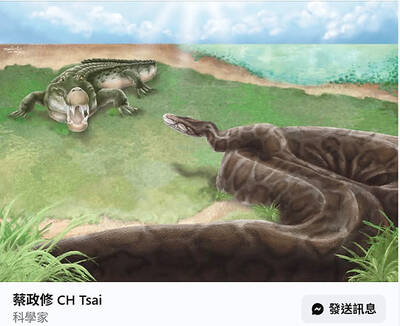
Taiwanese paleontologists have discovered fossil evidence that pythons up to 4m long inhabited Taiwan during the Pleistocene epoch, reporting their findings in the international scientific journal Historical Biology. National Taiwan University (NTU) Institute of Ecology and Evolutionary Biology associate professor Tsai Cheng-hsiu (蔡政修) led the team that discovered the largest snake fossil ever found in Taiwan. The single trunk vertebra was discovered in Tainan at the Chiting Formation, dated to between 400,000 and 800,000 years ago in the Middle Pleistocene, the paper said. The area also produced Taiwan’s first avian fossil, as well as crocodile, mammoth, saber-toothed cat and rhinoceros fossils, it said. Discoveries

Taiwanese paleontologists have discovered fossil evidence that pythons up to 4m long inhabited Taiwan during the Pleistocene epoch, reporting their findings in the international scientific journal Historical Biology. National Taiwan University (NTU) Institute of Ecology and Evolutionary Biology associate professor Tsai Cheng-hsiu (蔡政修) led the team that discovered the largest snake fossil ever found in Taiwan. A single trunk vertebra was discovered in Tainan at the Chiting Formation, dated to between 800,000 to 400,000 years ago in the Middle Pleistocene, the paper said. The area also produced Taiwan’s first avian fossil, as well as crocodile, mammoth, sabre-toothed cat and rhinoceros fossils, it said. Discoveries
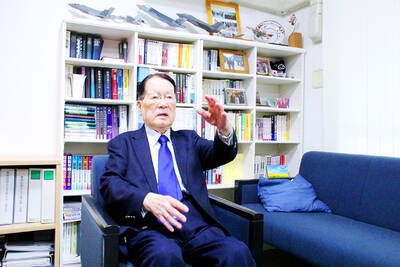
Whether Japan would help defend Taiwan in case of a cross-strait conflict would depend on the US and the extent to which Japan would be allowed to act under the US-Japan Security Treaty, former Japanese minister of defense Satoshi Morimoto said. As China has not given up on the idea of invading Taiwan by force, to what extent Japan could support US military action would hinge on Washington’s intention and its negotiation with Tokyo, Morimoto said in an interview with the Liberty Times (sister paper of the Taipei Times) yesterday. There has to be sufficient mutual recognition of how Japan could provide
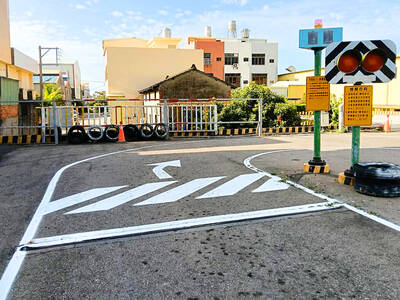
UPDATED TEST: The new rules aim to assess drivers’ awareness of risky behaviors and how they respond under certain circumstances, the Highway Bureau said Driver’s license applicants who fail to yield to pedestrians at intersections or to check blind spots, or omit pointing-and-calling procedures would fail the driving test, the Highway Bureau said yesterday. The change is set to be implemented at the end of the month, and is part of the bureau’s reform of the driving portion of the test, which has been criticized for failing to assess whether drivers can operate vehicles safely. Sedan drivers would be tested regarding yielding to pedestrians and turning their heads to check blind spots, while drivers of large vehicles would be tested on their familiarity with pointing-and-calling


 RSS
RSS