


Premier Wu Den-yih (吳敦義) yesterday defended the use of the so-called “1992 consensus” as the basis for the development of cross-strait relations, challenging the adoption of the “Macau Model” as proposed by a former Democratic Progressive Party (DPP) government official, saying it would diminish the nation’s dignity.
The “1992 consensus” is the best policy as Taiwan seeks to promote peaceful cross-strait relations while prioritizing the interests of the people, Wu said.
“With the ‘1992 consensus’ as the basis, we can set aside sensitive disputes over national sovereignty and focus efforts on cross-strait exchanges in economics, culture and tourism,” he said yesterday after attending a fire drill in Taipei City.
The “1992 consensus” refers to a supposed understanding reached during a meeting in Hong Kong in 1992 between Taiwanese and Chinese representatives, under which both sides claim to have acknowledged that there was “one China,” with each side having its own interpretation of what “one China” means.
The DPP insists that the “1992 consensus” does not exist.
In 2006, former Mainland Affairs Council chairman Su Chi (蘇起) admitted he made up the term “1992 consensus” in 2000 before the Chinese Nationalist Party (KMT) handed over power to the DPP.
Wu’s remarks came after former Mainland Affairs Council chairman Joseph Wu (吳釗燮) said in the US on Tuesday that the so-called “1992 consensus” could be dropped as part of cross-strait exchanges should DPP Chairperson Tsai Ing-wen (蔡英文) win next year’s presidential election.
The DPP, he said, would replace the “1992 consensus” with the “Macau Model,” which was adopted by former president Chen Shui-bian’s (陳水扁) administration to initiate talks on cross-strait chartered flights in 2005.
While negotiating on chartered flights and other cross-strait issues, the former DPP government sent officials to negotiate with China in Macau on a non-official basis, rather than engaging in the negotiations via semi-government agencies — the Straits Exchange Foundation (SEF) and China’s Association for Relations Across the Taiwan Strait (ARATS).
Wu said the “Macau Model” would diminish the nation’s dignity and that it should not be acceptable, even for the DPP.
Mainland Affairs Council Minister Lai Shin-yuan (賴幸媛) also dismissed Joseph Wu’s comments, arguing that cross-strait negotiations under the “Macau Model,” which would be conducted by non-governmental groups on an issue-to-issue basis, would be a step backwards from the systematic negotiations held by the SEF and ARATS.
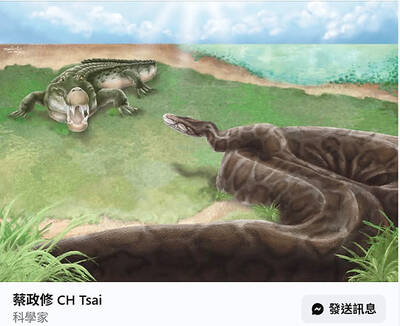
Taiwanese paleontologists have discovered fossil evidence that pythons up to 4m long inhabited Taiwan during the Pleistocene epoch, reporting their findings in the international scientific journal Historical Biology. National Taiwan University (NTU) Institute of Ecology and Evolutionary Biology associate professor Tsai Cheng-hsiu (蔡政修) led the team that discovered the largest snake fossil ever found in Taiwan. The single trunk vertebra was discovered in Tainan at the Chiting Formation, dated to between 400,000 and 800,000 years ago in the Middle Pleistocene, the paper said. The area also produced Taiwan’s first avian fossil, as well as crocodile, mammoth, saber-toothed cat and rhinoceros fossils, it said. Discoveries

Taiwanese paleontologists have discovered fossil evidence that pythons up to 4m long inhabited Taiwan during the Pleistocene epoch, reporting their findings in the international scientific journal Historical Biology. National Taiwan University (NTU) Institute of Ecology and Evolutionary Biology associate professor Tsai Cheng-hsiu (蔡政修) led the team that discovered the largest snake fossil ever found in Taiwan. A single trunk vertebra was discovered in Tainan at the Chiting Formation, dated to between 800,000 to 400,000 years ago in the Middle Pleistocene, the paper said. The area also produced Taiwan’s first avian fossil, as well as crocodile, mammoth, sabre-toothed cat and rhinoceros fossils, it said. Discoveries
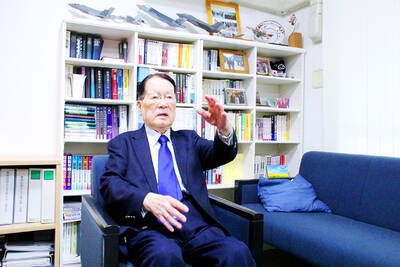
Whether Japan would help defend Taiwan in case of a cross-strait conflict would depend on the US and the extent to which Japan would be allowed to act under the US-Japan Security Treaty, former Japanese minister of defense Satoshi Morimoto said. As China has not given up on the idea of invading Taiwan by force, to what extent Japan could support US military action would hinge on Washington’s intention and its negotiation with Tokyo, Morimoto said in an interview with the Liberty Times (sister paper of the Taipei Times) yesterday. There has to be sufficient mutual recognition of how Japan could provide
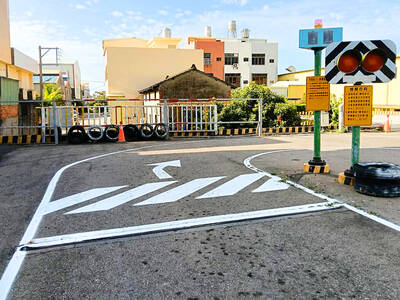
UPDATED TEST: The new rules aim to assess drivers’ awareness of risky behaviors and how they respond under certain circumstances, the Highway Bureau said Driver’s license applicants who fail to yield to pedestrians at intersections or to check blind spots, or omit pointing-and-calling procedures would fail the driving test, the Highway Bureau said yesterday. The change is set to be implemented at the end of the month, and is part of the bureau’s reform of the driving portion of the test, which has been criticized for failing to assess whether drivers can operate vehicles safely. Sedan drivers would be tested regarding yielding to pedestrians and turning their heads to check blind spots, while drivers of large vehicles would be tested on their familiarity with pointing-and-calling


 RSS
RSS