


The Supreme Court yesterday overturned a Taiwan High Court ruling last year that found the defendants in the “Hsichih Trio” case not guilty.
Saying there were “contradictory accounts” and issues that needed further investigation, the Supreme Court returned the case to the Taiwan High Court for retrial.
The latest ruling marked another turn in the series of legal twists that has seen the case drag on for more than two decades.
The “Hsichih Trio” are Su Chien-ho (蘇建和), Liu Bin-lang (劉秉郎) and Chuang Lin-hsun (莊林勳), who, along with Wang Wen-hsiao (王文孝), were suspected of robbing and murdering Wu Min-han (吳銘漢) and his wife, Yeh Ying-lan (葉盈蘭), in the Taipei suburb” of Sijhih (汐止), also known as Hsichih, on March 24, 1991. The couple were found dead in their apartment. They had been stabbed 79 times.
Wang, an army conscript, was sentenced and executed under military law in January 1992.
Su, Liu and Chuang were incarcerated in 1991 at the age of 19 and remained in jail until 2003, eight of those years spent on death row.
In May 2000, then-state public prosecutor-general Chen Han (陳涵) made three extraordinary appeals to the Supreme Court for a retrial. In January 2003, the High Court acquitted the trio. Prosecutors filed another appeal with the Supreme Court, which ordered yet another retrial. The High Court again sentenced the three to death in June 2007.
In 2009, the trio’s panel of lawyers presented a report by forensic scientist Henry Lee (李昌鈺), which said that a single killer could have carried out the double murder and rape.
Referring to new information given in the forensic report by Lee, the high court in November last year said Wang had most likely acted alone in committing the two murders. The court reversed the death sentences given to the three by the high court in June 2007 on charges of robbery and premeditated murder.
Expressing regret over the latest ruling, Su Yiu-chen (蘇友辰), the trio’s defense lawyer, asserted his clients’ innocence.
We will never see the end of this case if the court remains overly fastidious, he added.
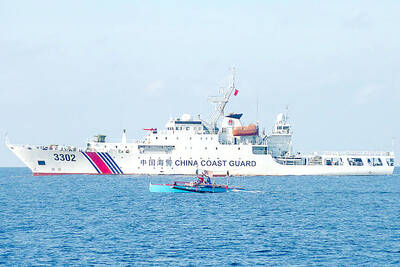
EXPANSIONIST: China deploys an average of 40 to 50 warships and coast guard vessels daily in the South China Sea, despite pledges not to militarize the region, an official said China is attempting to expand its influence across the First Island Chain and increase pressure on Japan by sending coast guard vessels into waters off of Taiwan under the pretext of maritime negotiations with Japan and the Philippines, a national security official said yesterday. China’s recent actions in the waters east of Taiwan and Japan and the Philippines’ exclusive economic zones (EEZ) are attempts to establish dominance in First Island Chain waters, said the official who declined to be named, adding that this is “expansion disguised as law enforcement.” Framing China’s actions solely as a cross-strait issue is a serious misjudgment that
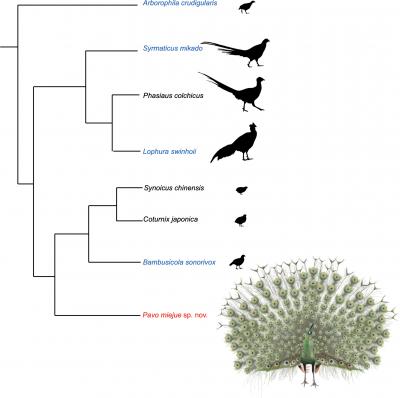
Through analyzing fossil evidence, a research team at National Taiwan University (NTU) discovered the largest endemic bird to have lived in Taiwan, naming it Pavo miejue, or extinct peafowl (滅絕孔雀). The Mikado pheasant, which is printed on the back of the NT$1,000 bank note, was previously believed to be the biggest endemic bird to Taiwan. The research team’s findings suggest that Pavo miejue lived during the Pleistocene epoch tens of thousands of years ago. It is the first endemic extinct bird species discovered and formally named in Taiwan. The study was coauthored by NTU Institute of Ecology and Evolutionary Biology professor Tsai Cheng-hsiu (蔡政修),
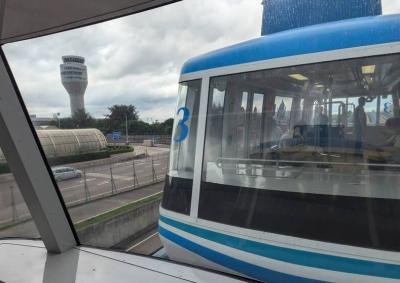
Taiwan Taoyuan International Airport is to suspend its automated Skytrain service connecting Terminal 1 and Terminal 2 starting on July 1 to facilitate connection works for the upcoming Terminal 3, the airport operator said today. Passengers and staff who need to travel between the two terminals after the suspension can instead use the Taoyuan MRT or the airport's 24-hour shuttle bus service, Taoyuan International Airport Corp said. The Taoyuan MRT Airport Line directly links the two terminals, while the shuttle buses are to operate around the clock, the company added. The Skytrain provides free transportation between the airport’s two terminals for travelers and
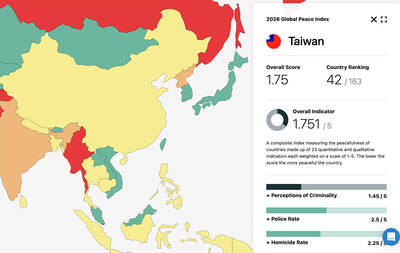
Taiwan ranked 42nd in terms of peacefulness among 163 countries, down five places from last year, according to this year’s Global Peace Index. With an overall score of 1.751, Taiwan dropped from 37th last year, the report published by the global Institute for Economics and Peace showed. The overall score measures a country’s level of peacefulness using 23 quantitative and qualitative indicators across three domains — ongoing domestic and international conflict, societal safety and security, and militarization. While Taiwan ranked 42nd worldwide, it was listed in ninth place among the 19 Asian-Pacific countries in the report, after New Zealand, Singapore, Japan, Malaysia,


 RSS
RSS