


The Taipei High Administrative Court yesterday rejected the Taiwan Solidarity Union’s (TSU) administrative appeal against the Central Election Commission (CEC) for turning down the party’s petition to hold a referendum on the issue of Taiwan signing a cross-strait trade pact.
TSU Chairman Huang Kun-huei (黃昆輝) filed the case with the court earlier this year after the Cabinet’s Referendum Review Committee rejected the TSU’s proposed referendum.
The TSU’s application requested a referendum on the question: “Do you agree that the government should sign an Economic Cooperation Framework Agreement (ECFA) with China?”
The court yesterday ruled the commission’s decision was not in violation of the law.
Noting the Council of Grand Justices’ Constitutional Interpretation No. 645, the administrative court said the setup of the Referendum Review Committee was in line with the Referendum Act (公民投票法) and, therefore, constitutional. As the committee rejected the TSU’s proposal in a vote after holding the hearing, the CEC simply acted in accordance with the committee’s decision and turned down the TSU’s case, the ruling said.
Upon learning of the result, Huang yesterday said he would appeal the case.
The review committee’s decision was in violation of constitutional rights and a serious affront to Taiwan’s democracy, he alleged, adding that the committee had overstepped its jurisdiction by striking down all three referendum proposals previously pitched by the TSU.
Huang also accused the court of being a tool of President Ma Ying-jeou’s (馬英九) administration to choke the liberty of the people.
Ma’s judicial reforms were a hoax, he said, charging that after Ma was sworn in as president, agencies that were supposed to act independently, such as the CEC and the review committee, ceased to do so.
Calling the Referendum Act a “birdcage referendum” that does not protect the people’s rights, Huang urged the Legislative Yuan to amend the law as soon as -possible to re-empower the public.
The Referendum Act stipulates that a referendum proposal, after completing the first stage of collecting signatures from 0.5 percent of the number of eligible voters in the previous presidential election, must obtain approval from the Referendum Review Committee before it can proceed to the next stage, which involves collecting signatures from 5 percent of that same number. It must then pass a second review before making it to the polling stations.
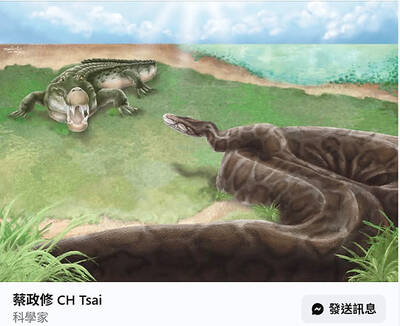
Taiwanese paleontologists have discovered fossil evidence that pythons up to 4m long inhabited Taiwan during the Pleistocene epoch, reporting their findings in the international scientific journal Historical Biology. National Taiwan University (NTU) Institute of Ecology and Evolutionary Biology associate professor Tsai Cheng-hsiu (蔡政修) led the team that discovered the largest snake fossil ever found in Taiwan. The single trunk vertebra was discovered in Tainan at the Chiting Formation, dated to between 400,000 and 800,000 years ago in the Middle Pleistocene, the paper said. The area also produced Taiwan’s first avian fossil, as well as crocodile, mammoth, saber-toothed cat and rhinoceros fossils, it said. Discoveries

Taiwanese paleontologists have discovered fossil evidence that pythons up to 4m long inhabited Taiwan during the Pleistocene epoch, reporting their findings in the international scientific journal Historical Biology. National Taiwan University (NTU) Institute of Ecology and Evolutionary Biology associate professor Tsai Cheng-hsiu (蔡政修) led the team that discovered the largest snake fossil ever found in Taiwan. A single trunk vertebra was discovered in Tainan at the Chiting Formation, dated to between 800,000 to 400,000 years ago in the Middle Pleistocene, the paper said. The area also produced Taiwan’s first avian fossil, as well as crocodile, mammoth, sabre-toothed cat and rhinoceros fossils, it said. Discoveries
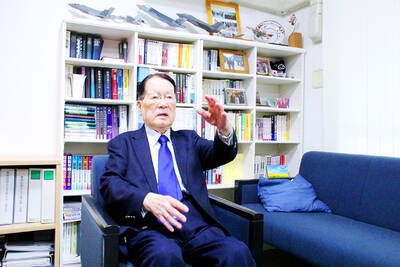
Whether Japan would help defend Taiwan in case of a cross-strait conflict would depend on the US and the extent to which Japan would be allowed to act under the US-Japan Security Treaty, former Japanese minister of defense Satoshi Morimoto said. As China has not given up on the idea of invading Taiwan by force, to what extent Japan could support US military action would hinge on Washington’s intention and its negotiation with Tokyo, Morimoto said in an interview with the Liberty Times (sister paper of the Taipei Times) yesterday. There has to be sufficient mutual recognition of how Japan could provide
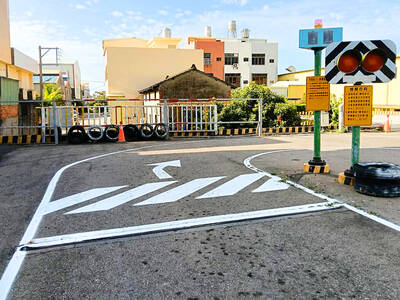
UPDATED TEST: The new rules aim to assess drivers’ awareness of risky behaviors and how they respond under certain circumstances, the Highway Bureau said Driver’s license applicants who fail to yield to pedestrians at intersections or to check blind spots, or omit pointing-and-calling procedures would fail the driving test, the Highway Bureau said yesterday. The change is set to be implemented at the end of the month, and is part of the bureau’s reform of the driving portion of the test, which has been criticized for failing to assess whether drivers can operate vehicles safely. Sedan drivers would be tested regarding yielding to pedestrians and turning their heads to check blind spots, while drivers of large vehicles would be tested on their familiarity with pointing-and-calling


 RSS
RSS