


A majority of Taiwanese are dissatisfied with President Ma Ying-jeou’s (馬英九) performance, with only 33 percent saying they are satisfied, a poll in the Chinese-language Global Views magazine showed yesterday.
The poll, conducted by the Global Views Survey Research Center, found 56.6 percent of respondents were not satisfied with Ma’s performance, up 4.6 percent from last month. Only 32.9 percent said they were satisfied with his performance, representing a 2.1 percent decrease.
The drop in Ma’s approval ratings was attributed to a series of blunders by his administration, including a controversial Council of Grand Justices nomination, its evasive position on the fate of the planned Kuokuang Petrochemical Park project and public doubt on the safety of nuclear power plants.
Although Ma’s level of trust grew 1.1 percent this month, it was still below 50 percent at 43.5 percent. The level of distrust dropped for the first time this year, but the decrease was marginal. As a result, Ma’s trust level was 43.5 percent against a distrust level of 42.6 percent.
On the performance of the -Chinese Nationalist Party (KMT), the poll showed that 56.3 percent of respondents said they were unhappy with the ruling party, which holds about 70 percent of the legislative seats, against 24.9 percent who said they were satisfied.
The figures represented a 2.4 percent decrease and 3 percent increase respectively.
Pollsters said the 3 percent growth in the satisfaction level could be related to the passage of the luxury tax, which is expected to come into force this summer.
The administration said it hoped the new tax would help rein in soaring housing prices, especially in Taipei.
The KMT’s approval ratings have hovered at about 20 percent since legislators began their current term in 2008.
On preferences for independence or unification, the poll found that 41.1 percent preferred the “status quo.” The number of respondents who favored independence stood at 27 percent, against 7.5 percent who were for unification with China and 12.4 percent who preferred a perpetual “status quo.”
Those choosing eventual independence — 49.3 percent — also exceeded those preferring eventual unification, at 15.7.
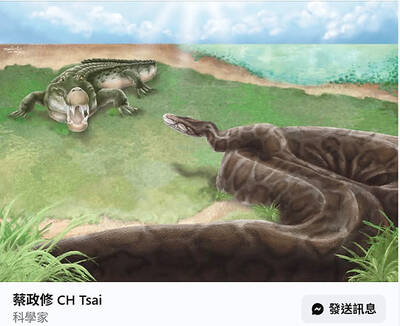
Taiwanese paleontologists have discovered fossil evidence that pythons up to 4m long inhabited Taiwan during the Pleistocene epoch, reporting their findings in the international scientific journal Historical Biology. National Taiwan University (NTU) Institute of Ecology and Evolutionary Biology associate professor Tsai Cheng-hsiu (蔡政修) led the team that discovered the largest snake fossil ever found in Taiwan. The single trunk vertebra was discovered in Tainan at the Chiting Formation, dated to between 400,000 and 800,000 years ago in the Middle Pleistocene, the paper said. The area also produced Taiwan’s first avian fossil, as well as crocodile, mammoth, saber-toothed cat and rhinoceros fossils, it said. Discoveries

Taiwanese paleontologists have discovered fossil evidence that pythons up to 4m long inhabited Taiwan during the Pleistocene epoch, reporting their findings in the international scientific journal Historical Biology. National Taiwan University (NTU) Institute of Ecology and Evolutionary Biology associate professor Tsai Cheng-hsiu (蔡政修) led the team that discovered the largest snake fossil ever found in Taiwan. A single trunk vertebra was discovered in Tainan at the Chiting Formation, dated to between 800,000 to 400,000 years ago in the Middle Pleistocene, the paper said. The area also produced Taiwan’s first avian fossil, as well as crocodile, mammoth, sabre-toothed cat and rhinoceros fossils, it said. Discoveries
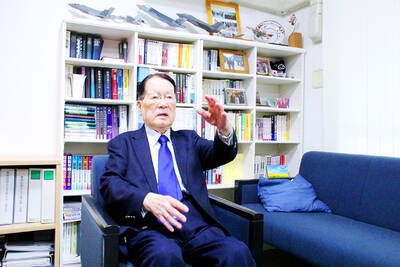
Whether Japan would help defend Taiwan in case of a cross-strait conflict would depend on the US and the extent to which Japan would be allowed to act under the US-Japan Security Treaty, former Japanese minister of defense Satoshi Morimoto said. As China has not given up on the idea of invading Taiwan by force, to what extent Japan could support US military action would hinge on Washington’s intention and its negotiation with Tokyo, Morimoto said in an interview with the Liberty Times (sister paper of the Taipei Times) yesterday. There has to be sufficient mutual recognition of how Japan could provide
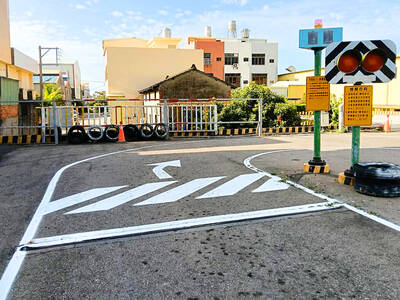
UPDATED TEST: The new rules aim to assess drivers’ awareness of risky behaviors and how they respond under certain circumstances, the Highway Bureau said Driver’s license applicants who fail to yield to pedestrians at intersections or to check blind spots, or omit pointing-and-calling procedures would fail the driving test, the Highway Bureau said yesterday. The change is set to be implemented at the end of the month, and is part of the bureau’s reform of the driving portion of the test, which has been criticized for failing to assess whether drivers can operate vehicles safely. Sedan drivers would be tested regarding yielding to pedestrians and turning their heads to check blind spots, while drivers of large vehicles would be tested on their familiarity with pointing-and-calling


 RSS
RSS