


Candidates offered some of their strongest and most passionate performances in yesterday’s final Democratic Progressive Party (DPP) televised policy session as all three kept to the strengths displayed so far in the campaign.
Although no major winners appeared from the session, the event was seen as a make-or-break appearance for the two frontrunners, Tsai Ing-wen (蔡英文) and Su Tseng-chang (蘇貞昌), struggling amid close poll numbers.
In the last session before the official polls are conducted to decide on the nominations, both expanded and clarified parts of their platforms that will play a key role in the general elections, including cross-strait and economic policies.
Hsu Hsin-liang (許信良), meanwhile, launched a fiery delivery on substantive policy measures he would take if elected president, including an invitation for Tsai to join his ticket. However, he acknowledged that a win would take a “miracle from God.”
The two-hour face-off consisted of questions asked by experts, as well as an extensive opening and closing period by the three candidates.
In his opening, Su described Taiwan as a vibrant, economically advanced country that has been kept down by international isolation and oppression from Beijing.
“Taiwanese can travel freely around the world, we can sell our goods all over the world, but are still unable to stand and sit as equals among the world’s nations,” Su said. “What we want is for Taiwan to be treated as an equal to China.”
Su emphasized his experience to say that he would seek to restructure Taiwan into a greater part of the global financial system and to strengthen relations with existing partners, instead of simply focusing on China.
Singaporean Minister Mentor Lee Kuan Yew (李光耀) met with him twice during a recent visit to Taiwan and the two shared an understanding that national interests could not run second to Chinese pressure, Su said.
“In order for Taiwan to change, it must maintain its dignity,” he said.
Tsai strengthened her rhetoric on her experience as a trade negotiator, pledging to further expand Taiwan’s international ties and its economy, calling them closely related to the country’s island culture.
However, carefully setting herself apart from President Ma Ying-jeou’s (馬英九) bid for greater cross-strait cooperation, she said Taiwan must decide “whether it wants to be at the center [of the world] or on the periphery of China.”
“When looking at cross-strait relations, we must put ourselves in an international framework and not be limited by a cross-strait framework,” she said.
A future administration would stand by the agreement, she suggested, but it would also look at other voices on how it would deal with its aftereffects.
Questions dealt mostly with softer domestic issues, including preparations for natural disasters and the balance between conservation and development, as well as remarks on the sex-trade industry.
Tsai and Su spoke briefly on the topics, but stressed that while the former DPP administration made mistakes, the DPP has since reflected and made changes to those policies to reflect modern realities.
Both Tsai and Su said the DPP would emphasize green planning and sustainable development. The two also agreed the country needed to refine its social welfare policies, but remained inconclusive on whether local municipalities should open up “red light” districts.
Through most of the session, Hsu, who is trailing heavily in polls, maintained his commitment to closer cross-strait ties. If elected, he said he would reduce the military, end Taiwan’s dollar diplomacy and look into modeling Taiwan after a “European social welfare state,” he said, adding he would nominate a “special ambassador to China.”
He would also push for former president Chen Shui-bian (陳水扁) to be granted a presidential pardon, arguing that the move would lower political tensions.
Absent yesterday from the last-ditch effort by Tsai and Su was any criticism of each other, consistent with past pleas to keep up party unity even as the DPP heads into its closest presidential primary race yet, judging by recent polls.
In emotional performances near the end of the session, the two used the closing remarks to stress that whether they win or lose the primaries, both would continue to support the DPP’s presidential campaign.
The DPP was more important than any one candidate, they said.
“Win or lose, we are all part of the same party … and I will never leave the party I helped found,” Su said. “The party is more important than one single person, but Taiwan is even more important than one single party. And we must unite the party and unite Taiwan.”
If he lost the primaries, he said, he would continue on as a “volunteer for Taiwan,” he said — stopping short of stating any concrete plans.
Tsai, meanwhile, also repeated her earlier remarks that all three candidates “represented the DPP” and praised the maturity of the primaries for avoiding the damaging splits that have characterized past party presidential candidate nominations.
“It’s a testament to the maturity of the DPP and to our primaries that we can have these policy sessions today,” she said.
The session is the last of four televised policy sessions that have largely continued the stalemate between Tsai and Su. The official telephone polls will start on Monday and a winner is expected as soon as Wednesday.
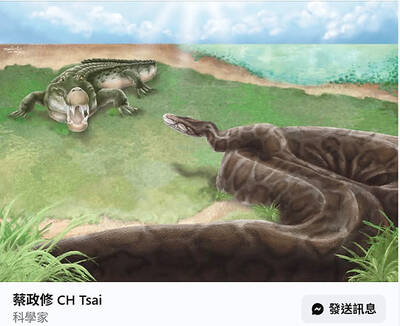
Taiwanese paleontologists have discovered fossil evidence that pythons up to 4m long inhabited Taiwan during the Pleistocene epoch, reporting their findings in the international scientific journal Historical Biology. National Taiwan University (NTU) Institute of Ecology and Evolutionary Biology associate professor Tsai Cheng-hsiu (蔡政修) led the team that discovered the largest snake fossil ever found in Taiwan. The single trunk vertebra was discovered in Tainan at the Chiting Formation, dated to between 400,000 and 800,000 years ago in the Middle Pleistocene, the paper said. The area also produced Taiwan’s first avian fossil, as well as crocodile, mammoth, saber-toothed cat and rhinoceros fossils, it said. Discoveries

Taiwanese paleontologists have discovered fossil evidence that pythons up to 4m long inhabited Taiwan during the Pleistocene epoch, reporting their findings in the international scientific journal Historical Biology. National Taiwan University (NTU) Institute of Ecology and Evolutionary Biology associate professor Tsai Cheng-hsiu (蔡政修) led the team that discovered the largest snake fossil ever found in Taiwan. A single trunk vertebra was discovered in Tainan at the Chiting Formation, dated to between 800,000 to 400,000 years ago in the Middle Pleistocene, the paper said. The area also produced Taiwan’s first avian fossil, as well as crocodile, mammoth, sabre-toothed cat and rhinoceros fossils, it said. Discoveries
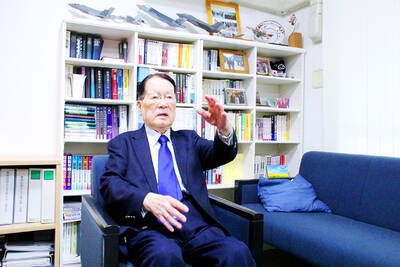
Whether Japan would help defend Taiwan in case of a cross-strait conflict would depend on the US and the extent to which Japan would be allowed to act under the US-Japan Security Treaty, former Japanese minister of defense Satoshi Morimoto said. As China has not given up on the idea of invading Taiwan by force, to what extent Japan could support US military action would hinge on Washington’s intention and its negotiation with Tokyo, Morimoto said in an interview with the Liberty Times (sister paper of the Taipei Times) yesterday. There has to be sufficient mutual recognition of how Japan could provide
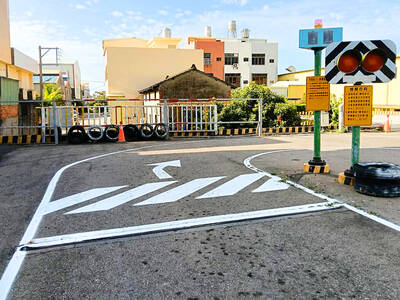
UPDATED TEST: The new rules aim to assess drivers’ awareness of risky behaviors and how they respond under certain circumstances, the Highway Bureau said Driver’s license applicants who fail to yield to pedestrians at intersections or to check blind spots, or omit pointing-and-calling procedures would fail the driving test, the Highway Bureau said yesterday. The change is set to be implemented at the end of the month, and is part of the bureau’s reform of the driving portion of the test, which has been criticized for failing to assess whether drivers can operate vehicles safely. Sedan drivers would be tested regarding yielding to pedestrians and turning their heads to check blind spots, while drivers of large vehicles would be tested on their familiarity with pointing-and-calling


 RSS
RSS