


Women’s groups and attorneys yesterday protested a Cabinet--approved amendment to the Criminal Code that would remove one of the criteria for an act to be considered a sexual assault and would raise the penalty for sex offenders, a move the groups said would only result in more offenders escaping punishment.
Amid public dissatisfaction with light verdicts for sex crimes, the Ministry of Justice has proposed an amendment to the Criminal Code. However, the proposed amendment has raised more questions than it has answered.
The amendment still pending legislative review, recommends raising the minimum penalty for sex crimes from three years in prison to five years. Also, it removes the objections of the victim as a criterion when considering whether a sexual assault occurred. Under current legislation, an encounter is considered a sexual assault if it can be proven the act was against the victim’s will or the victim objected.
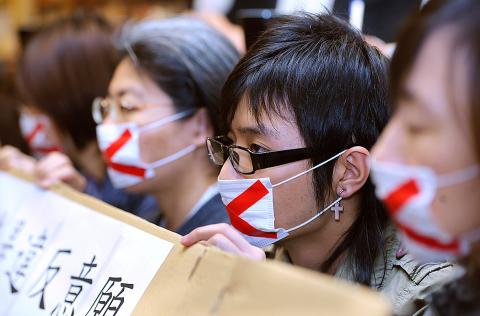
Photo: Liao Chen-huei, Taipei Times
In a written statement, the ministry said it had proposed deleting the criterion because when an offender sexually assaulted a victim, “the nature of the act was in violation of the victim’s will, hence, there is no need to include ‘the will of the victim’ as a criterion [for sexual assault] in law.”
If proof that the victim objected is written in the law as a criterion for judging whether a sexual act constituted sexual assault, “the action may not be considered a ‘sexual assault’ if it cannot be objectively proven that it was done in violation of the victim’s will,” the ministry said.
However, “the criterion should not be deleted so recklessly,” Lee Chao-huan (李兆環), an attorney and a researcher on children and young adult issues at the Taipei Bar Association, told a press conference in Taipei yesterday.
“What’s more important is raising gender awareness among judges and conducting thorough research on the issue,” she said.
On average, more than 70 percent of sexual assaults are perpetrated by people familiar with the victims, such as friends, colleagues, family members or relatives, and in many cases when a victim is raped by someone she or he knows, “the victim is either too shocked to react, or just succumbs without resisting,” Lee said.
“In such cases, you won’t find any ‘subjective’ evidence — such as wounds or screaming heard by witnesses — that the victim was raped,” she said.
However, Modern Women’s Association executive director Yao Shu-wen (姚淑文) said the amendment, if adopted by the legislature, could make matters worse.
Since it would become difficult to determine whether rape occurred because the victim would no longer be able to say whether she or he was unwilling during intercourse, prosecutors and judges could become more conservative in handing down guilty verdicts -because the new penalty would be more severe, Yao said.
As a result, “we will see more sex offenders escaping sanction,” Yao said.
Yu Mei-nu (尤美女), an attorney and a long-time women’s rights advocate, said government officials and lawmakers should not have the “conventional” image of a sex crime in mind when reviewing a case.
Yu said that the “conventional” image of a sex crime was a -scenario in which a woman is taken by a stranger by force in a car and driven to the middle of nowhere, while screaming and shouting “no” all the way.
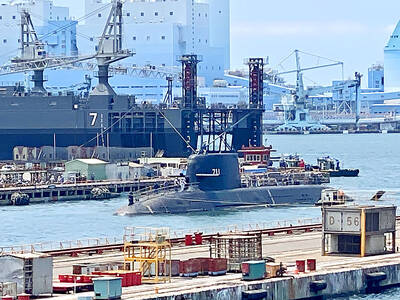
AGING: While Japan has 22 submarines, Taiwan only operates four, two of which were commissioned by the US in 1945 and 1946, and transferred to Taiwan in 1973 Taiwan would need at least 12 submarines to reach modern fleet capabilities, CSBC Corp, Taiwan chairman Chen Cheng-hung (陳政宏) said in an interview broadcast on Friday, citing a US assessment. CSBC is testing the nation’s first indigenous defense submarine, the Hai Kun (海鯤, Narwhal), which is scheduled to be delivered to the navy next month or in July. The Hai Kun has completed torpedo-firing tests and is scheduled to undergo overnight sea trials, Chen said on an SET TV military affairs program. Taiwan would require at least 12 submarines to establish a modern submarine force after assessing the nation’s operational environment and defense

A white king snake that frightened passengers and caused a stir on a Taipei MRT train on Friday evening has been claimed by its owner, who would be fined, Taipei Rapid Transit Corp (TRTC) said yesterday. A person on Threads posted that he thought he was lucky to find an empty row of seats on Friday after boarding a train on the Bannan (Blue) Line, only to spot a white snake with black stripes after sitting down. Startled, he jumped up, he wrote, describing the encounter as “terrifying.” “Taipei’s rat control plan: Release snakes on the metro,” one person wrote in reply, referring
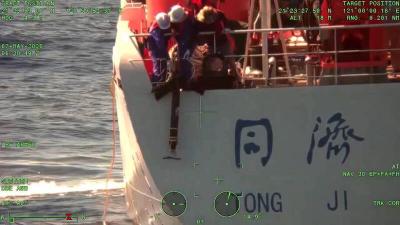
The coast guard today said that it had disrupted "illegal" operations by a Chinese research ship in waters close to the nation and driven it away, part of what Taipei sees a provocative pattern of China's stepped up maritime activities. The coast guard said that it on Thursday last week detected the Chinese ship Tongji (同濟號), which was commissioned only last year, 29 nautical miles (54km) southeast of the southern tip of Taiwan, although just outside restricted waters. The ship was observed lowering ropes into the water, suspected to be the deployment of scientific instruments for "illegal" survey operations, and the coast
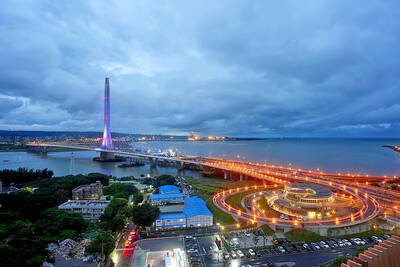
An inauguration ceremony was held yesterday for the Danjiang Bridge, the world’s longest single-mast asymmetric cable-stayed bridge, ahead of its official opening to traffic on Tuesday, marking a major milestone after nearly three decades of planning and construction. At the ceremony in New Taipei City attended by President William Lai (賴清德), Premier Cho Jung-tai (卓榮泰), Minister of Transportation and Communications Chen Shih-kai (陳世凱) and New Taipei City Mayor Hou Yu-ih (侯友宜), the bridge was hailed as both an engineering landmark and a long-awaited regional transport link connecting Tamsui (淡水) and Bali (八里)


 RSS
RSS