


Security cameras that could have helped identify two vans believed to have been the cause of an accident on Sunday night were of no help after it was discovered that they were not connected to a power source.
A 35-year-old scooter driver surnamed Hsu (徐) was left in a coma after trying to avoid two vans that allegedly made an illegal left turn at a red light on Minquan E Road in Taipei, witnesses said.
They said Hsu crashed into a sidewalk while avoiding the two vans, adding that the two drivers fled the scene.
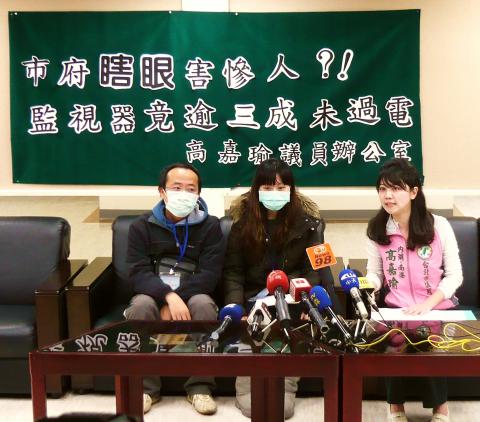
Photo: Huang Chung-jung, Taipei Times
After being contacted by police, Hsu’s wife asked to see a video of the accident from a surveillance camera at the scene. However, there was no video because the camera was not connected to a power source.
“The surveillance camera could have provided images of the vans and helped us find the drivers, but we are unable to do so because the Taipei City Government failed to connect the system to an electrical source,” she told a press conference at Taipei City Council yesterday.
Democratic Progressive Party (DPP) Taipei City Councilor Kao Chia-yu (高嘉瑜), who accompanied Hsu at the press conference, said 3,802 of the 13,699 surveillance cameras around the city were not connected to electrical outlets or wireless systems.
The site of the accident, on Minquan E Road Sec 6, was one of the 10 streets in the city with the highest traffic accident rate last year, she said.
However, only 61 of the 112 surveillance cameras installed along the area had power connections, she said.
“The city government pledged to reduce the crime rate by installing surveillance cameras around the city, but half are not functioning. How can this help improve public security if so many cameras are nothing but decorations?” Kao said.
The installation of surveillance cameras throughout 12 districts and at major crime hotspots was part of the “zero tolerance for crime” policy that Taipei Mayor Hau Lung-bin (郝龍斌) implemented to improve public safety.
The city government budgeted NT$160 million (US$5 million) to install the cameras and was originally scheduled to complete installation in January.
Chang Chiu-yi (張久宜), chief of the Taipei City Police Department’s Crime Prevention Division, acknowledged the delay in installation and said the 3,802 cameras had yet to be connected to power sources because they were located on roads that were recently resurfaced — part of another major policy of the Hau administration, improving roads.
As the installation of surveillance camera power connections involves digging up roads, contractors are required to apply with the city government before such work can be carried out.
Chang said the department was negotiating with the city government and the contractor to accelerate the underground construction that will connect the cameras to power sources and would seek to complete the project by the end of this year.

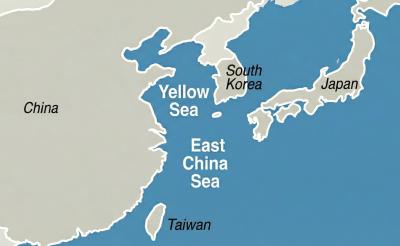
China has reserved offshore airspace in the Yellow Sea and East China Sea from March 27 to May 6, issuing alerts usually used to warn of military exercises, although no such exercises have been announced, the Wall Street Journal (WSJ) reported yesterday. Reserving such a large area for 40 days without explanation is an “unusual step,” as military exercises normally only last a few days, the paper said. These alerts, known as Notice to Air Missions (Notams), “are intended to inform pilots and aviation authorities of temporary airspace hazards or restrictions,” the article said. The airspace reserved in the alert is

South Korea is planning to revise its controversial electronic arrival card, a step Taiwanese officials said prompted them to hold off on planned retaliatory measures, a South Korean media report said yesterday. A Yonhap News Agency report said that the South Korean Ministry of Foreign Affairs is planning to remove the “previous departure place” and “next destination” fields from its e-arrival card system. The plan, reached after interagency consultations, is under review and aims to simplify entry procedures and align the electronic form with the paper version, a South Korean ministry official said. The fields — which appeared only on the electronic form
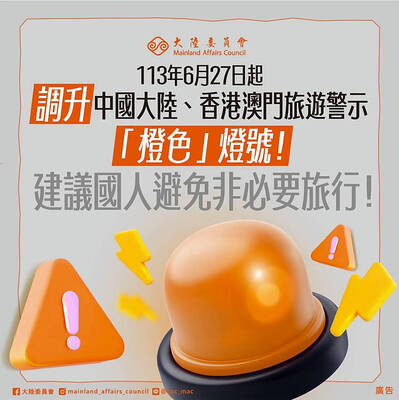
More than 6,000 Taiwanese students have participated in exchange programs in China over the past two years, despite the Mainland Affairs Council’s (MAC) “orange light” travel advisory, government records showed. The MAC’s publicly available registry showed that Taiwanese college and university students who went on exchange programs across the Strait numbered 3,592 and 2,966 people respectively. The National Immigration Agency data revealed that 2,296 and 2,551 Chinese students visited Taiwan for study in the same two years. A review of the Web sites of publicly-run universities and colleges showed that Taiwanese higher education institutions continued to recruit students for Chinese educational programs without

A bipartisan group of US senators has introduced a bill to enhance cooperation with Taiwan on drone development and to reduce reliance on supply chains linked to China. The proposed Blue Skies for Taiwan Act of 2026 was introduced by Republican US senators Ted Cruz and John Curtis, and Democratic US senators Jeff Merkley and Andy Kim. The legislation seeks to ease constraints on Taiwan-US cooperation in uncrewed aerial systems (UAS), including dependence on China-sourced components, limited access to capital and regulatory barriers under US export controls, a news release issued by Cruz on Wednesday said. The bill would establish a "Blue UAS


 RSS
RSS