


The Ministry of Education has instructed schools at all levels to carry out disaster drills before the end of June as part of the government’s effort to improve disaster preparedness, Minister of Education Wu Ching-ji (吳清基) said on Thursday.
The drills will be one of the criteria used to evaluate schools’ performance, Wu said after a meeting called by President Ma Ying-jeou (馬英九) on Thursday in response to the March 11 earthquake and tsunami in Japan.
The ministry also instructed schools located near nuclear power plants in New Taipei City (新北市) and Pingtung County to conduct regular nuclear disaster drills to raise awareness about the potential for a nuclear accident, he said.
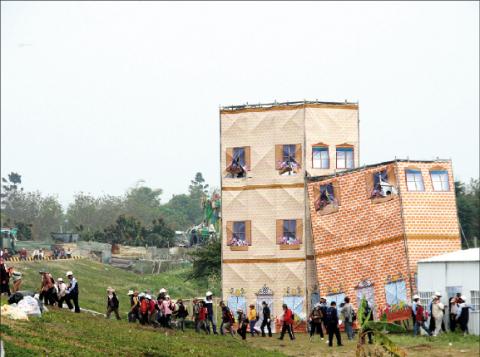
Photo: CNA
Wu said current regulations require that schools be built to withstand earthquakes measuring up to a magnitude 6, but the standard would be raised to a magnitude 7 — the highest level on the Central Weather Bureau’s scale — to guard against schools collapsing in the event of a powerful earthquake.
Deputy Minister of Education Chen Yi-hsing (陳益興) said emergency protective measures would be initiated at all schools if radioactive contaminants from Japan’s recent nuclear accident began to affect Taiwan.
These measures would include suspending all outdoor activities, closing windows tightly, wearing raincoats, rain gear and masks, and refraining from consuming water and food that had been exposed to the air, Chen said.
Separately, Premier Wu Den-yih (吳敦義) said that architects and building structure experts would be invited to study how strong an earthquake would need to be in order to knock down the Presidential Office, which was constructed in 1919.
The biggest earthquake to strike Taiwan was the magnitude 7.6 temblor that ravaged central Taiwan in 1999.
He said he did not know whether the Japanese-built building would be able to resist a quake bigger than that.
The premier added that he would launch a comprehensive review into the quake-resistance level of other major buildings around the country.
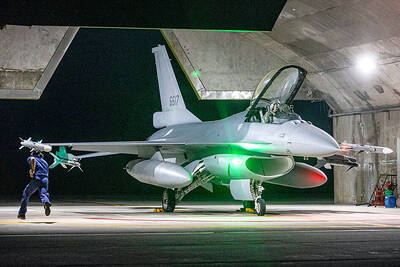
Taiwan has received more than US$70 million in royalties as of the end of last year from developing the F-16V jet as countries worldwide purchase or upgrade to this popular model, government and military officials said on Saturday. Taiwan funded the development of the F-16V jet and ended up the sole investor as other countries withdrew from the program. Now the F-16V is increasingly popular and countries must pay Taiwan a percentage in royalties when they purchase new F-16V aircraft or upgrade older F-16 models. The next five years are expected to be the peak for these royalties, with Taiwan potentially earning
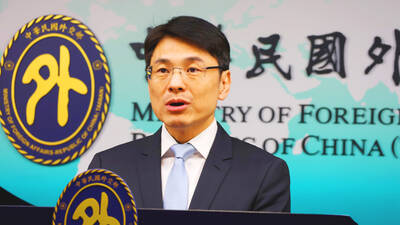
STAY IN YOUR LANE: As the US and Israel attack Iran, the ministry has warned China not to overstep by including Taiwanese citizens in its evacuation orders The Ministry of Foreign Affairs (MOFA) yesterday rebuked a statement by China’s embassy in Israel that it would evacuate Taiwanese holders of Chinese travel documents from Israel amid the latter’s escalating conflict with Iran. Tensions have risen across the Middle East in the wake of US and Israeli airstrikes on Iran beginning Saturday. China subsequently issued an evacuation notice for its citizens. In a news release, the Chinese embassy in Israel said holders of “Taiwan compatriot permits (台胞證)” issued to Taiwanese nationals by Chinese authorities for travel to China — could register for evacuation to Egypt. In Taipei, the ministry yesterday said Taiwan
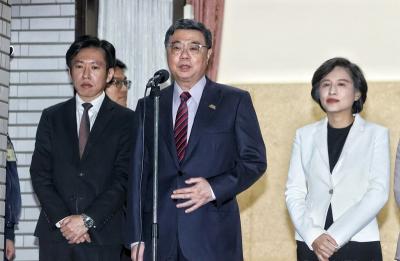
Taiwan is awaiting official notification from the US regarding the status of the Agreement on Reciprocal Trade (ART) after the US Supreme Court ruled US President Donald Trump's global tariffs unconstitutional. Speaking to reporters before a legislative hearing today, Premier Cho Jung-tai (卓榮泰) said that Taiwan's negotiation team remains focused on ensuring that the bilateral trade deal remains intact despite the legal challenge to Trump's tariff policy. "The US has pledged to notify its trade partners once the subsequent administrative and legal processes are finalized, and that certainly includes Taiwan," Cho said when asked about opposition parties’ doubts that the ART was
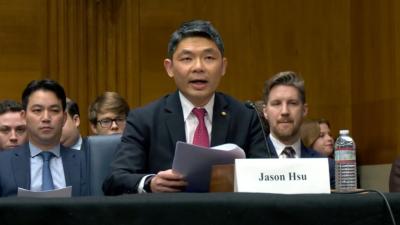
If China chose to invade Taiwan tomorrow, it would only have to sever three undersea fiber-optic cable clusters to cause a data blackout, Jason Hsu (許毓仁), a senior fellow at the Hudson Institute and former Chinese Nationalist Party (KMT) legislator, told a US security panel yesterday. In a Taiwan contingency, cable disruption would be one of the earliest preinvasion actions and the signal that escalation had begun, he said, adding that Taiwan’s current cable repair capabilities are insufficient. The US-China Economic and Security Review Commission (USCC) yesterday held a hearing on US-China Competition Under the Sea, with Hsu speaking on


 RSS
RSS