


With all eyes fixed on the ongoing emergency relief efforts in Japan, the Animal and Plant Health Inspection and Quarantine Bureau rang the alarm on the possibility that influenza A(H5N1) infections could be brought to Taiwan via fowl from Japan and South Korea.
Bureau director Hsu Tien-lai (許天來) said World Organization for Animal Health (OIE) records showed that from January through March 11, H5N1, also known as avian flu, had spread in 22 farms across eight prefectures in Japan and 48 farms across four provinces in South Korea. To date, 1.77 million chickens in Japan and 1.14 million in South Korea have been culled amid attempts to mitigate the outbreak.
While the outbreak in Japan was limited to chickens, in South Korea H5N1 had spread from water fowl to chicken and ducks, Hsu said.
This shows that the virus is highly contagious in all sorts of fowl, Hsu said, calling for preventive measures to be taken by poultry farms in Taiwan.
The bureau said poultry farms should step up animal health inspections and take appropriate measures, such as limiting pass-through of staff and vehicles, decontamination, staff safety protection, maintenance or establishment of measures to prevent wild birds flying in and sample taking.
If fowl show odd symptoms or are suspected of having avian flu, they should immediately be quarantined and reported to local animal disease prevention centers to prevent -further outbreaks, the bureau said.
Bureau officials called on the public to report any known cases of smuggled fowl or fowl-related products from infected areas in South Korea, Japan and Vietnam, another high-risk country. The Statute for Prevention and Control of Infectious Animal Disease (動物傳染病防治條例) stipulates that willful concealment of influenza outbreaks can result in fines of between NT$10,000 and NT$50,000 (US$338 to US$1,692).
Smuggling of interdicted fowl can result in seven years’ imprisonment and fines of up to NT$3 million. Vehicles used for smuggling can also be impounded.

LOUD AND PROUD Taiwan might have taken a drubbing against Australia and Japan, but you might not know it from the enthusiasm and numbers of the fans Taiwan might not be expected to win the World Baseball Classic (WBC) but their fans are making their presence felt in Tokyo, with tens of thousands decked out in the team’s blue, blowing horns and singing songs. Taiwanese fans have packed out the Tokyo Dome for all three of their games so far and even threatened to drown out home team supporters when their team played Japan on Friday. They blew trumpets, chanted for their favorite players and had their own cheerleading squad who dance on a stage during the game. The team struggled to match that exuberance on the field, with
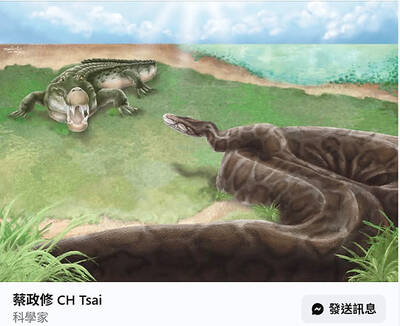
Taiwanese paleontologists have discovered fossil evidence that pythons up to 4m long inhabited Taiwan during the Pleistocene epoch, reporting their findings in the international scientific journal Historical Biology. National Taiwan University (NTU) Institute of Ecology and Evolutionary Biology associate professor Tsai Cheng-hsiu (蔡政修) led the team that discovered the largest snake fossil ever found in Taiwan. The single trunk vertebra was discovered in Tainan at the Chiting Formation, dated to between 400,000 and 800,000 years ago in the Middle Pleistocene, the paper said. The area also produced Taiwan’s first avian fossil, as well as crocodile, mammoth, saber-toothed cat and rhinoceros fossils, it said. Discoveries

Taiwanese paleontologists have discovered fossil evidence that pythons up to 4m long inhabited Taiwan during the Pleistocene epoch, reporting their findings in the international scientific journal Historical Biology. National Taiwan University (NTU) Institute of Ecology and Evolutionary Biology associate professor Tsai Cheng-hsiu (蔡政修) led the team that discovered the largest snake fossil ever found in Taiwan. A single trunk vertebra was discovered in Tainan at the Chiting Formation, dated to between 800,000 to 400,000 years ago in the Middle Pleistocene, the paper said. The area also produced Taiwan’s first avian fossil, as well as crocodile, mammoth, sabre-toothed cat and rhinoceros fossils, it said. Discoveries

Whether Japan would help defend Taiwan in case of a cross-strait conflict would depend on the US and the extent to which Japan would be allowed to act under the US-Japan Security Treaty, former Japanese minister of defense Satoshi Morimoto said. As China has not given up on the idea of invading Taiwan by force, to what extent Japan could support US military action would hinge on Washington’s intention and its negotiation with Tokyo, Morimoto said in an interview with the Liberty Times (sister paper of the Taipei Times) yesterday. There has to be sufficient mutual recognition of how Japan could provide


 RSS
RSS