


A survey of recent price hikes on consumer products showed that prices for cooking oil, infant formula, beverages and tissue paper last month rose between 8 percent and 24 percent from January, the Consumers’ Foundation said yesterday. The foundation urged the government to actively investigate possible price-fixing and collusion.
The consumer rights watchdog said that while businesses have attributed price hikes to the rising global cost of raw materials, such claims should be viewed with skepticism, as businesses rarely cut prices when global raw materials prices fall.
Volunteers at the foundation checked the prices of goods sold at supermarkets and grocery stores around the country and found that compared with prices in January, the price of cooking oil, powdered infant formula, beverages and tissue paper all increased -significantly last month.
Beverages accounted for the largest average increase in price, at 24 percent, while there was a significant price rise of about 12 percent for cooking oil and powdered infant formula. Prices of various brands of tissue paper also rose by about 8 percent, the foundation said.
Foundation chairperson Joann Su (蘇錦霞) called on the Fair Trade Commission to actively investigate possible price-fixing by companies such as makers of instant noodles, whose products have risen by between 10 percent and 30 percent in price, depending on the type of noodles and distribution channel.
“The commission should publicly announce increases in the price of staple products,” Su said. “Doing so would not only give consumers a convenient point of reference when shopping for groceries, but would also deter businesses from raising prices by unreasonable amounts.”
The foundation called on the commission to monitor price fluctuations to maintain a certain level of price stability for consumers.
In response, the commission said it would investigate violations of the Fair Trade Act (公平交易法) and crack down on collusion if any such activity was determined to have occurred.
Those found to be in violation of the act could be fined between NT$50,000 (US$1,697) and NT$25 million.
The commission also said it would seek to determine whether the price hikes represented reasonable adjustments reflecting rising costs in raw materials by looking at the cost of the goods and the operating costs of retailers stocking them.

In a historic first, Taiwanese officials participated in this year’s Riga Strategic Communications Dialogue in Latvia from Wednesday to Friday last week, which debuted a breakout session focused on Taiwan The event organizer, the NATO Strategic Communications Center of Excellence, displayed Taiwan’s national flag and the officials’ formal titles on their Web site. Taiwanese attendees included National Security Council (NSC) Deputy Secretary-General Lin Fei-fan (林飛帆) and deputy head of the Taipei Representative Office in the UK, Chiang Ya-chi (江雅綺). In addition to the session discussing Taiwan titled “Taiwan: Navigating Strategic Communication in a Tense Environment,” the dialogue also included sessions
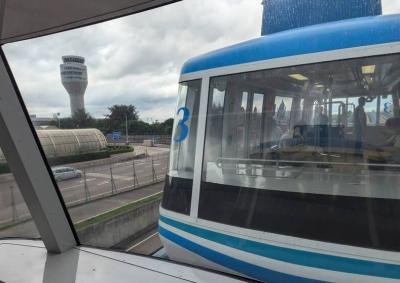
Taiwan Taoyuan International Airport is to suspend its automated Skytrain service connecting Terminal 1 and Terminal 2 starting on July 1 to facilitate connection works for the upcoming Terminal 3, the airport operator said today. Passengers and staff who need to travel between the two terminals after the suspension can instead use the Taoyuan MRT or the airport's 24-hour shuttle bus service, Taoyuan International Airport Corp said. The Taoyuan MRT Airport Line directly links the two terminals, while the shuttle buses are to operate around the clock, the company added. The Skytrain provides free transportation between the airport’s two terminals for travelers and
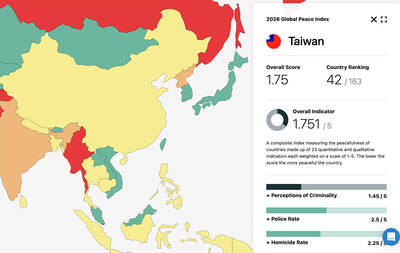
Taiwan ranked 42nd in terms of peacefulness among 163 countries, down five places from last year, according to this year’s Global Peace Index. With an overall score of 1.751, Taiwan dropped from 37th last year, the report published by the global Institute for Economics and Peace showed. The overall score measures a country’s level of peacefulness using 23 quantitative and qualitative indicators across three domains — ongoing domestic and international conflict, societal safety and security, and militarization. While Taiwan ranked 42nd worldwide, it was listed in ninth place among the 19 Asian-Pacific countries in the report, after New Zealand, Singapore, Japan, Malaysia,
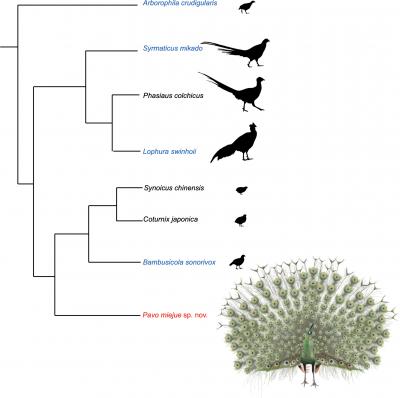
Through analyzing fossil evidence, a research team at National Taiwan University (NTU) discovered the largest endemic bird to have lived in Taiwan, naming it Pavo miejue, or extinct peafowl (滅絕孔雀). The Mikado pheasant, which is printed on the back of the NT$1,000 bank note, was previously believed to be the biggest endemic bird to Taiwan. The research team’s findings suggest that Pavo miejue lived during the Pleistocene epoch tens of thousands of years ago. It is the first endemic extinct bird species discovered and formally named in Taiwan. The study was coauthored by NTU Institute of Ecology and Evolutionary Biology professor Tsai Cheng-hsiu (蔡政修),


 RSS
RSS