


People could soon be able to purchase airplane and boat tickets at chain convenience stores nationwide after lawmakers yesterday gave preliminary approval to an amendment to the Act for the Development of Tourism (發展觀光條例).
Chinese Nationalist Party (KMT) Legislator Chen Ken-te (陳根德), who presided over a meeting of the Transportation Committee, said the amendment needed no further negotiation between the two main political parties.
“We hope the bill can be passed quickly this legislative session,” Chen said, adding that if passed, the measure could be implemented within a month.
UNI AIR
The amendment was proposed by KMT Legislator Tsao Erh-chang (曹爾忠) and 21 other lawmakers after Uni Air’s announcement in September last year that people could purchase the plane tickets at convenience stores triggered a controversy in the travel industry.
The Travel Agent Association of ROC, Taiwan, protested the airline’s move, saying the law did not allow convenience stores to sell plane tickets.
Article 27 of the Act stipulates that businesses other than travel agencies may not undertake the operations of a travel agency.
However, the resale of land transportation tickets necessary for daily traffic needs is not subject to the act’s restrictions.
EXPANDING SERVICES
Tsao’s amendment would expand the scope of ticket sales from land transportation to include air and sea transportation, thereby adding to the quickly growing number of services that can be purchased at convenience stores nationwide.
In February last year, Family Mart announced that tickets for the high-speed rail could be bought at its outlets nationwide, either by using the ticket kiosks in the stores or by making reservations online and paying them at the store.
Additional reporting by staff writer
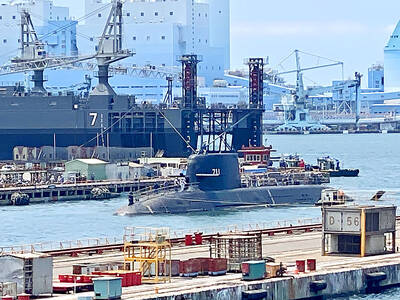
AGING: While Japan has 22 submarines, Taiwan only operates four, two of which were commissioned by the US in 1945 and 1946, and transferred to Taiwan in 1973 Taiwan would need at least 12 submarines to reach modern fleet capabilities, CSBC Corp, Taiwan chairman Chen Cheng-hung (陳政宏) said in an interview broadcast on Friday, citing a US assessment. CSBC is testing the nation’s first indigenous defense submarine, the Hai Kun (海鯤, Narwhal), which is scheduled to be delivered to the navy next month or in July. The Hai Kun has completed torpedo-firing tests and is scheduled to undergo overnight sea trials, Chen said on an SET TV military affairs program. Taiwan would require at least 12 submarines to establish a modern submarine force after assessing the nation’s operational environment and defense
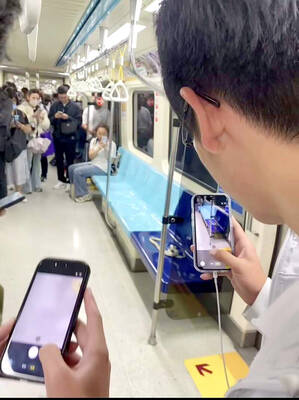
A white king snake that frightened passengers and caused a stir on a Taipei MRT train on Friday evening has been claimed by its owner, who would be fined, Taipei Rapid Transit Corp (TRTC) said yesterday. A person on Threads posted that he thought he was lucky to find an empty row of seats on Friday after boarding a train on the Bannan (Blue) Line, only to spot a white snake with black stripes after sitting down. Startled, he jumped up, he wrote, describing the encounter as “terrifying.” “Taipei’s rat control plan: Release snakes on the metro,” one person wrote in reply, referring
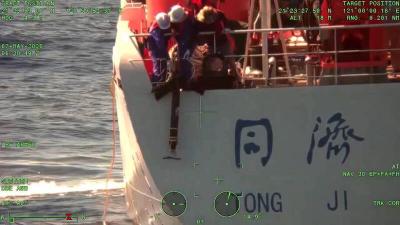
The coast guard today said that it had disrupted "illegal" operations by a Chinese research ship in waters close to the nation and driven it away, part of what Taipei sees a provocative pattern of China's stepped up maritime activities. The coast guard said that it on Thursday last week detected the Chinese ship Tongji (同濟號), which was commissioned only last year, 29 nautical miles (54km) southeast of the southern tip of Taiwan, although just outside restricted waters. The ship was observed lowering ropes into the water, suspected to be the deployment of scientific instruments for "illegal" survey operations, and the coast

Yangmingshan National Park authorities yesterday urged visitors to respect public spaces and obey the law after a couple was caught on a camera livestream having sex at the park’s Qingtiangang (擎天崗) earlier in the day. The Shilin Police Precinct in Taipei said it has identified a suspect and his vehicle registration number, and would summon him for questioning. The case would be handled in accordance with public indecency charges, it added. The couple entered the park at about 11pm on Thursday and began fooling around by 1am yesterday, the police said, adding that the two were unaware of the park’s all-day live


 RSS
RSS