


A Ministry of National Defense official yesterday said Taiwan planned to slash the number of its troops by 9,200 this year amid warming ties with China, adding that the cut would be offset by more advanced weaponry.
The reduction is part of a five-year plan aimed at trimming the size of Taiwan’s armed forces by 60,000, or more than 20 percent from the present level of 275,000 troops.
However, the ministry said Taiwan’s defensive capabilities would not be undermined as it seeks more high-tech and powerful weapons.
“The era of maintaining huge numbers of armed forces has gone. Defense capability is no longer determined by the number of troops,” a ministry spokesman said.
The news came in the wake of reports last week that China’s official military budget was set to rise about 13 percent to 601.1 billion yuan (US$91.7 billion).
China’s buildup is widely seen by analysts as directed in large part at Taiwan.
Despite easing tensions with China, President Ma Ying-jeou (馬英九) has said Taiwan needs to maintain sufficient forces for self-defense while pressing for dialogue with Beijing.
In January last year, the US government announced it had notified Congress of a weapons package for Taiwan that included Patriot missiles, Black Hawk helicopters and equipment to modernize Taiwan’s ageing F-16A/B fleet.
The Ma administration also continues to pressure Washington to sell it more advanced F-16C/D aircraft.
Legislators have expressed concern over the nation’s decreasing military budget, saying it paled in comparison with China’s boost to military spending and was insufficient to meet the country’s security needs.
During his presidential election campaign in 2008, Ma pledged that Taiwan would complete the implementation of an all-volunteer military by 2014 and that the military budget would be equal to at least 3 percent of GDP.
However, Chinese Nationalist Party (KMT) Legislator Chang Hsien-yao (張顯耀) said at a legislative hearing that the ministry had failed to meet the 3 percent target and expressed concern that the ongoing transformation to an all-volunteer force would drive up personnel costs.
“That [personnel costs] will crowd out spending on logistics and military procurement if there is no increase in our overall military budget,” Chang said.
Questions over the military budget’s adequacy were brought into focus in a missile drill in the middle of January when fewer than 70 percent of the missiles launched hit their targets.
At the time, lawmakers blamed the poor performance on a shortage of funding for logistics and maintenance. The problem will persist if things do not change, Chang said, because personnel costs will account for half of the country’s military budget by 2014.
Minister of National Defense Kao Hua-chu (高華柱) acknowledged that funding shortfalls had hurt maintenance, citing weapons systems purchased with a special budget that did not receive enough subsequent funding for maintenance.
Chang said that if the ministry were not able to increase its budget, it would have to adjust funding in each budget category, most likely requiring a dramatic reduction in personnel costs. Doing that, however, would impede the president’s all-volunteer military pledge.
The nation’s defense budget has fallen over the past three years, from US$10.4 billion in 2008 to US$9.6 billion in 2009 and US$9.3 billion last year.
The NT$297.2 billion (US$10 billion) budget for this year represents 2.2 percent of the nation’s estimated GDP of NT$13.73 trillion.
Though the budget for this year has already been approved, KMT Legislator Shuai Hua-min (帥化民), who is also co-convener of the Foreign and National Defense Affairs Committee, said the ministry’s budget for next year would be rejected if it was less than 3 percent of GDP.

A preclearance service to facilitate entry for people traveling to select airports in Japan would be available from Thursday next week to Feb. 25 at Taiwan Taoyuan International Airport, Taoyuan International Airport Corp (TIAC) said on Tuesday. The service was first made available to Taiwanese travelers throughout the winter vacation of 2024 and during the Lunar New Year holiday. In addition to flights to the Japanese cities of Hakodate, Asahikawa, Akita, Sendai, Niigata, Okayama, Takamatsu, Kumamoto and Kagoshima, the service would be available to travelers to Kobe and Oita. The service can be accessed by passengers of 15 flight routes operated by
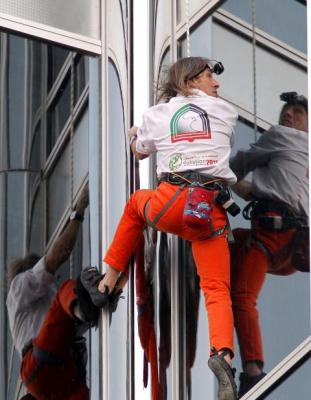
Alain Robert, known as the "French Spider-Man," praised Alex Honnold as exceptionally well-prepared after the US climber completed a free solo ascent of Taipei 101 yesterday. Robert said Honnold's ascent of the 508m-tall skyscraper in just more than one-and-a-half hours without using safety ropes or equipment was a remarkable achievement. "This is my life," he said in an interview conducted in French, adding that he liked the feeling of being "on the edge of danger." The 63-year-old Frenchman climbed Taipei 101 using ropes in December 2004, taking about four hours to reach the top. On a one-to-10 scale of difficulty, Robert said Taipei 101

Taiwanese and US defense groups are collaborating to introduce deployable, semi-autonomous manufacturing systems for drones and components in a boost to the nation’s supply chain resilience. Taiwan’s G-Tech Optroelectronics Corp subsidiary GTOC and the US’ Aerkomm Inc on Friday announced an agreement with fellow US-based Firestorm Lab to adopt the latter’s xCell, a technology featuring 3D printers fitted in 6.1m container units. The systems enable aerial platforms and parts to be produced in high volumes from dispersed nodes capable of rapid redeployment, to minimize the risk of enemy strikes and to meet field requirements, they said. Firestorm chief technology officer Ian Muceus said
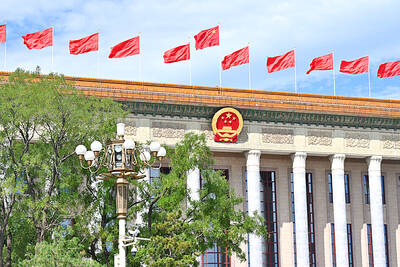
MORE FALL: An investigation into one of Xi’s key cronies, part of a broader ‘anti-corruption’ drive, indicates that he might have a deep distrust in the military, an expert said China’s latest military purge underscores systemic risks in its shift from collective leadership to sole rule under Chinese President Xi Jinping (習近平), and could disrupt its chain of command and military capabilities, a national security official said yesterday. If decisionmaking within the Chinese Communist Party has become “irrational” under one-man rule, the Taiwan Strait and the regional situation must be approached with extreme caution, given unforeseen risks, they added. The anonymous official made the remarks as China’s Central Military Commission Vice Chairman Zhang Youxia (張又俠) and Joint Staff Department Chief of Staff Liu Zhenli (劉振立) were reportedly being investigated for suspected “serious


 RSS
RSS