


The upcoming visit by a top Chinese envoy to central and southern Taiwan is a Chinese political tactic and highlights Beijing’s lack of confidence in President Ma Ying-jeou’s (馬英九) chances of getting re-elected next year, academics told a forum yesterday.
Lin Cheng-yi (林正義), a researcher at the Institute of European and American Studies at Academia Sinica, said the visit by Association for Relations Across the Taiwan Strait (ARATS) Chairman Chen Yunlin (陳雲林), who is arriving today, was politically significant because he would be visiting parts of the country that are considered to be more sympathetic to the Democratic Progressive Party (DPP).
“Although his sightseeing tour has been billed as business and economic in nature, the decision to skip Greater Tainan was made out of political consideration and had a lot to do with Zhang Mingqing (張銘清),” Lin told the forum on cross-strait affairs organized by Taiwan Brain Trust, a think tank.
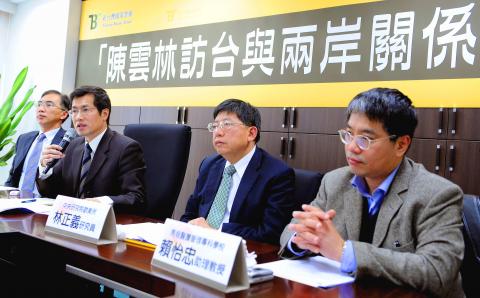
Photo: Chu Pei-hsiung, Taipei Times
Zhang, the deputy chairman of ARATS, visited the Confucius Temple in Tainan in October 2008, where he had a close encounter with pro-independence politicians and advocates. Amid some jostling, the envoy fell to the ground, though it was unclear whether he tripped or was pushed.
Lai I-chung (賴怡忠), a researcher at Taiwan Thinktank, said Chen’s visit to central and southern Taiwan showed China’s lack of confidence in Ma’s chances of being re-elected next year.
After the special-municipality elections in November last year, Lai said Beijing realized it could not pin all its hopes on Ma winning the presidential poll.
“[As a result] they’re sending Chen to take things into its own hands,” Lai said.
“If Ma fails in his re-election bid, China will at least have something to fall back on,” Lai said.
China also made sure that Chen’s arrival and the start of the cross-strait Economic Cooperation Committee meeting would not take place at the same time, Lai said.
The committee meeting started yesterday.
By doing so, it could draw attention away from the committee, allowing it to evade the scrutiny of the legislature and undermine the functions of the Mainland Affairs Council (MAC) and Straits Exchange Foundation (SEF).
Tung Li-wen (董立文), a professor at the Graduate School of Public Security at Central Police University, said not only would the committee dictate future trade talks, but it would also weaken the functions of the MAC and the SEF.
Moreover, by bypassing legislative oversight, it could become a future conduit for political negotiations, Tung said.
He added that the committee could also become a “fourth track” communication channel between the Chinese Nationalist Party (KMT) and the Chinese Communist Party.
Taiwan Brain Trust chief executive Lo Chih-cheng (羅致政) said Chen’s visit was politically motivated and carefully choreographed.
“China is using its economic means in exchange for political gains,” Lo said.
“China’s purpose is clear: Do whatever it can to help Ma consolidate his power and win his re-election bid in 2012,” Lo said.
Aside from the locations Chen is expected to visit, Lo said the timing of the visit was interesting, coming as it does days before the 64th anniversary of the 228 Incident on Feb. 28.
The 228 Incident refers to a government crackdown on Feb. 28, 1947, in which thousands of protesters were killed by KMT security forces.
“China’s every move is premeditated and is never a spur-of-the-moment decision,” he said.
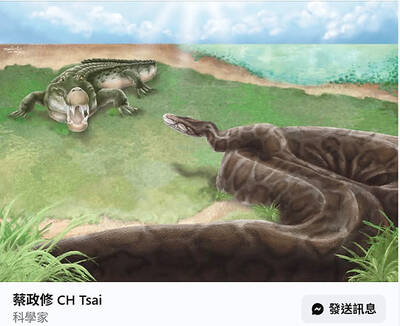
Taiwanese paleontologists have discovered fossil evidence that pythons up to 4m long inhabited Taiwan during the Pleistocene epoch, reporting their findings in the international scientific journal Historical Biology. National Taiwan University (NTU) Institute of Ecology and Evolutionary Biology associate professor Tsai Cheng-hsiu (蔡政修) led the team that discovered the largest snake fossil ever found in Taiwan. The single trunk vertebra was discovered in Tainan at the Chiting Formation, dated to between 400,000 and 800,000 years ago in the Middle Pleistocene, the paper said. The area also produced Taiwan’s first avian fossil, as well as crocodile, mammoth, saber-toothed cat and rhinoceros fossils, it said. Discoveries

Taiwanese paleontologists have discovered fossil evidence that pythons up to 4m long inhabited Taiwan during the Pleistocene epoch, reporting their findings in the international scientific journal Historical Biology. National Taiwan University (NTU) Institute of Ecology and Evolutionary Biology associate professor Tsai Cheng-hsiu (蔡政修) led the team that discovered the largest snake fossil ever found in Taiwan. A single trunk vertebra was discovered in Tainan at the Chiting Formation, dated to between 800,000 to 400,000 years ago in the Middle Pleistocene, the paper said. The area also produced Taiwan’s first avian fossil, as well as crocodile, mammoth, sabre-toothed cat and rhinoceros fossils, it said. Discoveries
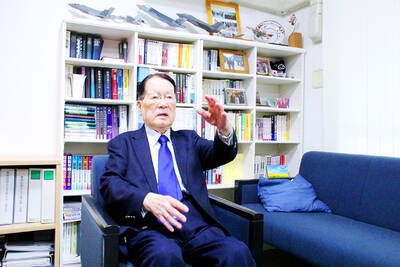
Whether Japan would help defend Taiwan in case of a cross-strait conflict would depend on the US and the extent to which Japan would be allowed to act under the US-Japan Security Treaty, former Japanese minister of defense Satoshi Morimoto said. As China has not given up on the idea of invading Taiwan by force, to what extent Japan could support US military action would hinge on Washington’s intention and its negotiation with Tokyo, Morimoto said in an interview with the Liberty Times (sister paper of the Taipei Times) yesterday. There has to be sufficient mutual recognition of how Japan could provide
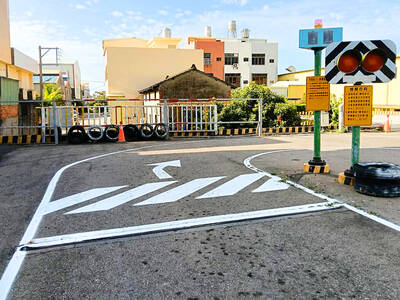
UPDATED TEST: The new rules aim to assess drivers’ awareness of risky behaviors and how they respond under certain circumstances, the Highway Bureau said Driver’s license applicants who fail to yield to pedestrians at intersections or to check blind spots, or omit pointing-and-calling procedures would fail the driving test, the Highway Bureau said yesterday. The change is set to be implemented at the end of the month, and is part of the bureau’s reform of the driving portion of the test, which has been criticized for failing to assess whether drivers can operate vehicles safely. Sedan drivers would be tested regarding yielding to pedestrians and turning their heads to check blind spots, while drivers of large vehicles would be tested on their familiarity with pointing-and-calling


 RSS
RSS