


The authorities were strangling free speech when the Presidential Office voiced support for a former minister in a controversial legal action, the Democratic Progressive Party (DPP) has said.
The Taipei Prosecutors’ Office on Friday began handling a request by the Department of Health (DOH) to prosecute seven talk show pundits and a physician for allegedly spreading rumors about the influenza A(H1N1) flu vaccine.
While former DOH head Yaung Chih-liang (楊志良) revealed on an ERA News talk show on Thursday that the petition against the pundits was the last official document he signed during his time as the country’s top health administrator, the complaint was filed in the name of the DOH.
The whole process looked like “a well-choreographed political move,” DPP spokesperson Lin Yu-chang (林右昌) said.
The government is using the executive and judicial agencies to control comments it does not like Lin said.
Contending that their sensational allegations made people reluctant to get vaccinated and left some vulnerable to severe bouts of flu and even death, Yaung said he felt compelled to file the complaint to prevent the further spread of misleading information to better protect public health.
This marked the first time that a government agency has taken legal action against television pundits over what it called false comments about the flu vaccine.
The Taipei Prosecutors’ Office said the prosecutor responsible for the case will summon DOH officials and the accused for questioning in the next few days.
If indicted and found guilty, each of the pundits is subject to a fine of up to NT$500,000 (US$17,100), according to a law on the prevention of contagious disease.
The seven pundits against whom the DOH is taking action are the program’s host Cheng Hung-yi (鄭弘儀) and six guests — Hsu Yung-ming (徐永明), Chung Nien-huan (鍾年晃), Wu Kuo-tung, (吳國棟), Wang Ting-yu (王定宇), Hou Han-chun (侯漢君) and Ho Po-wen (何博文).
Cheng has refuted Yaung’s accusation and said the former DOH head had refused an invitation from the show to discuss the vaccine issue.
He insisted the show was only providing the public with information about both the positive and negative impact of flu vaccines, and added he would consider filing a defamation lawsuit against Yaung.
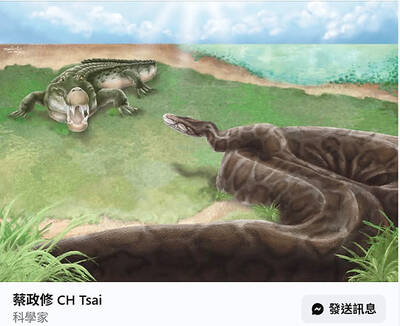
Taiwanese paleontologists have discovered fossil evidence that pythons up to 4m long inhabited Taiwan during the Pleistocene epoch, reporting their findings in the international scientific journal Historical Biology. National Taiwan University (NTU) Institute of Ecology and Evolutionary Biology associate professor Tsai Cheng-hsiu (蔡政修) led the team that discovered the largest snake fossil ever found in Taiwan. The single trunk vertebra was discovered in Tainan at the Chiting Formation, dated to between 400,000 and 800,000 years ago in the Middle Pleistocene, the paper said. The area also produced Taiwan’s first avian fossil, as well as crocodile, mammoth, saber-toothed cat and rhinoceros fossils, it said. Discoveries

Taiwanese paleontologists have discovered fossil evidence that pythons up to 4m long inhabited Taiwan during the Pleistocene epoch, reporting their findings in the international scientific journal Historical Biology. National Taiwan University (NTU) Institute of Ecology and Evolutionary Biology associate professor Tsai Cheng-hsiu (蔡政修) led the team that discovered the largest snake fossil ever found in Taiwan. A single trunk vertebra was discovered in Tainan at the Chiting Formation, dated to between 800,000 to 400,000 years ago in the Middle Pleistocene, the paper said. The area also produced Taiwan’s first avian fossil, as well as crocodile, mammoth, sabre-toothed cat and rhinoceros fossils, it said. Discoveries
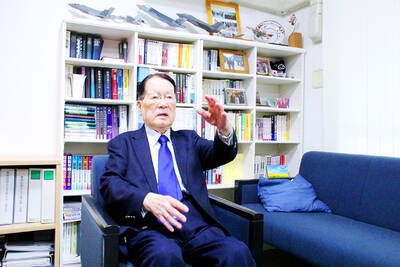
Whether Japan would help defend Taiwan in case of a cross-strait conflict would depend on the US and the extent to which Japan would be allowed to act under the US-Japan Security Treaty, former Japanese minister of defense Satoshi Morimoto said. As China has not given up on the idea of invading Taiwan by force, to what extent Japan could support US military action would hinge on Washington’s intention and its negotiation with Tokyo, Morimoto said in an interview with the Liberty Times (sister paper of the Taipei Times) yesterday. There has to be sufficient mutual recognition of how Japan could provide

UPDATED TEST: The new rules aim to assess drivers’ awareness of risky behaviors and how they respond under certain circumstances, the Highway Bureau said Driver’s license applicants who fail to yield to pedestrians at intersections or to check blind spots, or omit pointing-and-calling procedures would fail the driving test, the Highway Bureau said yesterday. The change is set to be implemented at the end of the month, and is part of the bureau’s reform of the driving portion of the test, which has been criticized for failing to assess whether drivers can operate vehicles safely. Sedan drivers would be tested regarding yielding to pedestrians and turning their heads to check blind spots, while drivers of large vehicles would be tested on their familiarity with pointing-and-calling


 RSS
RSS