

A legislative amendment that calls for the increased broadcasting of local TV dramas in place of Korean TV dramas is an important step in rebuilding Taiwan’s own cultural identity, Democratic Progressive Party (DPP) Legislator Lin Shu-fen (林淑芬) said.
“The purpose of the proposal that I recently forwarded to the legislature actually takes aim at the Taiwanese government and local cable TV operators,” Lin said.
“I don’t mean to stir up resentment against South Korean TV dramas, which are extremely popular here,” she added. “I simply contend that local cable TV stations should assume responsibility for promoting Taiwanese culture instead of feeding the public cheap imports from South Korea.”
Lin’s proposed amendment stipulates that the nation’s cable TV operators must increase the ratio of locally produced TV dramas they air to at least 40 percent — which would be double the current level.
Lin made her remarks in response to expressions of concern from South Korea over the proposals as well as local media outlets and TV stations that said any such action could hurt their ratings.
The proposed amendment to the Cable Television Act (有線廣播電視法) will be taken up by lawmakers in the legislature’s Transportation Committee during the next legislative session which is scheduled to begin on Feb. 22.
“It is by no means a battle against South Korean pop culture,” Lin said.
DPP Legislator Tsai Huang--liang (蔡煌瑯) said he was surprised to hear that the South Korean government had expressed concern over the matter, even though the proposed amendment had not yet been discussed by the legislature.
“It goes to show how protective the South Korean government is of its cultural industry,” he said.
“In view of the South Korean government’s reaction, the Taiwanese government, by contrast, should be ashamed,” he added.

The donation of offshore patrol vessel Kinmen to the Philippines includes provisions that protect Taiwanese fishers and facilitate security cooperation across the First Island Chain, officials said yesterday. The comment was made during the Cabinet’s comprehensive administrative report at the legislature after Chinese Nationalist Party (KMT) Legislator Hsu Yu-chen (許宇甄) expressed concerns about the decision to give a ship to a country whose coast guard had in 2013 fired on a Taiwanese trawler and killed its captain without provocation. The Cabinet should lay out the safeguards that have been established to prevent the Philippine government from using the Kinmen to harass, expel
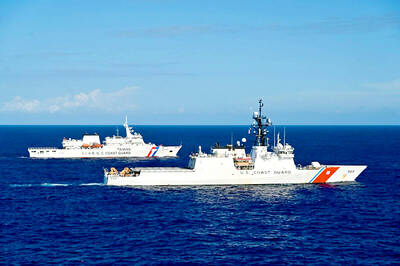
GROWING TIES: The CGA is planning a goodwill mission to the Philippines, in what would be the first time since 1975 a Taiwanese paramilitary vessel has visited the country The Coast Guard Administration (CGA) plans to significantly expand its participation in international security cooperative frameworks and its operational capabilities, a budget proposal for next year showed. The budget indicates a transformation of the CGA from a maritime law enforcement arm into a national defense and intelligence gathering entity capable of tackling larger regional security matters. The proposal showed that personnel from the coast guard’s Intelligence Division and Special Action Support Center are to participate in high-level national security talks with the US. As the CGA has dealt with China’s rising “gray zone” threats around Taiwan, it has become a valuable asset to
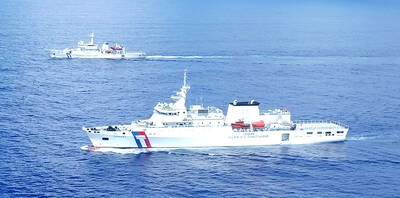
‘FRIENDSHIP FLEET’: A CGA official is scheduled to meet with the president of the Pacific nation, while one of the ships is to host a banquet and National Day event Two Coast Guard Administration (CGA) patrol vessels have docked at Malakal Harbor in Palau as part of an expedition exercise and diplomatic visit, during which a senior official is expected to meet with Palauan President Surangel Whipps Jr, the agency said yesterday. The two vessels, the 4,000-tonne-class Chiayi and the 1,000-tonne-class Penghu, set sail for Palau from Taiwan last week and arrived on Tuesday at Malakal Harbor, the CGA’s Fleet Branch said in a statement. The journey marks the second time the CGA has dispatched a “friendship fleet” to another country, after it sent its first-ever goodwill fleet, comprising the Hualien and
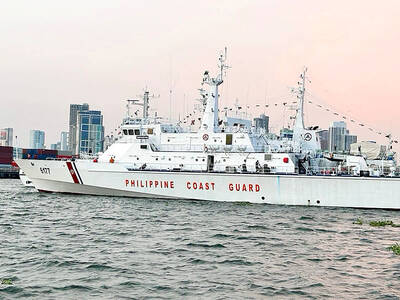
A patrol vessel donated by the Coast Guard Administration (CGA) to the Philippines was commissioned into the Philippine Coast Guard (PCG) on Friday, a Philippine non-governmental organization said. The CGA on Sept. 16 confirmed media reports that Taiwan had donated a retired 500-tonne patrol vessel to the Philippines. The Manila-based We Protect Our Seas (WPS) foundation, which served as an intermediary in the transfer, said that the vessel was formerly the CGA’s 500-tonne petrol vessel Kinmen (CG123). The WPS, in a statement issued on Friday, said the vessel, renamed as the BRP Sarangani, had been commissioned into the PCG the


 RSS
RSS