


Lienchiang County proposed yesterday that independent tourists from China be allowed to visit the outlying islands of Kinmen and Matsu first before Taiwan is opened fully to this segment of Chinese travelers.
Taiwan will need to negotiate details with China before the plan can go ahead, county officials said.
Chinese tourists are currently required to visit Taiwan as part of tour groups, but Taiwan and China have been discussing the possibility that some tourists be allowed to travel to Taiwan independent of tour groups. The idea to use Matsu (the main island chain in Lienchiang County) and Kinmen as testing grounds for the policy was raised by Lienchiang County Commissioner Yang Sui-sheng (楊綏生) during a visit to Matsu by Mainland Affairs Council Minister Lai Shin-yuan (賴幸媛).
Lienchiang-elected Legislator Tsao Erh-chang (曹爾忠) and Lienchiang County Council speaker Chen Kuei-chung (陳貴忠) were also on hand to push the idea.
As part of its efforts to draw more Chinese tourists, the county is seeking to further expand ferry services between Matsu and China by adding a new route to Huangqi in Guangdong Province, the officials said, beyond the current services that reach only Fujian Province.
Also, the officials said, the county hopes that application procedures for Chinese citizens traveling to Matsu and Kinmen via the “small three links” can be simplified.
Lai said she would help push for the plan, the officials said.
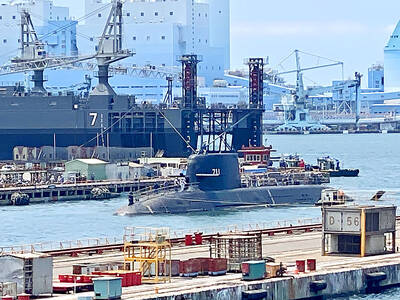
AGING: While Japan has 22 submarines, Taiwan only operates four, two of which were commissioned by the US in 1945 and 1946, and transferred to Taiwan in 1973 Taiwan would need at least 12 submarines to reach modern fleet capabilities, CSBC Corp, Taiwan chairman Chen Cheng-hung (陳政宏) said in an interview broadcast on Friday, citing a US assessment. CSBC is testing the nation’s first indigenous defense submarine, the Hai Kun (海鯤, Narwhal), which is scheduled to be delivered to the navy next month or in July. The Hai Kun has completed torpedo-firing tests and is scheduled to undergo overnight sea trials, Chen said on an SET TV military affairs program. Taiwan would require at least 12 submarines to establish a modern submarine force after assessing the nation’s operational environment and defense

A white king snake that frightened passengers and caused a stir on a Taipei MRT train on Friday evening has been claimed by its owner, who would be fined, Taipei Rapid Transit Corp (TRTC) said yesterday. A person on Threads posted that he thought he was lucky to find an empty row of seats on Friday after boarding a train on the Bannan (Blue) Line, only to spot a white snake with black stripes after sitting down. Startled, he jumped up, he wrote, describing the encounter as “terrifying.” “Taipei’s rat control plan: Release snakes on the metro,” one person wrote in reply, referring
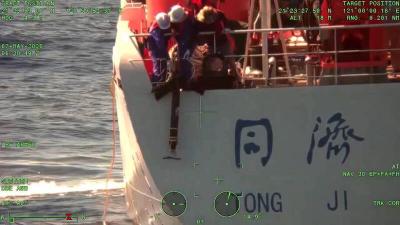
The coast guard today said that it had disrupted "illegal" operations by a Chinese research ship in waters close to the nation and driven it away, part of what Taipei sees a provocative pattern of China's stepped up maritime activities. The coast guard said that it on Thursday last week detected the Chinese ship Tongji (同濟號), which was commissioned only last year, 29 nautical miles (54km) southeast of the southern tip of Taiwan, although just outside restricted waters. The ship was observed lowering ropes into the water, suspected to be the deployment of scientific instruments for "illegal" survey operations, and the coast

Yangmingshan National Park authorities yesterday urged visitors to respect public spaces and obey the law after a couple was caught on a camera livestream having sex at the park’s Qingtiangang (擎天崗) earlier in the day. The Shilin Police Precinct in Taipei said it has identified a suspect and his vehicle registration number, and would summon him for questioning. The case would be handled in accordance with public indecency charges, it added. The couple entered the park at about 11pm on Thursday and began fooling around by 1am yesterday, the police said, adding that the two were unaware of the park’s all-day live


 RSS
RSS