


A major new analysis concludes that China’s military modernization program has focused on building capabilities to coerce Taiwan into unification.
The analysis also says the program is aimed at establishing air supremacy over Taiwan and interdicting and destroying US surface ships entering the region.
Written by Dan Blumenthal, director of Asian studies at the American Enterprise Institute and published by the National Bureau of Asian Research, the analysis says that Chinese operational planning for Taiwan seems to include a punitive attack on the nation.
Blumenthal, a former senior director for China and Taiwan at the Pentagon’s Office of International Security Affairs, argues that China’s strategy would be guided by the principles of surprise, possible pre-emption and “decisive blows.”
This strategy is driven, he says, by lessons that China believes that it has learned from Iraq’s failed strategy and tactics during the first Gulf War.
“According to Chinese analysts, in that conflict the United States was given too much time to build up its forces without being attacked and Iraqi Scud missiles were not fired in a concentrated and operationally effective manner,” Blumenthal said
The 30-page analysis says: “If China does not achieve its desired strategic goals with a quick punitive strike against Taiwan — by, for example, bringing Taiwan to the table on Beijing’s terms — it appears to have plans in place to escalate the conflict. The [People’s Republic of China (PRC)] could utilize missile forces to kick in the door on the island by taking out all Taiwan’s airfields and runways and establishing air superiority over the Strait. China’s increasingly sophisticated air force could then attack Taiwan with relative impunity.”
At the same time, Blumenthal says, China might seek to “strike devastating blows against the United States and Japan” in order to keep the two countries from intervening.
“Indeed, China is contemplating massive air and missile strikes on the Kadena and Iwakuni air bases in Japan, despite the geopolitical risks. Beijing may be willing to take this risk if it calculates that a devastating blow against the US and allied bases would present Washington with a fait accompli because the US has no good conventional responses and would not risk nuclear escalation,” he added.
If China decides it needs to engage US forces to win in Taiwan, the analysis argues, the People’s Liberation Army (PLA) would execute a sea-denial strategy employing attack submarines, fighter aircraft equipped with cruise missiles and land-based ballistic missiles with maneuverable warheads to threaten US aircraft carriers.
“When dealing with a political issue for which China has raised the stakes to a very high level, such as Taiwan, the PRC may be willing to use a great deal of force and attain a high level of doctrinal and technical innovation to achieve its goals. That the United States has nuclear-powered carriers, F-22s or Virginia-class submarines does not matter if Washington chooses not to use such assets within China’s close-in kill zones. The key questions are what would we actually bring to the fight and when and how would we do so?” he asked.
The analysis also asks under what conditions would US allies — Japan, Singapore and Australia — fight alongside each other and the US?
Japan, says the analysis, may be eager to clear its territorial waters of PLA surface ships and submarines, but “responding to an attack on Taiwan, particularly if Japan itself is not attacked, may be a whole other matter.”
Blumenthal says that if China conducts an unprovoked attack that looks like an opening gambit to change the regional balance of power, then perhaps Canberra, Singapore and Tokyo “would do what they could to help defeat PRC forces.”
However, he added: “Today, it is just as easy to imagine that they would be reluctant to participate.”
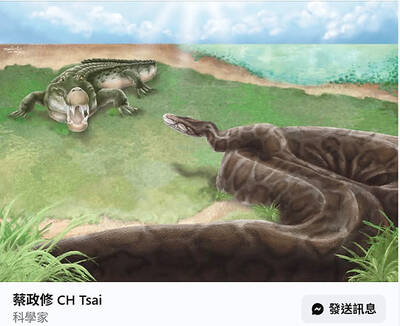
Taiwanese paleontologists have discovered fossil evidence that pythons up to 4m long inhabited Taiwan during the Pleistocene epoch, reporting their findings in the international scientific journal Historical Biology. National Taiwan University (NTU) Institute of Ecology and Evolutionary Biology associate professor Tsai Cheng-hsiu (蔡政修) led the team that discovered the largest snake fossil ever found in Taiwan. The single trunk vertebra was discovered in Tainan at the Chiting Formation, dated to between 400,000 and 800,000 years ago in the Middle Pleistocene, the paper said. The area also produced Taiwan’s first avian fossil, as well as crocodile, mammoth, saber-toothed cat and rhinoceros fossils, it said. Discoveries

Taiwanese paleontologists have discovered fossil evidence that pythons up to 4m long inhabited Taiwan during the Pleistocene epoch, reporting their findings in the international scientific journal Historical Biology. National Taiwan University (NTU) Institute of Ecology and Evolutionary Biology associate professor Tsai Cheng-hsiu (蔡政修) led the team that discovered the largest snake fossil ever found in Taiwan. A single trunk vertebra was discovered in Tainan at the Chiting Formation, dated to between 800,000 to 400,000 years ago in the Middle Pleistocene, the paper said. The area also produced Taiwan’s first avian fossil, as well as crocodile, mammoth, sabre-toothed cat and rhinoceros fossils, it said. Discoveries
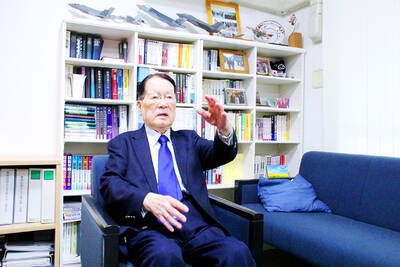
Whether Japan would help defend Taiwan in case of a cross-strait conflict would depend on the US and the extent to which Japan would be allowed to act under the US-Japan Security Treaty, former Japanese minister of defense Satoshi Morimoto said. As China has not given up on the idea of invading Taiwan by force, to what extent Japan could support US military action would hinge on Washington’s intention and its negotiation with Tokyo, Morimoto said in an interview with the Liberty Times (sister paper of the Taipei Times) yesterday. There has to be sufficient mutual recognition of how Japan could provide
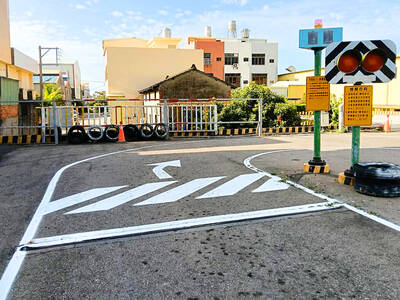
UPDATED TEST: The new rules aim to assess drivers’ awareness of risky behaviors and how they respond under certain circumstances, the Highway Bureau said Driver’s license applicants who fail to yield to pedestrians at intersections or to check blind spots, or omit pointing-and-calling procedures would fail the driving test, the Highway Bureau said yesterday. The change is set to be implemented at the end of the month, and is part of the bureau’s reform of the driving portion of the test, which has been criticized for failing to assess whether drivers can operate vehicles safely. Sedan drivers would be tested regarding yielding to pedestrians and turning their heads to check blind spots, while drivers of large vehicles would be tested on their familiarity with pointing-and-calling


 RSS
RSS