


The Mainland Affairs Council (MAC) caught the public’s attention after it ran advertisements in Chinese-language media promoting the Republic of China flag, to coincide with the sixth round of high-level cross-strait talks between Straits Exchange Foundation Chairman Chiang Pin-kung (江丙坤) and Association for Relations Across the Taiwan Strait Chairman Chen Yunlin (陳雲林) last week.
For many, the move was yet another attempt by the Chinese Nationalist Party (KMT) administration in recent months to convince the public that its China policy has the best interests of Taiwanese in mind.
Since President Ma Ying-jeou (馬英九) took office in May 2008, he has taken pride in improving cross-strait relations — at least at some levels. His efforts have received much praise, as well as harsh criticism, at home and abroad.
However, sometime in August, he began to realize that he could no longer ignore public apprehensions over the speed at which his administration has engaged Beijing.
During an interview with the Chinese-language China Times on Aug. 31, Ma said cross-strait liberalization would “maintain its current speed” and that there was no need to “go any faster.”
He also offered a thorough explanation of his three-stage cross-strait policy, with the final stage aimed at strengthening bilateral exchanges in the hopes that Taiwan would have an impact on Chinese development.
Earlier the same month, Mainland Affairs Council (MAC) Minister Lai Shin-yuan (賴幸媛) raised eyebrows by urging Beijing to “abolish policies and laws” concerning military deployments targeting Taiwan. Although China’s “Anti-Secession” Law was not named, MAC Deputy Minister Liu Te-shun (劉德勳) called on China to review the law, which he described as “something unnecessary” in cross-strait relations.
A few days after last month’s five special municipality elections, Lai delivered the welcoming remarks at an international forum on cross-strait relations in Taipei, laying down what she called the seven core interests of Taiwanese — democracy, sovereignty, security, the right to free choice on the future of cross-strait relations, the right to meaningful participation in international organizations, the right not to be discriminated against and the right of disadvantaged to survive.
The concept was nothing new, but it was the first time a senior MAC official had made such a complete summary of the matter.
On the same day, former National Security Council secretary-general Su Chi (蘇起) urged the Democratic Progressive Party (DPP) to take the initiative and work with the KMT to come up with what he called a “Taiwan consensus” before Taipei and Beijing could enter negotiations on thorny issues such as Taiwan’s sovereignty.
Su said he did not think Ma could single-handedly take care of all the political issues such as Taiwan’s international space, a military confidence--building mechanism and a peace agreement.
So what are all the signals about? What is the message the administration is trying to get across?
Hsu Szu-chien (徐斯儉), assistant research fellow at Academia Sinica’s Institute of Political Science, said the administration was trying to send three messages.
Domestically, as Ma realizes that his China-friendly policy is losing public support, he needs to adjust his politics and lean more toward the center. Ma, who doubles as KMT chairman, must also take into account the needs of his party legislators, who are up for re-election next year.
Internationally, Ma realizes he must respond to mounting pressure from China to returning its economic favors. However, he is trying to tell Beijing that he cannot go too fast because of public concerns in Taiwan.
“It is not so much about what he wants to do, but about what the Taiwanese public does not want him to do,” Hsu said. “The honeymoon is over.”
Hsu said Ma secured a handsome mandate in the 2008 election, but since then his popularity has been in steady decline. Although many factors can be attributed to this drop, his cross-strait policies have played a dominant role, he said.
Ma’s response to public concerns about warming ties with Beijing was a smart and necessary approach, he said, and the DPP should worry about it because the party is yet to finalize its own policy on the subject.
Former deputy National Security Council secretary-general Chen Chung-hsin (陳忠信) said he did not think the DPP had much to worry about because the party is in the process of amending its cross-strait policy to reflect political change. It must focus more on making itself a more viable political alternative than counting success on the KMT’s failure.
Chen said there were two principal reasons why the administration appears to have taken public concerns over its cross-strait policies more seriously in recent months.
For one, it realized these policies were the main factor behind Ma’s declining public support. Although the KMT retained the three northern cities in last month’s elections, it lost the popular vote to the DPP by 5 percent, or about 400,000 votes.
“Let’s hope its damage control genuinely comes from the realization that its cross-strait policies raise a lot of concern,” he said.
The other factor is that this is a political gesture made in the run-up to the upcoming elections, Chen said.
Yang Kai-huang (楊開煌), a public affairs professor at Ming Chuan University, said Ma slowed down the pace of intensifying cross-strait relations not because he was changing course or becoming more conservative, but mainly because he needed time to figure out a new discourse for cross-strait ties.
Ma is sure about what he does not want, he said. He has made it clear that he will not discuss unification with Beijing during his presidency, not pursue or support de jure independence for Taiwan and will not agree to use military force to resolve any conflict in the Taiwan Strait.
However, Ma has never said exactly what he wants, Yang said.
The DPP is clear about its goal, although it is aware that this is not attainable at the moment, he said.
The party is also working on its “10-year policy platform” to address foreign affairs issues, including China. What is more important is that the DPP is transforming itself from a party resorting to resolute nationalism to adopting a more pragmatic, conciliatory approach.
Ma sees that Taiwan is caught between Beijing and Washington, so he needs to come up with a policy that can pacify both China and the US, he said.
“It is a critical time and the Ma administration can turn the crisis into an opportunity,” he said.
On Su’s proposal of a “Taiwan consensus,” Hsu said Su was right about urging the two parties to talk to each other. However, Su sounded as if the KMT had already come to a consensus and the DPP was the main source of the problem.
“The problem between Taipei and Beijing is not a matter between the DPP and the KMT alone,” Hsu said. “It is a problem for all Taiwanese. The two parties alone cannot represent Taiwan.”
Yang said the DPP and the KMT must realize that political talks with China are inevitable. However, they must iron out differences before they can talk with Beijing about more sensitive issues.
“The most important thing is that the KMT must come to a consensus within the party before it can talk with the DPP,” he said.
“The DPP may need some time to convince its core supporters, but some party elites understand that they cannot go back to the old path or they will have a very hard time surviving,” Yang said.
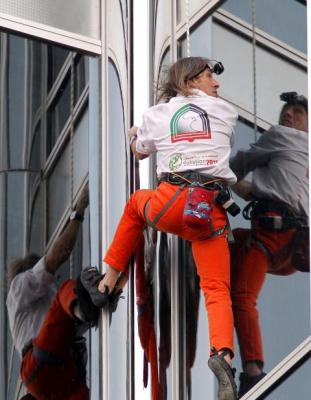
Alain Robert, known as the "French Spider-Man," praised Alex Honnold as exceptionally well-prepared after the US climber completed a free solo ascent of Taipei 101 yesterday. Robert said Honnold's ascent of the 508m-tall skyscraper in just more than one-and-a-half hours without using safety ropes or equipment was a remarkable achievement. "This is my life," he said in an interview conducted in French, adding that he liked the feeling of being "on the edge of danger." The 63-year-old Frenchman climbed Taipei 101 using ropes in December 2004, taking about four hours to reach the top. On a one-to-10 scale of difficulty, Robert said Taipei 101

A preclearance service to facilitate entry for people traveling to select airports in Japan would be available from Thursday next week to Feb. 25 at Taiwan Taoyuan International Airport, Taoyuan International Airport Corp (TIAC) said on Tuesday. The service was first made available to Taiwanese travelers throughout the winter vacation of 2024 and during the Lunar New Year holiday. In addition to flights to the Japanese cities of Hakodate, Asahikawa, Akita, Sendai, Niigata, Okayama, Takamatsu, Kumamoto and Kagoshima, the service would be available to travelers to Kobe and Oita. The service can be accessed by passengers of 15 flight routes operated by

Taiwanese and US defense groups are collaborating to introduce deployable, semi-autonomous manufacturing systems for drones and components in a boost to the nation’s supply chain resilience. Taiwan’s G-Tech Optroelectronics Corp subsidiary GTOC and the US’ Aerkomm Inc on Friday announced an agreement with fellow US-based Firestorm Lab to adopt the latter’s xCell, a technology featuring 3D printers fitted in 6.1m container units. The systems enable aerial platforms and parts to be produced in high volumes from dispersed nodes capable of rapid redeployment, to minimize the risk of enemy strikes and to meet field requirements, they said. Firestorm chief technology officer Ian Muceus said
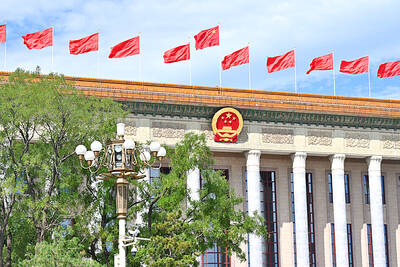
MORE FALL: An investigation into one of Xi’s key cronies, part of a broader ‘anti-corruption’ drive, indicates that he might have a deep distrust in the military, an expert said China’s latest military purge underscores systemic risks in its shift from collective leadership to sole rule under Chinese President Xi Jinping (習近平), and could disrupt its chain of command and military capabilities, a national security official said yesterday. If decisionmaking within the Chinese Communist Party has become “irrational” under one-man rule, the Taiwan Strait and the regional situation must be approached with extreme caution, given unforeseen risks, they added. The anonymous official made the remarks as China’s Central Military Commission Vice Chairman Zhang Youxia (張又俠) and Joint Staff Department Chief of Staff Liu Zhenli (劉振立) were reportedly being investigated for suspected “serious


 RSS
RSS