


The introduction last month of a state-of-the-art multimedia physical treatment center in Taipei called Smart Ambience has taken the drudgery out of physical rehabilitation, some users said.
“I was amazed when I first set foot in the center,” said Liu Yu-yuan, a 51-year-old mastectomy patient.
The aesthetics include walls of aquariums with tropical fish swimming around and colorful bottles that are meant to produce a healing and calming effect on the mind.
The center offers six different rehabilitation training programs that feature LEDs, sensors and newly developed software.
HIGH-TECH
Patients can go through a one-hour exercise routine that is based on high-end computer technology and is tailored to individual needs, all free of charge.
In the diaphragmatic breathing program, for example, a sensor band attached to the patient tells the therapist whether or not the exercise is being done correctly, said Chen Shu-chun (陳淑君), a nurse at the Taiwan Breast Cancer Foundation (TBCF), which founded the center.
“To help the patients relax, we have an overhead projector that displays videos of a figure doing breathing exercises in a forest to soft relaxing music,” Chen said.
The forest scene turns into a night sky with stars that brighten or dim depending how deeply the patient breathes during the exercise, she said.
Diaphragmatic breathing can calm the mind, Chen said, adding that this is a state most cancer patients find quite difficult to achieve.
ONE-ON-ONE
At the center, patients can also concentrate fully on the rehabilitation routines since the space is used by one person at a time, with an assigned therapist offering assistance, she said.
“When I can’t fall asleep at home, I picture the forest and practice the breathing method I learned here,” Liu said.
“Although I knew the breathing method before, my technique was wrong. The therapist corrected me and demonstrated it for me, which was nice and thoughtful,” Liu said.
LONG PROCESS
The center, a brainchild of TBCF and National Taiwan University’s Graduate Institute of Networking and Multimedia (GINM), took two years to complete.
Hung Yi-ping (洪一平), a GINM professor and leading researcher, said that the biggest challenge facing the project was the synchronization and integration of the multimedia resources.
“There was a lot of trial and error. Sometimes we had to toss out what we had done and build something better,” Hung said.
The project experience was presented at an international conference in Italy last year, he said.
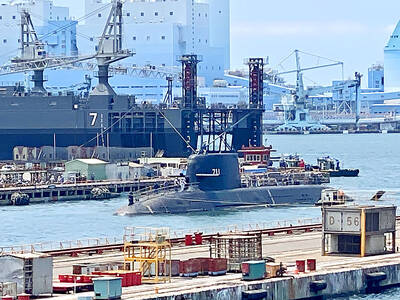
AGING: While Japan has 22 submarines, Taiwan only operates four, two of which were commissioned by the US in 1945 and 1946, and transferred to Taiwan in 1973 Taiwan would need at least 12 submarines to reach modern fleet capabilities, CSBC Corp, Taiwan chairman Chen Cheng-hung (陳政宏) said in an interview broadcast on Friday, citing a US assessment. CSBC is testing the nation’s first indigenous defense submarine, the Hai Kun (海鯤, Narwhal), which is scheduled to be delivered to the navy next month or in July. The Hai Kun has completed torpedo-firing tests and is scheduled to undergo overnight sea trials, Chen said on an SET TV military affairs program. Taiwan would require at least 12 submarines to establish a modern submarine force after assessing the nation’s operational environment and defense

Yangmingshan National Park authorities yesterday urged visitors to respect public spaces and obey the law after a couple was caught on a camera livestream having sex at the park’s Qingtiangang (擎天崗) earlier in the day. The Shilin Police Precinct in Taipei said it has identified a suspect and his vehicle registration number, and would summon him for questioning. The case would be handled in accordance with public indecency charges, it added. The couple entered the park at about 11pm on Thursday and began fooling around by 1am yesterday, the police said, adding that the two were unaware of the park’s all-day live
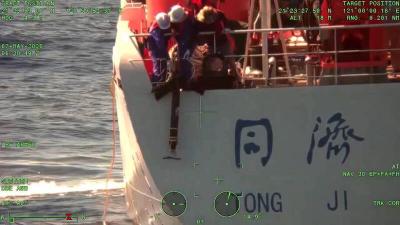
The coast guard today said that it had disrupted "illegal" operations by a Chinese research ship in waters close to the nation and driven it away, part of what Taipei sees a provocative pattern of China's stepped up maritime activities. The coast guard said that it on Thursday last week detected the Chinese ship Tongji (同濟號), which was commissioned only last year, 29 nautical miles (54km) southeast of the southern tip of Taiwan, although just outside restricted waters. The ship was observed lowering ropes into the water, suspected to be the deployment of scientific instruments for "illegal" survey operations, and the coast

A former soldier and an active-duty army officer were yesterday indicted for allegedly selling classified military training materials to a Chinese intelligence operative for a total of NT$79,440. The Taipei District Prosecutors’ Office indicted Chen Tai-yin (陳泰尹) and Lee Chun-ta (李俊達) for contravening the National Security Act (國家安全法) and the Anti-Corruption Act (貪污治罪條例). Chen left the military in September 2013 after serving alongside then-staff sergeant Lee, now an army lieutenant, at the 21st Artillery Command of the army’s Sixth Corps from 2011 to 2013, according to the indictment. Chen met a Chinese intelligence operative identified as “Wang” (王) through a friend in November


 RSS
RSS