


Democratic Progressive Party (DPP) candidate for Taipei mayor Su Tseng-chang (蘇貞昌) yesterday said he hoped his new campaign strategy would change the country’s traditional party-focused election culture in next week’s five-special municipality elections.
The public is so “sick and tired of the infighting between the blue and green” camps that they want change and they want to be their own master and make their own decisions, Su said, calling this development the “third wave” of democratic reform.
“Those candidates who have a good track record will win and those who don’t will have to go,” he said.
In the US, for example, the fate of US President Barack Obama’s party in the midterm elections showed that Americans were fully aware that they were the real masters of their country, Su said during a live interview on Yam Web TV.
Taiwan saw the “first wave” of the democratic movement about 30 years ago, when the country was under one-party rule and people began to demand political liberation much like Burmese and Chinese dissidents are doing today, Su said.
Political liberation led to an explosion of political parties and at the beginning of party politics, -competition between the two main parties resulted in ugly infighting, he said.
As Taiwan becomes more democratic, Su said an increasing number of Taiwanese wanted politicians to know that they did not blindly favor any political party and that they could make their own judgment as to the direction the country should go.
Change of government as a phenomenon is also increasing, he said.
While the electoral structure of Taipei City is traditionally dominated by the Chinese Nationalist Party (KMT), Su said he hoped this would change next week.
“Let elections return to their original meaning of choosing someone who is qualified for the job,” he said.
While Su’s KMT opponent, Taipei Mayor Hau Lung-bin (郝龍斌), has vowed to “annihilate” his enemy in this battle, Su said he did not want to “annihilate” anybody and that he only wanted to serve the people.
Su urged voters to elect someone who is bold and resolute, someone who can deliver on his promises, who is effective and who does not promote confrontation.
“Elections are not gambling and voters are not the bargaining chips of politicians,” Su said.
On his new campaign strategy, Su said the core concept was to put Taipei residents foremost in his mind. By doing so, his policy platform was aimed at addressing their problems, he said.
Su vowed to make the capital city a fun and interesting place to be, a place mixing the old and new as well as convenience and vitality.
“It might not be the first in some world rankings, but I guarantee you it will be unique and Taipei will surpass itself,” he said.

Fast food chain McDonald's is to raise prices by up to NT$5 on some products at its restaurants across Taiwan, starting on Wednesday next week, the company announced today. The prices of all extra value meals and sharing boxes are to increase by NT$5, while breakfast combos and creamy corn soup would go up by NT$3, the company said in a statement. The price of the main items of those meals, if ordered individually, would remain the same. Meanwhile, the price of a medium-sized lemon iced tea and hot cappuccino would rise by NT$3, extra dipping sauces for chicken nuggets would go up

Yangmingshan National Park’s Qingtiangang (擎天崗) nature area has gone viral after a park livestream camera observed a couple in the throes of intimate congress, which was broadcast live on YouTube, drawing large late-night crowds and sparking a backlash over noise, bright lights and disruption to wildlife habitat. The area’s livestream footage appeared to show a couple engaging in sexual activity on a picnic table in the park on Friday last week, with the uncensored footage streamed publicly online. The footage quickly spread across social media, prompting a tide of visitors to travel to the site to “check in” and recreate the
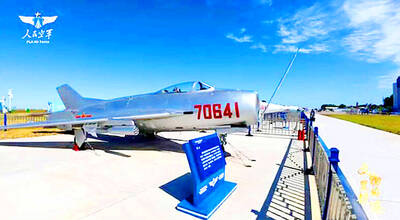
GROUNDED: A KMT lawmaker proposed eliminating drone development programs and freezing funding for counterdrone systems, despite China’s adoption of the technology China has deployed attack drones at air bases near the Taiwan Strait in a strategy aimed at overwhelming Taiwan’s air defense systems through saturation attacks, the Mainland Affairs Council (MAC) said. The council’s latest quarterly report on China said that satellite imagery and open-source intelligence indicate that the Chinese People’s Liberation Army (PLA) had converted retired J-6 fighter jets into J-6W drones, which the PLA has stationed at six air bases near Taiwan, five in China’s Fujian Province and one in Guangdong Province. The report cited J. Michael Dahm, a senior fellow at the US-based Mitchell Institute, as saying that China has

Carrefour Taiwan is to begin using a new name from the start of July, but it cannot divulge the name until then, the chairman of the supermarket chain's parent company said today. President Chain Store Co chairman Lo Chih-hsien (羅智先) was asked by reporters after a shareholders' meeting to confirm whether the company has settled on a new name for the supermarket brand. In March, the government-registered name of two Carrefour Taiwan branches was quietly changed to "Le Chia Kang" (樂家康) in Chinese, raising speculation that has been selected as the name. Lo said that because of local regulations and contractual obligations, the


 RSS
RSS