


National Palace Museum Director Chou Kung-shin (周功鑫) yesterday managed the rare feat of uniting both ruling party and opposition lawmakers in fury as she defended her administration of the museum and plans to open a southern branch of the museum in 2015.
Chou told the legislature’s Education and Culture Committee she hoped her team could begin looking for architects for the Chiayi branch museum by the end of this year and complete construction of the facility by the end of 2015, provided everything goes smoothly. She said the museum had earmarked NT$114 million (US$3.78 million) in next year’s budget for the four-year, NT$7.9 billion project.
The original design, by Antoine Predock Architects and Lord Cultural Resources, called for a multi-functional museum to handle research, display, education and storage. It was supposed to be completed in 2008, but years of delay led the two firms to lose the contract.
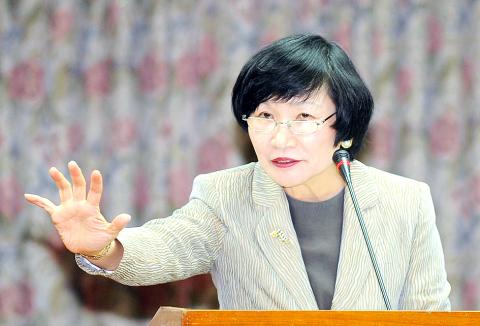
Photo: CNA
Chou told lawmakers the delays stemmed from a number of factors, including concerns about flooding in the area and problems with the two major contractors, who are now involved in a contract dispute with the government.
The meeting got off to a rough start in the morning when Chou upset Democratic Progressive Party (DPP) and Chinese Nationalist Party (KMT) legislators by interrupting as they were speaking.
At one point, KMT Legislator Yang Li-huan (楊麗環) pounded the table and told Chou to shut up as Yang was talking, while KMT Legislator Chao Li-yun (趙麗雲) was so angry she slammed Chou’s report on the table and threatened to cut the museum’s budget.
Matters didn’t improve when Chou called the DPP and KMT legislators’ questions unprofessional and told them she was speaking as an expert in museum management.
Yang refused to shake hands with Chuo during the meeting’s recess and said all the museum’s problems would be resolved if Chou were replaced.
Asked about public complaints of overcrowding at the museum and it being turned into a “market” or “wholesale store” because of the dramatic increase in Chinese visitors, Chou said certain measures should be implemented to address the problem, including extending opening hours and increasing the number of service people.
She said it might also be necessary to turn away visitors once the daily limit of 7,000 and 8,000 has been reached.
The museum also planned to spend NT$16 million on an expansion project approved by the Executive Yuan in August, she said. However, DPP legislators accused Chou of jumping the gun by spending NT$900,000 on a feasibility assessment for the expansion, even though the legislature has yet to approve the project.
Chou said the museum’s gift shops and restaurants have generated revenues of NT$550 million this year and should reach NT$700 million next year.
She also said the museum had stopped distributing profits to its employees this year — a practice the Ministry of the Interior said in June last year was illegal — and began paying 10 percent of annual revenues to the treasury.
DPP Legislator Lin Shu-fen (林淑芬) said it would make more sense to place all the museum’s revenues under legislative oversight because they were generated by national treasures that are state property.
Building a southern branch of the museum was first announced by then-president Chen Shui-bian (陳水扁) in 2003. In October last year, President Ma Ying-jeou (馬英九) promised the branch would be open in 2012 as he campaigned for a KMT candidate in last December’s local elections.
ADDITIONAL REPORTING BY STAFF WRITER

FUKUOKA SITUATION: Japanese media reported that the pathogen is expected to be identified by the summer, while the CDC downplayed the idea that it was hMPV A “mysterious cold-like illness” reported in Japan’s Fukuoka Prefecture does not seem to be a new disease, but Japanese authorities have been asked about the situation, the Centers for Disease Control (CDC) said yesterday. The Fukuoka Prefectural Medical Association on Wednesday told a news conference that a “mystery cold” that has become a hot topic on social media is “highly likely to be caused by some kind of viral infection,” Japan’s KBC News reported. “Many people are experiencing symptoms starting with a sore throat, followed by a runny nose, phlegm and a severe cough,” KBC News reported, citing association officials. Health authorities are

Nvidia Corp CEO Jensen Huang (黃仁勳) arrived in Taiwan yesterday ahead of upcoming AI and technology events, saying he plans to meet with clients and Taiwan Semiconductor Manufacturing Co Chairman C.C. Wei (魏哲家) during his visit. After landing at Taipei Songshan Airport, Huang posed for photos with fans and handed out Yakult drinks to reporters and supporters waiting at the scene, saying he has “a lot to do” during the trip. Asked about reports that Nvidia’s planned headquarters site in Taipei’s Beitou Shilin Technology Park could break ground on May 27, Huang said that if the company holds an event, he would

The Ministry of Finance this afternoon announced the winning numbers for the March-April uniform invoice lottery. The winning number for the NT$10 million (US$318,060) special prize is 19531471, and the winning number for the NT$2 million grand prize is 85941329. Three numbers were drawn for the NT$200,000 first prize: 07225810, 20231230 and 83518781. Those with receipts matching the last seven digits of any of the first-prize numbers will win the NT$40,000 second prize, while those matching the last six digits will win the NT$10,000 third prize. Those whose receipts match the last five digits of the first-prize numbers can claim the NT$4,000 fourth prize,
Taiwan Travelogue (臺灣漫遊錄), which earlier this week became the first Taiwanese novel to win the International Booker Prize, is to be adapted into a television series through a Taiwan-Japan coproduction, producer Chang Chen-yu (張辰漁) said yesterday. Chang, a producer at World Softest Production Film Co, wrote on Facebook that the company had been searching for projects with international appeal that retain a strong Taiwanese identity after colleagues and Japanese partners strongly recommended the novel. After reading the book, Chang said he immediately decided to pursue the screen rights. “A great story has the power to transcend time and borders, and connect countless people,”


 RSS
RSS