


Recent media interest about new types of submarines being developed by the People’s Liberation Army Navy (PLAN) could provide important clues about China’s naval capabilities and intentions, a specialist on China said in a recent article.
“Whereas the development and deployment of the Chinese navy’s surface fleet have been prominently displayed in unprecedented scale in recent naval exercises both in the South and East China Sea, the expansion of China’s subsurface fleet appears to have been slowed in recent years,” Russell Hsiao, editor of the China Brief, a publication of the US-based Jamestown Foundation, wrote in the publication’s latest edition.
From 2007 until this year, he said, the total number of submarines deployed in the PLAN was steady, rising by a single vessel, to 63, Hsiao wrote.
While the scope of the PLAN’s development remained to be seen and would depend on tested capabilities rather than media photos and speculation, the increased incidence of reports on new submarines could nevertheless provided important clues about Beijing’s strategic outlook, he said.
“In this context, these reports raise interesting questions about what is known regarding the pace of investments that China has undertaken to increase stealth, missile capacity, survivability and the capability to project its submarine force both regionally and globally,” he wrote.
Early last month, a Hong Kong-based media ran a story based on a photo of a new conventionally powered attack submarine that had been circulating on the Web for several weeks. The SSK submarine was allegedly developed by state-owned China Shipbuilding Industry Corp, China’s largest shipbuilder, the report said.
The People’s Liberation Army (PLA) has yet to officially acknowledge reports that the new submarine has stealth capabilities.
“Chinese academic engineering literature cited by a prominent Western defense magazine supports the fact ‘that the PLA has also been researching fuel cell AIP engine technology — with the PLA having benefited via Chinese academics from several conferences with German fuel cell technology experts,” the report said, citing Jane’s Defense Weekly.
“The addition of an AIP system could allow a Chinese submarine to operate underwater for up to 30 days on battery power, and would make the Song and Yuan submarines inaudible to existing US surveillance networks-and US subs,” the report said.
Reports also claim that China would finish testing and deploy two additional Yuan-class submarines by the end of next year, Hsiao wrote, adding that if reports were true, it would confirm the belief, held by some experts, that the apparent slowdown in the PLAN’s expansion was only a transitory phase and that its submarine fleet appeared set to resume its upward trajectory.
These revelations coincide with the recent sighting of a new Type 093 Shang-class nuclear-powered attack submarine docked at a Chinese naval base in Sanya, on Hainan Island. A photograph obtained by Japan-based Kyodo News showed two nuclear-powered submarines docked at a quay on the base.
Hsiao wrote that the reports and images showcasing new submarines and deployments underscored Beijing’s growing assertiveness, which has also been accompanied by an increasing incidence of sorties and exercises in waters close to Taiwan, Japan and South Korea.

The military has spotted two Chinese warships operating in waters near Penghu County in the Taiwan Strait and sent its own naval and air forces to monitor the vessels, the Ministry of National Defense (MND) said. Beijing sends warships and warplanes into the waters and skies around Taiwan on an almost daily basis, drawing condemnation from Taipei. While the ministry offers daily updates on the locations of Chinese military aircraft, it only rarely gives details of where Chinese warships are operating, generally only when it detects aircraft carriers, as happened last week. A Chinese destroyer and a frigate entered waters to the southwest
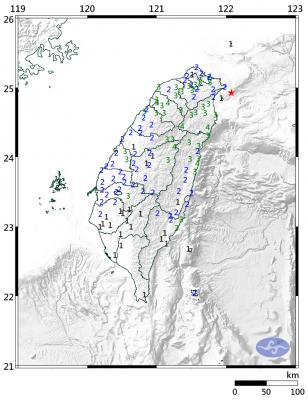
A magnitude 6.1 earthquake struck off the coast of Yilan County at 8:39pm tonight, the Central Weather Administration (CWA) said, with no immediate reports of damage or injuries. The epicenter was 38.7km east-northeast of Yilan County Hall at a focal depth of 98.3km, the CWA’s Seismological Center said. The quake’s maximum intensity, which gauges the actual physical effect of a seismic event, was a level 4 on Taiwan’s 7-tier intensity scale, the center said. That intensity level was recorded in Yilan County’s Nanao Township (南澳), Hsinchu County’s Guansi Township (關西), Nantou County’s Hehuanshan (合歡山) and Hualien County’s Yanliao (鹽寮). An intensity of 3 was

Japanese Prime Minister Sanae Takaichi’s comment last year on Tokyo’s potential reaction to a Taiwan-China conflict has forced Beijing to rewrite its invasion plans, a retired Japanese general said. Takaichi told the Diet on Nov. 7 last year that a Chinese naval blockade or military attack on Taiwan could constitute a “survival-threatening situation” for Japan, potentially allowing Tokyo to exercise its right to collective self-defense. Former Japan Ground Self-Defense Force general Kiyofumi Ogawa said in a recent speech that the remark has been interpreted as meaning Japan could intervene in the early stages of a Taiwan Strait conflict, undermining China’s previous assumptions
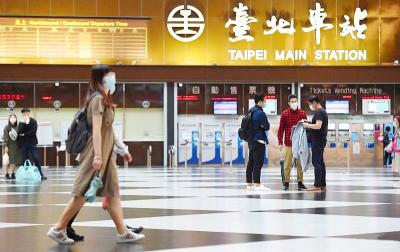
Taiwan Railways Corp (TRC) today announced that Shin Kong Mitsukoshi has been selected as the preferred bidder to operate the Taipei Railway Station shopping mall, replacing the current operator, Breeze Development Co Ltd. Among eight qualified firms that delivered presentations and were evaluated by a review committee, Shin Kong Mitsukoshi was ranked first, while Breeze was named the runner-up, the rail company said in a statement. Contract negotiations are to proceed in accordance with regulations, it said, adding that if negotiations with the top bidder fail, it could invite the second-ranked applicant to enter talks. Breeze in a statement today expressed doubts over


 RSS
RSS