


As tensions in the Asia-Pacific region heat up amid disputes involving China and a number of countries over contested islands and sovereignty over the South China Sea, there have been signs in recent months that the US may be on the brink of reassessing its strategy for the region in ways that raise questions about Taiwan’s place in it.
For almost eight years under former US president George W. Bush and the first year-and-a-half or so of the administration of US President Barack Obama, the US, preoccupied with counterinsurgencies in Afghanistan and Iraq and severe economic downturn, adopted a hands-off approach to Asia, for the most part limiting itself to assuaging Beijing’s fears that Washington was seeking to contain it.
Recognizing an opportunity when it saw one, Beijing played along and, for most of that period, crafted a policy that managed to reassure the neighborhood of its “peaceful intentions” even as it continued to modernize its military. In doing so, it also successfully isolated Taipei during the eight years of former president Chen Shui-bian’s (陳水扁) time in office, capitalizing on Washington’s wariness regarding an administration it saw as a potential “troublemaker.”
Beijing’s policy remained quite skillful after the election of the Chinese Nationalist Party’s (KMT) President Ma Ying-jeou (馬英九) in 2008, unveiling a series of carrots to an administration in Taipei that was all-too-willing to please China and foster rapprochement. Not only had Taiwan been neutralized during the Chen era, but since 2008, it was pulled ever closer into its embrace, so much so that doubts emerged as to Taipei’s willingness to remain part of the unofficial US-Japan security alliance.
Then, just as Taiwan was signing the Economic Cooperation Framework Agreement (ECFA) with China in late June, Tokyo announced it was extending its Air Defense Identification Zone (ADIZ) so that it now overlapped with sections of a zone controlled by Taiwan.
This was followed in July by an announcement by Japanese Minister of Defense Toshimi Kitazawa that Japan was “positively considering’’ a plan to deploy Ground Self--Defense Force troops to the Sakishima island chain southwest of Okinawa Island.
Furthermore, because of the People’s Liberation Army Navy’s growing operations in waters close to the island chain, Japan said it was considering deploying a 100-troop coastal surveillance unit to Yonaguni Island and hundreds of border security troops to Miyako and Ishigaki islands in stages over a period of five to eight years.
The following month, Tokyo announced that Japan and the US planned to hold joint exercises later this year (ostensibly next month) in waters close to the Diaoyutai Islands (釣魚台), a source of frequent clashes between China, Japan and Taiwan, which all claim sovereignty over them.
All these moves, added to a Washington that appeared to be increasingly reluctant to provide Taiwan with the advanced weapons it needed to defend itself, pointed to a possible reassessment of the line drawn by then-US secretary of state John Foster Dulles and then-assistant secretary of state for Far Eastern affairs Dean Rusk in 1950, just as the Korean War was breaking out, which turned Taiwan into a redoubt against the communists in China. This is a line that, for all intents and purposes, remains effective today. Could this mean that Japan and the US, 50 years into their security alliance, have opted for a strategic retreat, abandoning Taiwan in order to consolidate a more easily defensible position, whose outer edge begins at the newly redrawn ADIZ?
“A month or so ago, that would have been a plausible position. That is why, I think, Japan shifted the ADIZ,” Arthur Waldron, Lauder professor of international relations in the Department of History at the University of Pennsylvania, told the Taipei Times by e-mail. “Ironically, it has been the Taiwanese leadership and a seeming public lack of concern that has caused some to consider redrawing the line.”
On the same question, Richard Bush, director of the Center for Northeast Asian Policy Studies at the Brookings Institution in Washington, said that while “we can certainly not rule out the possibility that the United States might decide to play less of an international role and provide less ‘security public goods’ than it has in the past … I see no sign that the US commitment to the peace and security in East Asia is waning.”
“We have a multi-faceted stake in the region. Our regional policy is one supported by both Democratic and Republican leaders and policy experts [so continuity between administrations is likely],” said Richard Bush, whose book The Perils of Proximity: China-Japan Security Relations, will be published later this month.
For his part, David Arase, professor of political science at Pomona College and co-editor of the book The US-Japan Alliance: Balancing Soft and Hard Power in East Asia, did not think the “abandonment” scenario was ever feasible, mostly for reasons of US credibility vis-a-vis Japan.
“I’m pretty sure no one is thinking about handing Taiwan over to China. If it did, why should Japan trust the US with its security?” he said.
Those views held even before Beijing, for reasons that have yet to be fully understood, miscalculated, claiming sovereignty over the South China Sea in its entirety and turning an incident close to the -Diaoyutais into a major war of words with Tokyo. To these we can add Beijing’s taking Pyongyang’s side in the Cheonan sinking incident, harassment of India over Arunachal Pradesh state and the browbeating by Chinese Minister of Foreign Affairs Yang Jiechi (楊潔篪) of Singaporean Minister for Foreign Affairs George Yeo (楊榮文) at an ASEAN security forum in July. All of a sudden, the dragon that for the past two decades had been rising peacefully began turning into a menacing beast for the entire region, and its growing military power, hitherto seen as focused on a Taiwan contingency, was increasingly seen as a threat to all regional powers. As a result, Beijing has created a self-fulfilling prophecy: A region that was uncertain of China’s intentions and that feared the emergence of a hegemon was more likely to seek reassurances from the US or to form a coalition to help contain China.
“Washington is beginning to entertain the possibility that China is not going to be the stakeholder and partner that had been envisioned,” Waldron said.
This would also seem to apply to Asian countries, which up until now had looked to China as an emerging regional leader.
“The actions of China are driving our friends back into our embrace,” Richard Bush said, with Taiwan ostensibly in mind. “That Beijing has brought this about is quite astounding after its fairly deft diplomacy of the last two decades.”
Seeing Beijing’s blunder as a possibility for the US to reinvigorate its presence in the region, Arase said: “The Pentagon could see an advantage in provoking China to assume a belligerent stance. One good incident and China’s charm offensive in Southeast Asia is undone.”
“The other Asian countries know that the Taiwan Strait is still the front line,” Waldron said, adding that as Taiwanese, like others in Asia, recoil from China’s “crude behavior,” more confidence and coherence will develop in society to oppose Beijing.
This, in turn, will add pressure on the Ma administration to make a crucial decision and ultimately choose sides — enter China’s camp and forsake a budding regional alliance spearheaded by the US and Japan, or adopt what is likely to become a growing consensus among Taiwanese and reaffirm its commitment to the “status quo” under the umbrella of the US-Japan alliance.
These developments also open a window of opportunity for Washington to repair the damage its neglect of Taiwan — what retired Japanese diplomat Hisahiko Okazaki referred to as the “single biggest issue for the future of East Asia, or even the entire world in the 21st century” — in recent years has caused to the trust of Taiwanese in the US’ commitment to ensure its security. The onus, therefore, will be as much on Washington as it is on Taipei.
“American policymakers are much more sure-footed when it comes to East Asia than [former US president Harry] Truman and [former US secretary of state Dean Acheson] were 60 years ago,” Richard Bush said. “If we eventually fail, the reason will not be utter stupidity or cowardice on the part of our leaders, but a decision by the American public that the effort to remain a resident Asian power is just not worth the effort.”

FUKUOKA SITUATION: Japanese media reported that the pathogen is expected to be identified by the summer, while the CDC downplayed the idea that it was hMPV A “mysterious cold-like illness” reported in Japan’s Fukuoka Prefecture does not seem to be a new disease, but Japanese authorities have been asked about the situation, the Centers for Disease Control (CDC) said yesterday. The Fukuoka Prefectural Medical Association on Wednesday told a news conference that a “mystery cold” that has become a hot topic on social media is “highly likely to be caused by some kind of viral infection,” Japan’s KBC News reported. “Many people are experiencing symptoms starting with a sore throat, followed by a runny nose, phlegm and a severe cough,” KBC News reported, citing association officials. Health authorities are

Nvidia Corp CEO Jensen Huang (黃仁勳) arrived in Taiwan yesterday ahead of upcoming AI and technology events, saying he plans to meet with clients and Taiwan Semiconductor Manufacturing Co Chairman C.C. Wei (魏哲家) during his visit. After landing at Taipei Songshan Airport, Huang posed for photos with fans and handed out Yakult drinks to reporters and supporters waiting at the scene, saying he has “a lot to do” during the trip. Asked about reports that Nvidia’s planned headquarters site in Taipei’s Beitou Shilin Technology Park could break ground on May 27, Huang said that if the company holds an event, he would

Carrefour Taiwan is to begin using a new name from the start of July, but it cannot divulge the name until then, the chairman of the supermarket chain's parent company said today. President Chain Store Co chairman Lo Chih-hsien (羅智先) was asked by reporters after a shareholders' meeting to confirm whether the company has settled on a new name for the supermarket brand. In March, the government-registered name of two Carrefour Taiwan branches was quietly changed to "Le Chia Kang" (樂家康) in Chinese, raising speculation that has been selected as the name. Lo said that because of local regulations and contractual obligations, the
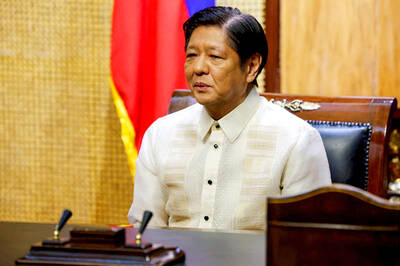
The Philippines would likely be involved in any conflict over Taiwan due to its proximity to the democracy claimed by China, President Ferdinand Marcos Jr said, reiterating a stance that risks angering Beijing. “In the Philippines, we do not have a choice because Taiwan is so close to the Philippines and we have almost 200,000 Filipino nationals living and working in Taiwan,” Marcos said in an interview with Japanese media in Manila on Monday. The Philippine leader’s comments come ahead of a state visit to Japan next week, where he is to meet with Japanese Prime Minister Sanae Takaichi to discuss security


 RSS
RSS