


The rise of China’s power is not limited to its economy: It also involves its military, with the People’s Liberation Army (PLA) making significant advances in the past decade in technology, training and strategic planning.
These developments include a massive buildup of missiles across the Taiwan Strait designed to discourage any move toward de jure independence for Taiwan. They also include the expansion of the Pacific Fleet, complete with new operation bases, aircraft carriers and nuclear submarines with first-strike capabilities.
All this raises concerns about Beijing’s true intentions as it tries to reassure the international community that it’s rise is peaceful. However, these concerns have been heightened by two recent developments.
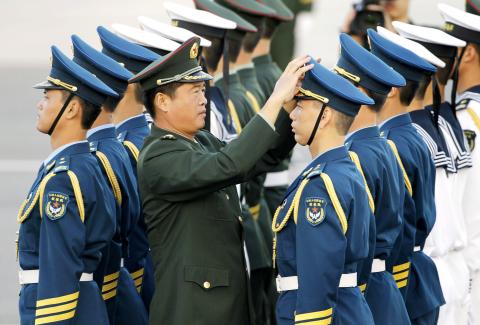
Photo: Reuters
One is China’s growing aggressiveness in pressing territorial disputes with neighbors such as Japan and India.
The other is emerging signs that the PLA may be increasing its influence over state affairs. When US Secretary of Defense Robert Gates was denied a request to visit Beijing in June, he blamed elements within the PLA for blocking the invitation, which he said the civilian leadership had likely wanted to make.
The Gates snub also followed a three-minute “rant” in May by Rear Admiral Guan Youfei (關友飛) to 65 visiting US officials in Beijing, in which he said that US arms sales to Taiwan proved that Washington viewed China as an enemy.
US diplomats attempted to portray Guan’s remarks as at odds with the thinking of the rest of the Chinese government. However, some said his comments represented mainstream views within the Chinese Communist Party (CCP).
What, then, lies behind the mixed signals from the Chinese military and civilian leadership?
One thing commentators agree on when discussing the often -mysterious relations between the CCP and one of the world’s largest military forces is that they exhibit none of the instability witnessed in Latin American and Africa in the last century as authoritarian regimes repeatedly fell victim to military coups. Indeed, the CCP and the PLA have shown a remarkable similarity of purpose over the years.
York Chen (陳文政), a former senior adviser at the National Security Council in Taipei, said the relationship between the CCP and the PLA was unique.
The two are so intermingled, Chen said, that senior military leaders are party representatives and party officials are members of the Central Military Commission (CMC).
In Latin America, though, the military banked on different political parties depending on their interests, he said.
Though there might be factional differences between the CCP and the PLA, they never escalated into open confrontation, Chen said.
Kou Chien-wen (寇健文), a professor of political science at the Graduate Institute of East Asian Studies at National Chengchi University, said the relationship between the PLA and the CCP was similar to that between the Chinese Nationalist Party (KMT) and Republic of China troops in the old days.
“The military is an interest group living on the party,” he said.
The PLA remains loyal to the CCP for three reasons, Kou said.
The first is the unique relationship developed when the revolution started. Political and military leaders were “dual elites,” he said, meaning they had the identity of both soldier and civilian.
While some early political leaders such as Mao Zedong (毛澤東) and Deng Xiaoping (鄧小平) had combat experience, soldiers were later appointed administrative positions. It took between 40 and 50 years to see the older generation retire, during which time the military developed the habit of submitting to the party, Kou said.
The second reason is that the party controls the appointments and dismissals of military positions. Finally, the CCP uses defense budgets to buy allegiance as long as the military promises not to challenge the political authorities, he said.
There have been exceptions, of course, including former minister of defense Peng Dehuai (彭德懷) and former CCP vice chairman Lin Biao (林彪).
Peng and several other leaders expressed concern over Mao’s Great Leap Forward campaign and reported the truth about the famine to Mao during the Lushan Conference in 1959. Peng’s candor, however, was considered an action beyond his authority. He was put under house arrest for 16 years and later persecuted during the Cultural Revolution.
Lin staged a failed coup to oust Mao, but some analysts saw it more as Lin’s personal attempt rather than a concerted group action. Lin died in a mysterious plane crash in Mongolia in 1971.
Rumors of dissent have also been played down by the party and the military. As one PLA general who spoke on condition of anonymity told the Washington Post recently, it is silly to talk about factions when it comes to relations with the US.
“The army follows the party,” the general was quoted as saying. “Do you really think that Guan did this unilaterally?”
Liu Shih-chung (劉世忠), a -research fellow at Taiwan Brain Trust, said he suspected the CCP and the PLA were playing “good cop, bad cop” when it came to foreign and cross-strait affairs.
“The CCP and the PLA might have different approaches, but they share the same mentality,” he said.
Little is known about factions in the CCP and the PLA because of the lack of transparency, but analysts say the public can still piece together bits of information to get a glimpse of the power struggle between the two.
The Tiananmen Square Massacre of 1989 saw an alleged division between the party and the military, Kuo said, adding that although no one could confirm whether the military refused to back military action in the first place, senior officers were later transferred.
The functions of the PLA have changed over the years, Kuo said. The 1991 Gulf War played a significant role in making the PLA more professional than political, he said, adding that the modern technology used in the operation made the PLA realize that it must spend more time training than involved in political infighting.
Nowadays, the PLA has a simpler job description, Kuo said. It is in charge of military matters, army building, foreign affairs, Taiwan -affairs and disaster relief.
Chen said it was not surprising to see the Chinese government call in outside troops to suppress student demonstrators in 1989 after the military purportedly did not show immediate backing for military action.
Chen said he did not think the military disobeyed orders from the civilian leadership, but instead the CCP made the decision to pre-empt a possible mutiny.
Chi Mao-chi (齊茂吉), director of the Graduate Institute of History at National Central University, said things took a dramatic turn in 1996 when the military botched its attempt to scare Taiwanese ahead of the first free presidential election.
“The incident was a turning point for the PLA, which considered it a significant humiliation,” he said. “Not only did [former president] Lee Teng-hui (李登輝) win by a landslide, but the US also got involved by sending two aircraft carrier fleets to patrol the Taiwan Strait.”
Since then, the number of soldiers at the CCP’s Political Bureau has gradually dwindled, he said, and so has the military’s influence on politics.
However, former Democratic Progressive Party legislator Lin Cho-shui (林濁水) disagreed, saying the PLA had been gaining more power since 1996 and that there was no indication that this would change in the near future.
While it is true that the party and military used to enjoy a close and often friendly relationship, Lin Cho-shui said, after the Chinese Civil War they have gradually grown apart, with the party retreating from the military and the army developing into an independent — and increasingly influential — faction.
Now as the only civilian official sitting on the CMC, Chinese President Hu Jintao (胡錦濤) must spend time building up loyalty to have real influence over the military, which Lin said had no problem setting the political agenda.
One example was Beijing’s recent claim that the South China Sea was its core national interest, which ran counter to the civilian government’s “good neighbor” policy, Lin Cho-shui said.
Beijing has also planned to establish a body similar to the US’ National Security Council, where the civilian government and the military could jointly formulate policies on foreign affairs and national security, but the proposal was emphatically rejected by the military, Lin Cho-shui said.
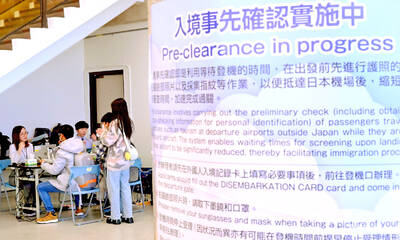
A preclearance service to facilitate entry for people traveling to select airports in Japan would be available from Thursday next week to Feb. 25 at Taiwan Taoyuan International Airport, Taoyuan International Airport Corp (TIAC) said on Tuesday. The service was first made available to Taiwanese travelers throughout the winter vacation of 2024 and during the Lunar New Year holiday. In addition to flights to the Japanese cities of Hakodate, Asahikawa, Akita, Sendai, Niigata, Okayama, Takamatsu, Kumamoto and Kagoshima, the service would be available to travelers to Kobe and Oita. The service can be accessed by passengers of 15 flight routes operated by

Chinese spouse and influencer Guan Guan’s (關關) residency permit has been revoked for repeatedly posting pro-China videos that threaten national security, the National Immigration Agency confirmed today. Guan Guan has said many controversial statements in her videos posted to Douyin (抖音), including “the red flag will soon be painted all over Taiwan” and “Taiwan is an inseparable part of China,” and expressing hope for expedited reunification. The agency last year received multiple reports alleging that Guan Guan had advocated for armed reunification. After verifying the reports, the agency last month issued a notice requiring her to appear and explain her actions. Guan

GIVE AND TAKE: Blood demand continues to rise each year, while fewer young donors are available due to the nation’s falling birthrate, a doctor said Blood donors can redeem points earned from donations to obtain limited edition Formosan black bear travel mugs, the Kaohsiung Blood Center said yesterday, as it announced a goal of stocking 20,000 units of blood prior to the Lunar New Year. The last month of the lunar year is National Blood Donation Month, when local centers seek to stockpile blood for use during the Lunar New Year holiday. The blood demand in southern Taiwan — including Tainan and Kaohsiung, as well as Chiayi, Pingtung, Penghu and Taitung counties — is about 2,000 units per day, the center said. The donation campaign aims to boost
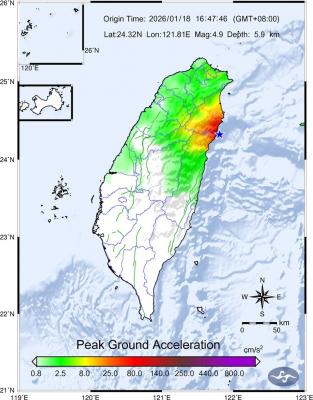
The Central Weather Administration (CWA) said a magnitude 4.9 earthquake that struck off the coast of eastern Taiwan yesterday was an independent event and part of a stress-adjustment process. The earthquake occurred at 4:47pm, with its epicenter at sea about 45.4km south of Yilan County Hall at a depth of 5.9km, the CWA said. The quake's intensity, which gauges the actual effects of a temblor, was highest in several townships in Yilan and neighboring Hualien County, where it measured 4 on Taiwan's seven-tier intensity scale, the CWA said. Lin Po-yu (林柏佑), a division chief at the CWA's Seismological Center, told a news conference


 RSS
RSS