


In a long-awaited move to address the ever-increasing wealth gap in Taiwan, the Executive Yuan yesterday eased restrictions on subsidies to economically disadvantaged people, officials said.
Under the Cabinet’s amendment to the Social Assistance Act (社會救助法), the number of households living under a redefined poverty line — or “low-income families” — would increase by 52,000 people in 21,000 households. At present, 264,000 people in 108,000 households, or 1.36 of the population, fall into this category.
The draft also proposed defining in the act “middle-to-low-income families” to legally conceptualize the category currently defined in different ways in rules and regulations and to ensure that existing subsidies would be legally protected.
About 536,000 people in 183,000 households will be categorized as “middle-to-low-income families,” which, together with “low-income families,” would bring the number of people covered by the act to 852,000 in 312,000 households, or 3.68 percent of the population.
At present, the poverty line is set at 60 percent of the average per capita monthly living expenditure of a given administrative area over the most recent statistical year, with some restrictions relating to ownership of personal assets and real estate, among others.
If the amendment passes the legislature the standard would be defined as 60 percent of the median disposable income per capita per month of a given administrative area over the latest statistical year.
The new poverty line in the five administrative areas — Taipei City, Kaohsiung City, Lienchiang County, Kinmen County and Taiwan Province, which includes the remainder of cities and counties on the Taiwanese mainland — however, would be subject to a ceiling of 70 percent of the national median disposable income per capita.
At a press conference following the Cabinet meeting, Minister of the Interior Jiang Yi-huah (江宜樺) said each of the five administrative areas would have a new poverty line “higher than the current one by a range of between NT$400 [US$12.60] and more than NT$1,000.”
Citing Taipei City as an example, Chiang said the minimum living expense standard was supposed to be lifted from NT$14,614 at present to NT$16,793 after the adjustment.
“However, because of the ceiling restrictions, the new poverty line in Taipei City could be less than NT$16,793,” Chiang said.
Without a clear-cut legal definition of “middle-to-low-income households,” different government agencies apply various criteria to hand out subsidies to people living in middle-to-low-income families: Households whose average per capita income exceeds the minimum living expenses standard, but is no greater than two-and-a-half times the standard for the family’s area of residence.
To standardize the definition, the amendment stipulated that “middle-to-low-income households” would be defined as households whose average per capita income exceeds the poverty line, but is not greater than 1.5 times that standard for the family’s region of residence.
Chiang said the adjustments would cost the government an additional NT$4.35 billion in the first year of its implementation, expected to be 2012.
Reacting to the news, Taiwan Fund for Families and Children chairman Lin Po-jung (林柏榕) praised the revisions, but said the government should do more to help families living in poverty.
“The government must be very careful when putting the ideas behind the revision into practice and come up with more policies to help these families become financially independent,” Lin said.
While the government intends to include more people under welfare coverage, Lin said, the revisions could face some challenges in practice.
“Despite what the law says, most local governments — besides Taipei and Kaohsiung cities — do not have concrete policy plans to help economically disadvantaged families to become financially independent,” Lin said.
Meanwhile, Democratic Progressive Party legislators Huang Wei-cher (黃偉哲) and Wong Chin-chu (翁金珠) said they hoped the plan wasn’t just another “election gimmick” to gain votes for the Chinese Nationalist Party (KMT) in the November special municipality elections.
ADDITIONAL REPORTING BY LOA IOK-SIN AND YAN JUO-CHIN

In a historic first, Taiwanese officials participated in this year’s Riga Strategic Communications Dialogue in Latvia from Wednesday to Friday last week, which debuted a breakout session focused on Taiwan The event organizer, the NATO Strategic Communications Center of Excellence, displayed Taiwan’s national flag and the officials’ formal titles on their Web site. Taiwanese attendees included National Security Council (NSC) Deputy Secretary-General Lin Fei-fan (林飛帆) and deputy head of the Taipei Representative Office in the UK, Chiang Ya-chi (江雅綺). In addition to the session discussing Taiwan titled “Taiwan: Navigating Strategic Communication in a Tense Environment,” the dialogue also included sessions
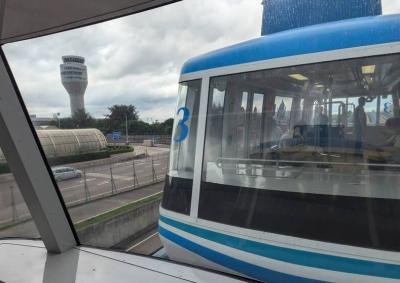
Taiwan Taoyuan International Airport is to suspend its automated Skytrain service connecting Terminal 1 and Terminal 2 starting on July 1 to facilitate connection works for the upcoming Terminal 3, the airport operator said today. Passengers and staff who need to travel between the two terminals after the suspension can instead use the Taoyuan MRT or the airport's 24-hour shuttle bus service, Taoyuan International Airport Corp said. The Taoyuan MRT Airport Line directly links the two terminals, while the shuttle buses are to operate around the clock, the company added. The Skytrain provides free transportation between the airport’s two terminals for travelers and
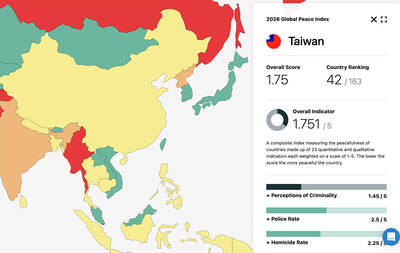
Taiwan ranked 42nd in terms of peacefulness among 163 countries, down five places from last year, according to this year’s Global Peace Index. With an overall score of 1.751, Taiwan dropped from 37th last year, the report published by the global Institute for Economics and Peace showed. The overall score measures a country’s level of peacefulness using 23 quantitative and qualitative indicators across three domains — ongoing domestic and international conflict, societal safety and security, and militarization. While Taiwan ranked 42nd worldwide, it was listed in ninth place among the 19 Asian-Pacific countries in the report, after New Zealand, Singapore, Japan, Malaysia,
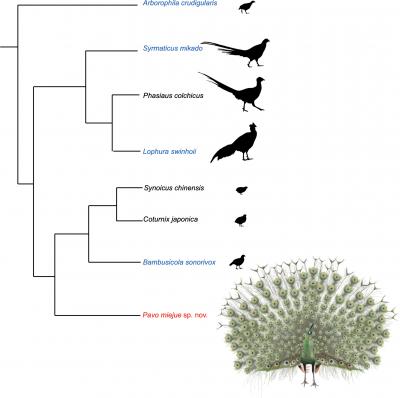
Through analyzing fossil evidence, a research team at National Taiwan University (NTU) discovered the largest endemic bird to have lived in Taiwan, naming it Pavo miejue, or extinct peafowl (滅絕孔雀). The Mikado pheasant, which is printed on the back of the NT$1,000 bank note, was previously believed to be the biggest endemic bird to Taiwan. The research team’s findings suggest that Pavo miejue lived during the Pleistocene epoch tens of thousands of years ago. It is the first endemic extinct bird species discovered and formally named in Taiwan. The study was coauthored by NTU Institute of Ecology and Evolutionary Biology professor Tsai Cheng-hsiu (蔡政修),


 RSS
RSS