


Recent remarks by President Ma Ying-jeou (馬英九) about cross-strait relations reflected the strategic jousting between Taiwan and China as Beijing steps up pressure for political talks, analysts said.
With the two sides signing 14 agreements in the past two years, Ma signaled that the current rate of progress was more than adequate.
During an interview with the Chinese-language China Times on Aug. 31, Ma said cross-strait liberalization would “maintain its current speed,” and that there was no need to “go any faster.”
He also offered a thorough explanation of his three-stage cross-strait policy. The first stage was to substantially relax cross-strait regulations. The second stage is to adhere to his “three nos:” no discussion of unification with Beijing during his presidency, no pursuit or support of de jure Taiwan independence and no use of force to resolve the Taiwan issue.
The final stage is to “exchange space with time,” so the two sides would strengthen bilateral exchanges, hoping that Taiwan would have an impact on development in China.
Ma’s remarks, interestingly, came on the heels of South Korean President Lee Myung-bak’s unification plan. Lee proposed on Aug. 15 a three-step plan to unify the Korean Peninsula and a new tax to help his country absorb the enormous costs of integration.
Lee’s plan calls for North Korea’s denuclearization. If the North meets that demand, Lee’s plan then calls for a “peace community,” improved economic cooperation and the eventual establishment of a “national community” of the Korean nation.
Lee and Ma are both halfway into their first term of presidencies.
Former president Chen Shui-bian (陳水扁) raised political eyebrows when he proposed the “one country on each side of the Taiwan Strait” theory two years into his first term in office.
Were Ma’s remarks merely a coincidence or a carefully plotted plan? Did Ma have any special intention and what did he want to achieve?
Former National Security Council adviser Lin Chen-wei (林成蔚) said Taipei and Beijing have been jockeying to set the agenda after they signed the Economic Cooperation Framework Agreement (ECFA), which came into force yesterday, and Ma’s recent remarks were part of the exchange.
While China has been clear in its goal of unifying with Taiwan, Lin said Ma was vague about the country’s future because he has the next election to worry about.
Lin said Taiwanese politicians often mistake slogans for policies, which they want the public to believe are indeed policies.
Taking Ma’s “three nos” pledge as an example, Lin said Ma never explained clearly what it meant.
Does “no pursuit or support of de jure Taiwan independence” mean there would not be a writing of a new constitution, or there would be a constitutional amendment, but it would steer clear of changing the national title or territorial boundaries?
As for no use of military force to resolve the Taiwan issue, it is even more “ridiculous,” Lin said, adding that Taiwan never wanted to go down that path.
Hsu Szu-chien (徐斯儉), an assistant research fellow at Academia Sinica’s Institute of Political Science, said Ma’s remarks were not at all surprising, but they nevertheless reflected the dilemmas faced by Ma and Beijing.
For Ma, he is facing Beijing’s mounting pressure for political talks and the public’s increasing displeasure with his performance.
Since the administration’s cross-strait policy is to tackle the economic and easier issues first, and then steadily move toward political and more difficult ones, Hsu said Ma reckoned that if Taiwan benefited considerably from the ECFA, the public would be more inclined to support his cross-strait policies, including returning Beijing’s economic favors with political concessions.
However, economic benefits will take time to be felt and the public has doubts about the administration’s ability to fairly allocate wealth once the economic benefits take effect.
Beijing, since it is not certain whether Ma will win his re-election bid in 2012, was likely to intensify its pressure on Ma. The intensity would depend heavily on the performance of his party in upcoming elections, Hsu said. The more election victories the Chinese Nationalist Party (KMT) secures, the more political capital Ma will have, Hsu said.
“If Beijing wants Ma to repay the debt too fast, Ma will soon lose his credibility at home,” Hsu said. “If China decides to let him pay it in installments, it is not clear whether he will be able to pay it all off.”
However, Ma has no one to blame but himself, since the predicament he’s in was of his own making, Hsu said.
Tang Shao-cheng (湯紹成), a research fellow at National Chengchi University’s Institute of International Relations, said Ma’s remarks were aimed at the US and Taiwanese who had doubts about the hasty improvement of cross-strait ties.
“The message is that Taipei and Beijing will not be as much in love as before,” he said. “The president is also saying that maybe it is better to take a step backward because they have already taken two steps forward.”
Tang said he suspected there would not be any major breakthrough in cross-strait relations during the remainder of Ma’s presidency. Although the two sides might sign a cultural agreement, Tang said it would not have an overwhelming political effect.
If Ma achieves a strong showing in the 2012 re-election, he would likely make a big move before Chinese President Hu Jintao (胡錦濤) hands over power in October that year, Tang said.
Regarding unification on the Korean Peninsula, analysts agreed that Lee made the proposal because of pressure from home and abroad, and that political integration was a complicated issue that was unlikely to happen soon.
Hsu said such a possibility was a remote one and the undertaking would be expensive.
“To fall in love with someone is one thing, but to get married is another,” he said.
Besides, if North and South Korea decided to integrate, the US would lose the legitimacy of being a constant security presence in East Asia, a result Seoul would not want to see, since it would boost China’s dominance in the region, he said.
Lin said various polls indicated that most Koreans wanted to see the two countries integrate, but they were ambivalent about the cost.
China would have to change its Taiwan policy one way or another regardless of the position of a potential united-Korea government, Lin said. While a pro-US Korean government would pose a security threat to China, a pro-China regime would make Beijing more confident, he said.
“Either way, Taiwan would not be an independent variable in the game,” he said. “It must survive among powerful players.”
Tang said Beijing does not want to see the collapse of North Korea, since it would bring an influx of refugees across the borders and more direct contact with South Korean and US forces.
However, unification of the two Koreas might not be a bad thing for Taiwan, he said, because Beijing would likely shift its focus to the Korean Peninsula.
Also, because regional integration has become a global trend, analysts agreed that it was a viable option for Taiwan.
Lin said regional integration was the “third choice” for Taiwan apart from independence or unification.
While it is impossible to directly adopt the EU model, there are lessons to be learned, he said. The most important one is to make Taiwan’s interest in joining the regional bloc conform to that of the US, he said.
Facing the rapid rise of China, Lin said regional integration was a good way to “tame” China because different countries have individual interests and common ones, but to protect their best interests, they must work together.
Some might question whether Taiwan has the political legitimacy to participate, but this should not hinder such an option, he said.
Hsu said regional integration was the way to go no matter what the future holds for Taiwan. Sadly however, both the ruling and opposition parties are paying little attention to the issue, he said.
He disagreed with Lin that regional integration was an alternative for Taiwan, saying he saw it as a different dimension.
Since Japan has proposed the creation of an East Asia Community and Australia suggested an Asia-Pacific Community, Hsu said Ma would prefer the country to join the China-centered body. However, for the interests of Taiwan, it would be best to gain access to both, he said.
“But it will be very hard,” Hsu said.
However, Taiwan has a trump card. Taiwanese voters can elect different parties to govern every four years, he said.
Also See: Beware of China’s peace offensive

Chinese spouse and influencer Guan Guan’s (關關) residency permit has been revoked for repeatedly posting pro-China videos that threaten national security, the National Immigration Agency confirmed today. Guan Guan has said many controversial statements in her videos posted to Douyin (抖音), including “the red flag will soon be painted all over Taiwan” and “Taiwan is an inseparable part of China,” and expressing hope for expedited reunification. The agency last year received multiple reports alleging that Guan Guan had advocated for armed reunification. After verifying the reports, the agency last month issued a notice requiring her to appear and explain her actions. Guan

GIVE AND TAKE: Blood demand continues to rise each year, while fewer young donors are available due to the nation’s falling birthrate, a doctor said Blood donors can redeem points earned from donations to obtain limited edition Formosan black bear travel mugs, the Kaohsiung Blood Center said yesterday, as it announced a goal of stocking 20,000 units of blood prior to the Lunar New Year. The last month of the lunar year is National Blood Donation Month, when local centers seek to stockpile blood for use during the Lunar New Year holiday. The blood demand in southern Taiwan — including Tainan and Kaohsiung, as well as Chiayi, Pingtung, Penghu and Taitung counties — is about 2,000 units per day, the center said. The donation campaign aims to boost

The Kaohsiung Tourism Bureau audited six hotels in an effort to prevent price gouging ahead of Korean band BTS’ concert tour in the city scheduled for Nov. 19, 21 and 22 this year. The bureau on Friday said that the audits — conducted in response to allegations of unfair pricing posted on social media — found no wrongdoing. These establishments included the local branches of Chateau de Chine, Hotel Nikko, My Humble House, and Grand Hai Lai, it said, adding that the Consumer Protection Commission would have penalized price gougers had the accusations been substantiated. The bureau said the Tourism Development Act
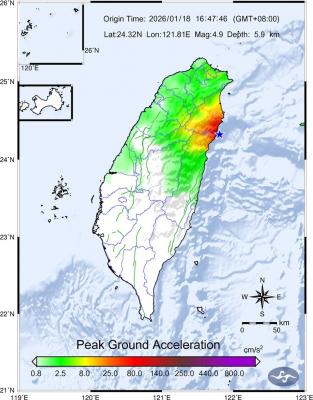
The Central Weather Administration (CWA) said a magnitude 4.9 earthquake that struck off the coast of eastern Taiwan yesterday was an independent event and part of a stress-adjustment process. The earthquake occurred at 4:47pm, with its epicenter at sea about 45.4km south of Yilan County Hall at a depth of 5.9km, the CWA said. The quake's intensity, which gauges the actual effects of a temblor, was highest in several townships in Yilan and neighboring Hualien County, where it measured 4 on Taiwan's seven-tier intensity scale, the CWA said. Lin Po-yu (林柏佑), a division chief at the CWA's Seismological Center, told a news conference


 RSS
RSS