


Taipei prosecutors yesterday denied reports that a former Taiwan High Court judge convicted of corruption had disappeared and said they had him under surveillance to make sure he did not flee the country before serving a prison term.
Former Taiwan High Court judge Lo Chi-hsiung (羅紀雄) was indicted for corruption in 1994 for receiving NT$1 million (US$30,000) from a defendant in his court. After a long legal process, Lo on Aug. 26 received a final sentence of 11 years in prison.
Prosecutors ordered Lo to present himself to begin his prison term on Sept. 17.
Prosecutors yesterday denied reports by media that agents of the Ministry of Justice’s Investigation Bureau had lost track of Lo since Thursday.
Lo on Saturday made a phone call to prosecutors and reported to them, prosecutors said, adding that they had the situation under control and that they knew his whereabouts.
Lo allegedly told prosecutors that he found it “bothersome” to have agents follow him closely whenever he left home.
Prosecutors have a long history of being concerned about criminals fleeing abroad, often to China.
Chang Ping-lung (張炳龍), another former Taiwan High Court judge who was given a 12 year prison sentence for taking bribes, fled the country months ago before the final verdict in his case could be delivered.
Other white collar criminals who fled the country before beginning their jail term or receiving a final verdict include former Rebar president Wang You-theng (王又曾), former Tuntex Group chairman Chen Yu-hao (陳由豪) and former An Feng Group (安峰集團) president Chu An-hsiung (朱安雄).
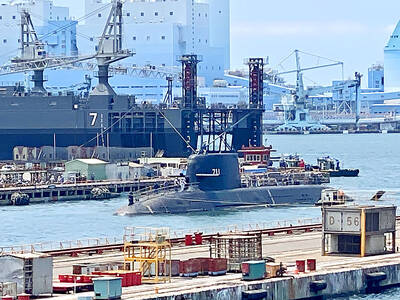
AGING: While Japan has 22 submarines, Taiwan only operates four, two of which were commissioned by the US in 1945 and 1946, and transferred to Taiwan in 1973 Taiwan would need at least 12 submarines to reach modern fleet capabilities, CSBC Corp, Taiwan chairman Chen Cheng-hung (陳政宏) said in an interview broadcast on Friday, citing a US assessment. CSBC is testing the nation’s first indigenous defense submarine, the Hai Kun (海鯤, Narwhal), which is scheduled to be delivered to the navy next month or in July. The Hai Kun has completed torpedo-firing tests and is scheduled to undergo overnight sea trials, Chen said on an SET TV military affairs program. Taiwan would require at least 12 submarines to establish a modern submarine force after assessing the nation’s operational environment and defense

Yangmingshan National Park authorities yesterday urged visitors to respect public spaces and obey the law after a couple was caught on a camera livestream having sex at the park’s Qingtiangang (擎天崗) earlier in the day. The Shilin Police Precinct in Taipei said it has identified a suspect and his vehicle registration number, and would summon him for questioning. The case would be handled in accordance with public indecency charges, it added. The couple entered the park at about 11pm on Thursday and began fooling around by 1am yesterday, the police said, adding that the two were unaware of the park’s all-day live
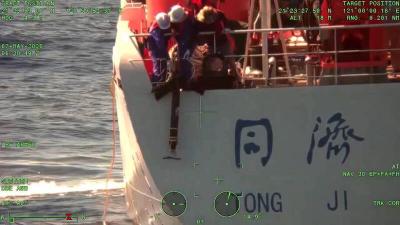
The coast guard today said that it had disrupted "illegal" operations by a Chinese research ship in waters close to the nation and driven it away, part of what Taipei sees a provocative pattern of China's stepped up maritime activities. The coast guard said that it on Thursday last week detected the Chinese ship Tongji (同濟號), which was commissioned only last year, 29 nautical miles (54km) southeast of the southern tip of Taiwan, although just outside restricted waters. The ship was observed lowering ropes into the water, suspected to be the deployment of scientific instruments for "illegal" survey operations, and the coast

A former soldier and an active-duty army officer were yesterday indicted for allegedly selling classified military training materials to a Chinese intelligence operative for a total of NT$79,440. The Taipei District Prosecutors’ Office indicted Chen Tai-yin (陳泰尹) and Lee Chun-ta (李俊達) for contravening the National Security Act (國家安全法) and the Anti-Corruption Act (貪污治罪條例). Chen left the military in September 2013 after serving alongside then-staff sergeant Lee, now an army lieutenant, at the 21st Artillery Command of the army’s Sixth Corps from 2011 to 2013, according to the indictment. Chen met a Chinese intelligence operative identified as “Wang” (王) through a friend in November


 RSS
RSS