


Speculation that China could withdraw the missiles targeting Taiwan in the second half of next year to pave the way for political negotiations drew a mixed reaction among legislators yesterday.
Chinese Nationalist Party (KMT) Legislator Lin Yu-fang (林郁方), a member of the legislature’s Foreign and National Defense Committee, dismissed the possibility of political negotiations with China in the near future and accused former Taiwanese representative to the US Joseph Wu (吳釗燮) of fueling speculation that the KMT has secret political agreements with Beijing ahead of the presidential election in 2012.
Responding to reporters’ questions after a conference in Los Angeles on Sunday, Wu said Chinese President Hu Jintao (胡錦濤), who will hand over the presidency to his successor in 2013, could do his best to pressure Taiwan into beginning political negotiations with China.
However, it was unlikely Taiwan would accept the proposal, the former envoy said, as President Ma Ying-jeou (馬英九) has on several occasions said he would not pursue political talks with Beijing during his term in office, while Taiwanese have yet to reach a consensus on the matter.
To compel Taiwan to accept talks, he said, China could remove the missiles to create a false impression of cross-strait peace so the KMT government would agree to negotiating a peace agreement.
If this happened, he said, it would likely occur in the second half of next year.
Lin said the KMT would not proceed with political talks with Beijing for the time being because Taiwanese remained widely divided on the issue. Instead it would only seek to stabilize cross-strait relations through cultural and academic exchanges and economic cooperation.
KMT Legislator Wu Yu-sheng (吳育昇), head of the legislature’s Internal Administration Committee, said it was impossible for the government to accept any proposed political negotiation because “the time is not ripe” for the two sides to talk about political issues.
Democratic Progressive Party (DPP) Legislator Huang Wei-cher (黃偉哲) said he believed Joseph Wu’s comments were based on sound logical reasoning, but failed to take into account Beijing’s tendency to hand out wild cards.
Using China’s currency stance as an example, Huang said Beijing did not allow its currency to float on the open market despite sustained pressure from its trading partners.
“They were quite firm in their approach ... and it shows that while Hu might come under some pressure before his term is up, it doesn’t necessarily mean that he will remove the missiles,” Huang said.
While the missiles are a key point of contention, DPP Legislator Wang Sing-nan (王幸男) said a far more important issue was whether Beijing would agree to renounce the use of force against Taiwan.
Taiwanese politicians should refrain from falling for Beijing’s bait and treating the removal of the missiles as a step forward in cross-strait relations, he said, adding that “a promise to never use force against Taiwan is the only right direction.”
However, even if the missiles were relocated, Huang said it would most likely take place in 2012 rather than next year as Wu said, to coincide with Ma’s re-election bid.
“This way, everybody gets a Nobel Prize,” Huang said.
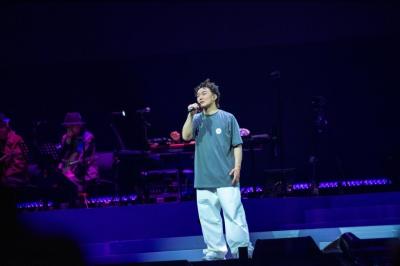
Hong Kong singer Eason Chan’s (陳奕迅) concerts in Kaohsiung this weekend have been postponed after he was diagnosed with Covid-19 this morning, the organizer said today. Chan’s “FEAR and DREAMS” concert which was scheduled to be held in the coming three days at the Kaohsiung Arena would be rescheduled to May 29, 30 and 31, while the three shows scheduled over the next weekend, from May 23 to 25, would be held as usual, Universal Music said in a statement. Ticket holders can apply for a full refund or attend the postponed concerts with the same seating, the organizer said. Refund arrangements would
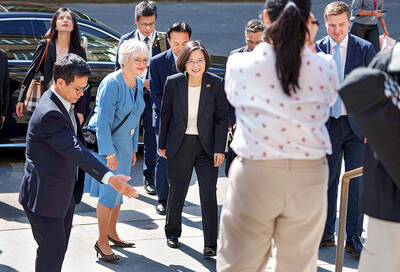
Former president Tsai Ing-wen (蔡英文) on Monday called for greater cooperation between Taiwan, Lithuania and the EU to counter threats to information security, including attacks on undersea cables and other critical infrastructure. In a speech at Vilnius University in the Lithuanian capital, Tsai highlighted recent incidents in which vital undersea cables — essential for cross-border data transmission — were severed in the Taiwan Strait and the Baltic Sea over the past year. Taiwanese authorities suspect Chinese sabotage in the incidents near Taiwan’s waters, while EU leaders have said Russia is the likely culprit behind similar breaches in the Baltic. “Taiwan and our European
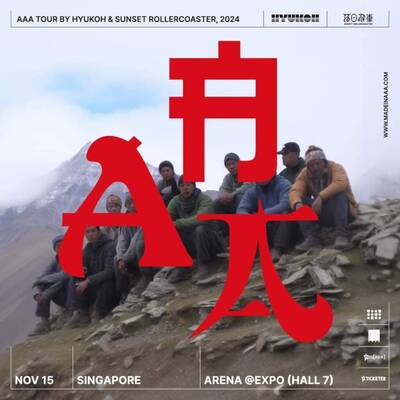
Taiwanese indie band Sunset Rollercoaster and South Korean outfit Hyukoh collectively received the most nominations at this year’s Golden Melody Awards, earning a total of seven nods from the jury on Wednesday. The bands collaborated on their 2024 album AAA, which received nominations for best band, best album producer, best album design and best vocal album recording. “Young Man,” a single from the album, earned nominations for song of the year and best music video, while another track, “Antenna,” also received a best music video nomination. Late Hong Kong-American singer Khalil Fong (方大同) was named the jury award winner for his 2024 album

The Taipei District Court sentenced babysitters Liu Tsai-hsuan (劉彩萱) and Liu Jou-lin (劉若琳) to life and 18 years in prison respectively today for causing the death of a one-year-old boy in December 2023. The Taipei District Prosecutors’ Office said that Liu Tsai-hsuan was entrusted with the care of a one-year-old boy, nicknamed Kai Kai (剴剴), in August 2023 by the Child Welfare League Foundation. From Sept. 1 to Dec. 23 that year, she and her sister Liu Jou-lin allegedly committed acts of abuse against the boy, who was rushed to the hospital with severe injuries on Dec. 24, 2023, but did not


 RSS
RSS