


When Democratic Progressive Party (DPP) Taipei City councilors Lee Wen-ying (李文英) and Chuang Ruei-hsiung (莊瑞雄) first questioned the price of flowers to decorate the Xinsheng Overpass and connect the project with Taipei International Flora Exposition last week, the Taipei City Government ignored the accusation and made no effort to clarify the issue.
It was not until the purchase plan became a hot topic on political talk shows that the city government began to take the issue more seriously.
Taipei Mayor Hau Lung-bin (郝龍斌) made his first response on Tuesday by revealing the prices of flowers used and saying that the city’s Department of New Construction paid about two times the market price for the flowers. However, Hau defended the incident as merely “administrative negligence” from civil officials, and slammed the DPP for politicizing the issue.
The Hau team’s failure to offer a clear explanation of the matter and thoroughly review the purchase plan presented the DPP with opportunities to issue more attacks, digging out more information to accuse the city government of paying up to 30 times the market price for flowers and turning the incident into a threat to Hau’s re-election bid in November’s special municipality elections.
“The civil servants who oversaw the purchase plans were either blind, or took kickbacks to have paid such ridiculously high prices for flowers. However, I think what’s more ridiculous is the city government’s slow and sloppy responses to the issue,” People First Party Taipei City Councilor Vivian Huang (黃珊珊) said.
Huang said the Hau team could have stopped the dispute from turning into a crisis if it acknowledged the mistake and launched an investigation into the problematic expenditures immediately.
The city government did not launch an investigation into the matter until six DPP Taipei City councilors filed a lawsuit on Thursday against Hau for negligence of duty.
Hau on Friday offered his apology to the public over the incident, and removed the head of the city’s Public Works Bureau from his post. He also set up a task force to review the purchase plans for the overpass and flora expo.
“We did react to the incident a little too late, but we will face up to the dispute candidly. The city government will not hide the truth, and any officials who are involved in illegal acts will be punished,” he said.
However, Hau’s apology and promise of a thorough investigation failed to impress the public.
According to the latest poll released by the Chinese-language Apple Daily, 64 percent of respondents said they believed Hau would lose votes over the incident. He stood at 43.12 percent in the poll, falling behind his DPP counterpart Su Tseng-chang (蘇貞昌), at 44.68 percent.
The flora expo, a 171-day international event that will open on Nov. 6, will be a key variable for the Taipei mayoral election, which is stated to take place on Nov 27.
Of the NT$9.5 billion (US$296.5 million) budget for the expo, the city government assigned NT$136 million for publicity and promotion, hoping to boost Hau’s approval ratings with the extravaganza.
However, the flower purchase plans for the bridge project, which the DPP insisted was part of the expo project, could become the biggest obstacle for Hau ahead of the election.
“The flora expo is a great chance for Taiwan to show its strength in the horticulture industry, but the general public is not sharing the pride. The overpriced flower purchase plans are making things worse, and the public will think of the expo as an expensive event that city officials tried to benefit from,” New Party Taipei City Councilor Wang Hung-wei (王鴻薇) said.
The Hau team has failed to learn its lessons from past incidents, including the problematic support pillars of the Maokong Gondola and the frequent malfunctions of the Wenshan-Neihu MRT Line. Hau and top city officials shrugged off concerns about the projects at first, only acknowledging negligence after the problems grew worse.
A Chinese Nationalist Party (KMT) official, who spoke on condition of anonymity, said the Hau team has long been a headache for the party, as Hau and his aides have strong opinions on how to handle issues, and ignored the KMT’s instructions on several occasions.
As the KMT cannot afford to lose the mayoral election in Taipei City, where the KMT has been in power for 12 years, the party will take over the issue and instruct the party’s Taipei City council caucus to strengthen cooperation with the Hau team in solving the dispute, he said.
Top party officials, including President Ma Ying-jeou (馬英九) — who doubles as KMT chairman — and KMT Secretary-General King Pu-tsung (金溥聰) will step up the efforts to campaign for Hau, he said.
Shih Cheng-feng (施正鋒), a political analyst at National Tung Hua University, said the city government’s poor handling of the incident showed its overconfidence in the Taipei mayoral election.
Hau won the mayoral election by a thin margin four years ago over then-DPP candidate Frank Hsieh (謝長廷), winning just over 10 percent more votes than Hsieh in the pan-blue stronghold.
Hau is fighting a tougher battle this time, as Su has shown rising support in several polls.
Shih said Hau must make the budget plans for the bridge and expo as transparent as possible and devote more effort to organizing a successful flora expo before he can win the re-election.

UPGRADE: The Kang Ding-class frigate is replacing its Chaparall missiles with Tien Chien II and Hua Yang VLS, which would provide it with long-range, 360° air defense Taiwan plans to produce 1,200 to 1,376 Hai Chien II missiles (海劍二, Sea Sword II) — also known as TC-2N — to serve as the standard air defense system of the navy’s surface combatant fleet, a source said yesterday. Last week, the Hai Chien II, the naval version of the Tien Kung II missile (天劍二, Sky Sword II), completed a live-fire test in waters off the National Chungshan Institute of Science and Technology’s Jiupeng facility (九鵬) in Pingtung County’s Manjhou Township (滿州). The MIM72 Chaparral and other dated air defense missiles that currently arm Taiwanese ships have inadequate range to combat Chinese

REASONS FOR TRAVEL: An assistant professor said that proposed amendments to penalize drivers if they used drugs overseas would not deter people from traveling People who operate a motor vehicle under the influence of marijuana would have their driver’s license revoked, even if they used the substance while overseas, the Ministry of Transportation and Communications said yesterday, citing proposed amendments to the Road Traffic Management and Penalty Act (道路交通管理處罰條例). The amendments would also authorize the government to revoke the licenses of people determined to have used Category 1 or Category 2 narcotics, even if they were not operating a vehicle while under the influence of drugs, as well as ban them from taking the license test for three years, the ministry said. People aged 18 or

HEAVY WEATHER: Typhoon Jangmi is due to crash straight into the Ryukyus as airlines look to shift flights to larger aircraft or cancel flights to Okinawa entirely Taiwan’s international air carriers announced flight adjustments over the weekend as Typhoon Jangmi is forecast to hit the Ryukyu Islands today and tomorrow. The Central Weather Administration (CWA) upgraded Jangmi from a tropical storm to a typhoon at 8am yesterday, with the eye located 580km south of Naha city. It was moving north at 19kph. Today, China Airlines’ CI-120, CI-121, CI-122 and CI-123 flights between Taoyuan and Naha, Okinawa, have been canceled as well as CI-132 and CI-133 between Kaohsiung and Naha. EVA Air’s BR-112, BR-113, BR-186 and BR-185 flights between Taoyuan and Naha are also canceled. Low-cost carrier Tigerair Taiwan canceled IT-230,
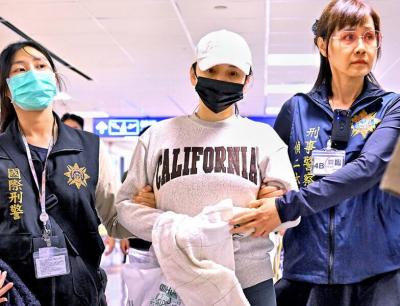
Johanne Liou (劉喬安), a Taiwanese woman who shot to unwanted fame during the Sunflower movement protests in 2014, returned to Taiwan last night after being deported from the US. She is to stand trial in Taiwan for charges involving embezzlement, fraud and drug crimes. The Criminal Investigation Bureau (CIB) said it took her into custody at Taiwan Taoyuan International Airport and would first question her before transferring her to the New Taipei District Prosecutors’ Office. She was arrested upon disembarking a flight from San Francisco that landed shortly before 7pm. Liou absconded to the US in 2019 after jumping bail


 RSS
RSS