


With the runaway success of the 3D version of Avatar, Taiwan’s puppet show industry is preparing to launch its own 3D film featuring the nation’s traditional cloth puppets within a year.
The National Center for High-Performance Computing (NCHC) and local puppet theater company Pili International Multimedia Co are cooperating to develop Taiwan’s first 3D puppet film, a collaboration that aims to invigorate the traditional art with the use of new technology, the NCHC said.
A 3D puppet film, which would normally take five years to complete, may now take less than a year with the help of the NCHC, Pili managing director Vincent Huang said.
NCHC’s technologies have mostly been used in biomedical and disaster relief fields in the past, National Applied Research Laboratories (NARL) president Chen Wen-hwa (陳文華) said at a press conference on Wednesday.
“It was beyond our expectations, but people in the technology business can now make contributions in the creative industry,” Chen said.
A five-minute experimental 3D puppet film featuring the legendary puppet character Su Huang-chen was shown at the press conference that the NARL held.
The crew also gave live demonstrations of how to shoot a 3D film at the press conference, which was titled “Technology Meets Creative Industry — Su Huan-chen Revitalized.”
Audiences listened in awe as Huang, the “Eight Tone Genius” known for his one-man-with-multiple-voices talent, alternated between characters in the puppet roles “Sheng,” “Dan” and “Chou.”
Pili’s attempts to make 3D films in the past have been hampered by expensive post-production costs and a lack of technical support, Huang said.
“Now that we have a chance to cooperate, I hope that the NCHC will continue to be our visual consultant,” Huang said.
Huang, who said he dreamed that puppet Su Huang-chen told him to jiayou, or “go,” added that he hopes to bring the 3D puppet show onto an international stage.
The budget for Legend of the Sacred Stone, the first-ever puppet movie, was originally estimated at NT$80 million (US$2.493 million), but increased to NT$200 million as the filming proceeded, Huang said.
“With the help of the NCHC, we will be able to lower the film’s production costs and re-evaluate technology costs,” Huang said.
As Taiwan’s only national-level supercomputing center, the NCHC possesses advanced supercomputing, storage and scientific visualization technologies, the NCHC said.
“The experimental film is the first step in our cooperation, and we expect to work together in the fields of supercomputing, video storage, and visual technologies in the future to help our local puppetry art gain a competitive edge in the international market,” it said in a statement on its Web site.

The military has spotted two Chinese warships operating in waters near Penghu County in the Taiwan Strait and sent its own naval and air forces to monitor the vessels, the Ministry of National Defense (MND) said. Beijing sends warships and warplanes into the waters and skies around Taiwan on an almost daily basis, drawing condemnation from Taipei. While the ministry offers daily updates on the locations of Chinese military aircraft, it only rarely gives details of where Chinese warships are operating, generally only when it detects aircraft carriers, as happened last week. A Chinese destroyer and a frigate entered waters to the southwest
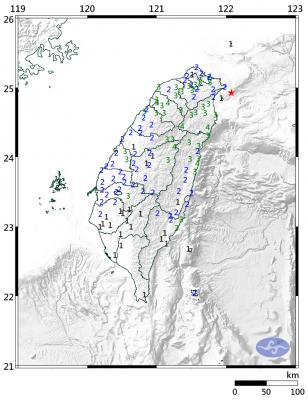
A magnitude 6.1 earthquake struck off the coast of Yilan County at 8:39pm tonight, the Central Weather Administration (CWA) said, with no immediate reports of damage or injuries. The epicenter was 38.7km east-northeast of Yilan County Hall at a focal depth of 98.3km, the CWA’s Seismological Center said. The quake’s maximum intensity, which gauges the actual physical effect of a seismic event, was a level 4 on Taiwan’s 7-tier intensity scale, the center said. That intensity level was recorded in Yilan County’s Nanao Township (南澳), Hsinchu County’s Guansi Township (關西), Nantou County’s Hehuanshan (合歡山) and Hualien County’s Yanliao (鹽寮). An intensity of 3 was

Japanese Prime Minister Sanae Takaichi’s comment last year on Tokyo’s potential reaction to a Taiwan-China conflict has forced Beijing to rewrite its invasion plans, a retired Japanese general said. Takaichi told the Diet on Nov. 7 last year that a Chinese naval blockade or military attack on Taiwan could constitute a “survival-threatening situation” for Japan, potentially allowing Tokyo to exercise its right to collective self-defense. Former Japan Ground Self-Defense Force general Kiyofumi Ogawa said in a recent speech that the remark has been interpreted as meaning Japan could intervene in the early stages of a Taiwan Strait conflict, undermining China’s previous assumptions
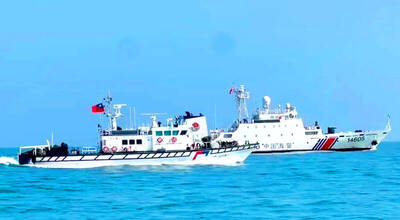
Instead of focusing solely on the threat of a full-scale military invasion, the US and its allies must prepare for a potential Chinese “quarantine” of Taiwan enforced through customs inspections, Stanford University Hoover fellow Eyck Freymann said in a Foreign Affairs article published on Wednesday. China could use various “gray zone” tactics in “reconfiguring the regional and ultimately the global economic order without a war,” said Freymann, who is also a nonresident research fellow at the US Naval War College. China might seize control of Taiwan’s links to the outside world by requiring all flights and ships entering or leaving Taiwan


 RSS
RSS