


The Democratic Progressive Party (DPP) will seek to win the year-end elections on a platform promising a brighter future for future generations, DPP candidates said at a party congress yesterday.
The day-long party congress was held to elect new members to the DPP’s central standing and central executive committees, two groups that have considerable sway over party nominees for 2012’s legislative elections and the 2012 presidential election.
Prior to the elections in the afternoon, all five DPP candidates for the year-end special municipality elections took turns speaking in front of the delegates.
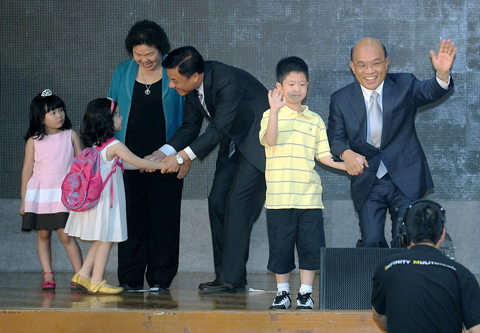
PHOTO: LIAO CHEN-HUEI, TAIPEI TIMES
This was the second time the five candidates were together in preparation for the Nov. 27 elections. Walking onto the stage holding the hands of young children, the candidates said they would aim to provide future generations with a better life.
“What’s the meaning of our participation in politics if not to give the next generation a sense of happiness and pride?” DPP Chairperson Tsai Ing-wen (蔡英文) asked.
“This is our responsibility, a responsibility we must do our utmost to realize,” she told the hundreds of delegates at the Taipei Municipal Dunhua Junior High School.
DPP candidate for Taipei City, former Premier Su Tseng-chang (蘇貞昌), said that if the party won the year-end elections, it would create hope for the next generation.
Holding the hands of his grandchildren as he walked on stage, Su said: “If we can win public support and win the year-end elections … we will have the ability to care for Taiwan and give our next generations more hope for the future.”
Sources close to the DPP’s election campaign said the party was aiming to win at least three of the five seats up for grabs in November. The other three candidates are Su Jia-chyuan (蘇嘉全) for Greater Taichung, William Lai (賴清德) for Greater Tainan and Chen Chu (陳菊) for Greater Kaohsiung.
All three delivered speeches during the convention. After the speeches, delegates agreed that the slogan for the congress, which held its first meeting in 1986, would be “providing the next generation with happiness and pride.”
The declaration came three days after the DPP chairperson pledged she would give residents in Sinbei City, where she is running for mayor, a new sense of happiness and well-being.
Observers said the word “happiness” was quickly shaping up to be one of the key election themes for Tsai as the nation is rocked by stagnating wages, rising housing prices and record-high unemployment.
Speaking at a series of town hall forums in April, Tsai, who has championed policies of reform since becoming head of the party in 2008, said the country needed to focus more on addressing the challenges awaiting future generations.
She said that if solutions were not found, the next generation would “look back and ask [us] where we went wrong,” and that “in the future, society will likely face a generational divide.”
Tsai said that to deal with these challenges, the opposition party needed to leave the next generation legacies of happiness and pride.
“The last generation sacrificed their youth and paved a road of democracy for Taiwan,” she said. “On this road, Taiwan became affluent and prosperous, enjoying a pluralistic culture and a firm, unshakable independence … creating a set of Taiwanese values.”
“As we sit on the legacies of our forefathers … we have to consider the legacy that we will leave for our next generation,” she said. “The [answer] is happiness and pride.”
She defined happiness as a safe environment, a sophisticated education system, full employment and opportunities to start a family. Pride meant that children would recognize their own country, take pride in the environment and be proud of their hometowns and Taiwan, she said.
Tsai also took aim at the Chinese Nationalist Party (KMT).
“For the governing KMT, the year-end elections may be a battle to protect its governance,” she said. “But for the DPP, we are doing this for the happiness and pride of the people.”

FUKUOKA SITUATION: Japanese media reported that the pathogen is expected to be identified by the summer, while the CDC downplayed the idea that it was hMPV A “mysterious cold-like illness” reported in Japan’s Fukuoka Prefecture does not seem to be a new disease, but Japanese authorities have been asked about the situation, the Centers for Disease Control (CDC) said yesterday. The Fukuoka Prefectural Medical Association on Wednesday told a news conference that a “mystery cold” that has become a hot topic on social media is “highly likely to be caused by some kind of viral infection,” Japan’s KBC News reported. “Many people are experiencing symptoms starting with a sore throat, followed by a runny nose, phlegm and a severe cough,” KBC News reported, citing association officials. Health authorities are

Nvidia Corp CEO Jensen Huang (黃仁勳) arrived in Taiwan yesterday ahead of upcoming AI and technology events, saying he plans to meet with clients and Taiwan Semiconductor Manufacturing Co Chairman C.C. Wei (魏哲家) during his visit. After landing at Taipei Songshan Airport, Huang posed for photos with fans and handed out Yakult drinks to reporters and supporters waiting at the scene, saying he has “a lot to do” during the trip. Asked about reports that Nvidia’s planned headquarters site in Taipei’s Beitou Shilin Technology Park could break ground on May 27, Huang said that if the company holds an event, he would

The Ministry of Finance this afternoon announced the winning numbers for the March-April uniform invoice lottery. The winning number for the NT$10 million (US$318,060) special prize is 19531471, and the winning number for the NT$2 million grand prize is 85941329. Three numbers were drawn for the NT$200,000 first prize: 07225810, 20231230 and 83518781. Those with receipts matching the last seven digits of any of the first-prize numbers will win the NT$40,000 second prize, while those matching the last six digits will win the NT$10,000 third prize. Those whose receipts match the last five digits of the first-prize numbers can claim the NT$4,000 fourth prize,

SIX SUBSIDIES: The monthly allowance for older farmers is to increase to NT$10,000, and NT$5,000 is to be given to homemakers under the national pension system, Lai said The government is to implement major welfare policies for disadvantaged groups, including raising the monthly allowance for older farmers to NT$10,000 and providing homemakers with NT$5,000 per month, President William Lai (賴清德) said yesterday. Lai made the remarks during a visit to Wangling Temple in Chiayi County, saying that the planned increases were being introduced amid economic growth and an increase in tax revenue. Touting a policy, in which the government plans to provide a monthly allowance of NT$5,000 for every child under the age of 18 in a bid to address Taiwan’s low birthrate, Lai said that if received for the


 RSS
RSS