


From Green Island to Taipei, cities and towns nationwide feature works of art in public places. Though most may not rank as masterpieces, academic Lin Chih-ming (林志銘) has decided to tell their stories.
Rather than focusing on the works themselves, Lin zeroed in on the stories behind 15 public installations, recently publishing a book showing how for many artists or communities, the artworks have an emotional attachment.
“This is only the beginning of a series of books I am planning to publish in the hope of promoting the beauty of Taiwan,” said Lin, the president of the Educational Development Association for Public Art.
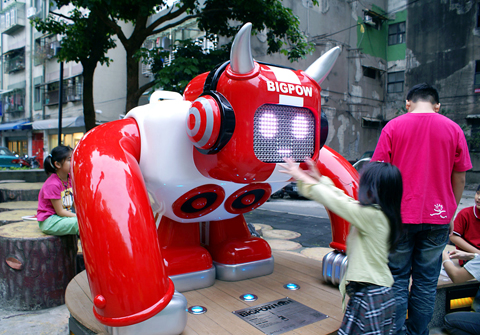
PHOTO PROVIDED COURTESY OF THE EDUCATIONAL DEVELOPMENT ASSOCIATI
One of the 15 public works featured in Lin’s book is a playground slide set called the Green Island Elephant, which was originally a fixture on a local elementary school playground for about 23 years.
AUCTION
The slide was put up for auction on the Taitung County Government’s Web site last year. It was bought for NT$900 by young Taitung native Lee Meng-fa (李孟發), who transformed it into a public work of art, Lin wrote.
Lee worked with students of Taitung Gungguan Primary School to paint the slide, turning it into a landmark piece of public art, Lin said.
With the help of a government subsidy, Lee recorded the process and asked the students what the elephant in the art work meant to them.
“I hope the elephant will take me on a train trip,” some answered, while others hoped for “the elephant to take me to travel the world.”
Lin said their responses made clear to him their strong desire to see the outside world, so he decided at the beginning of this year to take them on trips to Tainan and Kaohsiung.
More stories emerged during their trips, and the elephant and students became ambassadors of the county, Lin said.
Another story in the book describes a public artwork called Bigpow designed by artist Akibo Lee (李明道). The robot-like figure catches the eyes of children whenever they pass by it in a park near the Zhongshan MRT Station in Taipei City.
CATHARSIS
The work had a cathartic effect on the artist, he said, especially of the ups and downs he has experienced in his career and marriage, because his art became a bridge between him and his two sons.
“Through these stories, public artwork will no longer seem like cold statues, but will actually convey emotion,” Lin said.
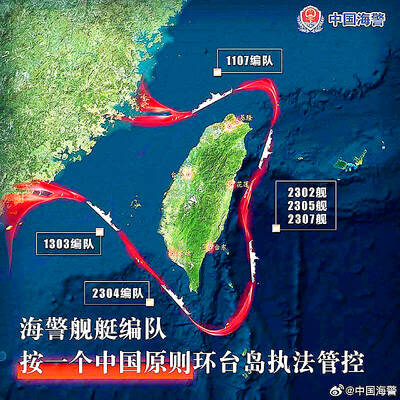
Taiwan would benefit from more integrated military strategies and deployments if the US and its allies treat the East China Sea, the Taiwan Strait and the South China Sea as a “single theater of operations,” a Taiwanese military expert said yesterday. Shen Ming-shih (沈明室), a researcher at the Institute for National Defense and Security Research, said he made the assessment after two Japanese military experts warned of emerging threats from China based on a drill conducted this month by the Chinese People’s Liberation Army’s (PLA) Eastern Theater Command. Japan Institute for National Fundamentals researcher Maki Nakagawa said the drill differed from the
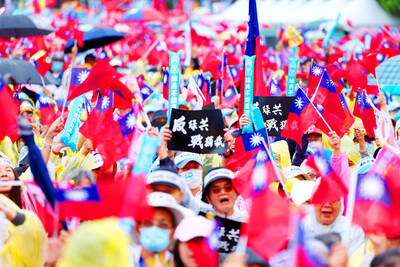
‘WORSE THAN COMMUNISTS’: President William Lai has cracked down on his political enemies and has attempted to exterminate all opposition forces, the chairman said The legislature would motion for a presidential recall after May 20, Chinese Nationalist Party (KMT) Chairman Eric Chu (朱立倫) said yesterday at a protest themed “against green communists and dictatorship” in Taipei. Taiwan is supposed to be a peaceful homeland where people are united, but President William Lai (賴清德) has been polarizing and tearing apart society since his inauguration, Chu said. Lai must show his commitment to his job, otherwise a referendum could be initiated to recall him, he said. Democracy means the rule of the people, not the rule of the Democratic Progressive Party (DPP), but Lai has failed to fulfill his

OFF-TARGET: More than 30,000 participants were expected to take part in the Games next month, but only 6,550 foreign and 19,400 Taiwanese athletes have registered Taipei city councilors yesterday blasted the organizers of next month’s World Masters Games over sudden timetable and venue changes, which they said have caused thousands of participants to back out of the international sporting event, among other organizational issues. They also cited visa delays and political interference by China as reasons many foreign athletes are requesting refunds for the event, to be held from May 17 to 30. Jointly organized by the Taipei and New Taipei City governments, the games have been rocked by numerous controversies since preparations began in 2020. Taipei City Councilor Lin Yen-feng (林延鳳) said yesterday that new measures by
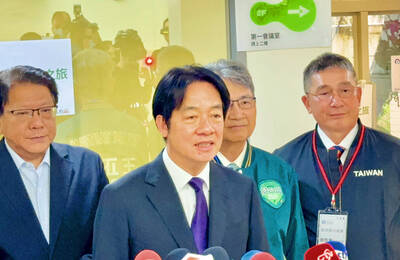
A rally held by opposition parties yesterday demonstrates that Taiwan is a democratic country, President William Lai (賴清德) said yesterday, adding that if opposition parties really want to fight dictatorship, they should fight it on Tiananmen Square in Beijing. The Chinese Nationalist Party (KMT) held a protest with the theme “against green communists and dictatorship,” and was joined by the Taiwan People’s Party. Lai said the opposition parties are against what they called the “green communists,” but do not fight against the “Chinese communists,” adding that if they really want to fight dictatorship, they should go to the right place and face


 RSS
RSS